


Transitional Bedstead
Description
This section is from the book "English Furniture", by Frederick S. Robinson. Also available from Amazon: English Furniture.
Transitional Bedstead
Reference must here be made to that celebrated monstrosity - size alone being considered - the 'Great Bed of Ware.' It is rendered famous by Shakespeare's allusion to it in Twelfth Night. Formerly in the 'Saracen's Head' at Ware, it is now at Rye House, a short distance away. The panelled head of the bed has two large arches planted in, with terminal figures between them, and on their outsides. These figures are enclosed between fluted columns, whilst the extreme edges of the bed-head are shaped with heads and leaf decoration in profile. The pillars of the bed-foot are very heavy and decorative. A box base supports four light plain columns, with one in the centre space. Above there are arches and a light frieze. On the platform, supported by these columns and arches, is the heavy part of the pillar. A huge bulb, covered with acanthus leaves, upholds a smaller shape of the same kind; and above this again, to support the heavy cornice of the bed-top, is a round pillar latticed with strap-work. An illustration of this huge piece of furniture is to be found in Shaw's Specimens of Ancient Furniture, where are also three other fine specimens of Henry VIII., James I., and Charles I. respectively.
A peculiarity of the bed of Ware is that the thick, round and but slightly tapering pillars which support the cornice have no capitals, but fit into the corners of the tester inside the frieze. This, if the original arrangement, is certainly a defect of design. While much of the ornament is peculiar, yet a good deal of it is very characteristic. On the frieze of the cornice is the running pattern formed of alternate squares and circles joined by a straight strap which we so often find on table frames, and which is on one of the chests illustrated from Newton Manor, Dorset.1 On the inside of the self-same frieze is the ' upright ornament' on a large scale, and similar to that on the lintels at Apethorpe, Northamptonshire. The usual large diamond appears on the box bases of the pillars at the bed-foot. Exceptional decoration is that of the buildings with front pavement in perspective, which appear on the panels enclosed by the great arches of the bed-head. Between these arches and the top of the tester are two long panels containing a peculiar kind of guilloche pattern of rectangles in sets of three, one above the other, and joined by a very tightly twisted strap. Finally, there is a pretty variation upon the common dental course in the highest member of the cornice.
It consists of a series of shapes pointed, somewhat like a broad canine tooth, on their under-sides. The size of this famous bed is about twelve feet square, and thus in Twelfth Night, III. 2, does Sir Toby Belch refer to it, anent Sir Andrew Aguecheek's challenge to 'the Count's youth':
1 Plate XXXI.2.
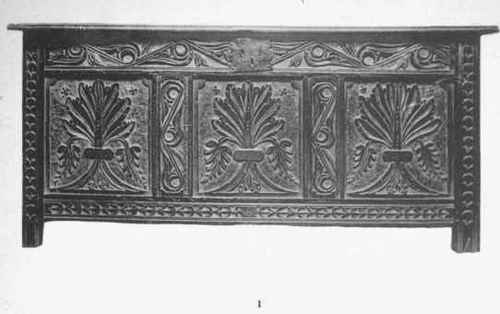
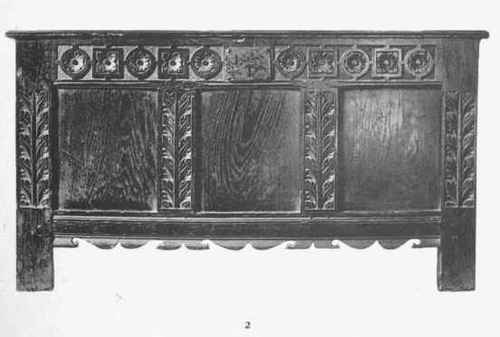
Plate XXXI.
1 - Oak Chest 17th Century
2 - Oak Chest 1 7th Century
XXXI. (1) Chest, oak, seventeenth century, with what is described in the text as a species of anthemion ornament on the panels. Sir Charles Robinson, C.B.
Dimensions : Length 54, Width 22½, Height 24 inches.
(2) Chest, oak, seventeenth century,with notched lower rail. Sir Charles Robinson, C.B.
Dimensions : Length 50, Width 20½, Height 27 inches.
Continue to:


My Books

