


Defective Designs
Description
This section is from the book "English Furniture", by Frederick S. Robinson. Also available from Amazon: English Furniture.
Defective Designs
What with grotesque masks and figures and S-brackets, the effect given by this bed, which is a large one, 8 feet 7½ inches high, is one of too great elaboration. The huge heads at the top are no improvement to the design, in which a little more of unornamental surface is to be desired. The slender pillars contrast too suddenly with the huge drum-shaped members on which they rest, and seem calculated to let the upper millstone of the canopy crash down upon the nether one of the bed.1
Compare this bed in these respects with the next example, of exactly the same date, 1593. The pillars of this are tapered gradually so as to show no painful contrast with the 'bulbs' or drums. There is a happier proportion between the pedestals and the pillars above them, and the only crying defect of design is the large size of the shallow capitals, which seem to be flattened by the weight of the cornice. There is a sobriety about this bed which we miss in the other, and there is not that odd mixture of the classical with a grotesque which is not classical, but decidedly barbaric. It has some inlay upon it.
A lesson, too, in characteristic ornaments may be here again learned. On the frieze of the tester appears that 'upright' ornament which, in the chapter on the Renaissance house, I have noticed as decorating the lintels of the windows of Apethorpe House, Northamptonshire (Plate XIX.).

Plate XIX. Bedstead, Oak Dated 1593
XIX. Bedstead, oak. Dated 1593. V. & A. M.
(1) Bedstead, oak. Seventeenth century.
Dimensions : Height 75¾, Length 80, Breadth 55 inches.
(2) Head of the same bedstead. The cornice has been restored. J. E. Clifton, Esq.
The bulbs or drums have gadroon ornaments - swelling pear shapes - as upon the Griffin monument in Braybrook Church, Northants. The bed-head has the planted arch and the 'upright leaf on the stiles.
The Sizergh Castle bed is inlaid in the same style as the room. It has Corinthian capitals on its pillars, which are fluted and reeded. There are eight terminal figures, rather grotesque, on the bed-head. On the foot end of the tester mermaids are carved in full relief, supporting a coat of arms. The panels and frieze are inlaid with the S-curve in light wood. There are six planted arches in the bed-head, with inlaid panels.
1 The arrangement and proportions of the panels and stiles of the lower head-board, if original, are certainly unfortunate.
A bed dated 1590, with initials T. B. and M. B. on the bed-head, is in the possession of Mr. J. Tubb, Clarensdean, Roehampton, Surrey. It comes from Warborough, near Wallingford, where it was bought in 1823 by the grandfather of its present owner. Its three planted arches at the bed-head are nicely inlaid with the familiar pattern of the flower in a vase for the centre panel, and architectural inlay recalling that on the Bed of Ware, to which reference is made later on, for the other two. There are four of the usual terminal figures on the stiles. The pillars are gadrooned on the top and bottom of the bulb, whilst the narrower parts are fluted and reeded above, and fluted only below. The capitals are simply a square abacus with a dental course round them. The canopy is heavily panelled underneath with a guilloche ornament on the stiles. There is a centre panel with a heavy gadrooned moulding. The middle of this panel is peculiar. It is not inlaid in the usual manner, but filled with a composition showing a curiously contorted 'figuring,' said to be made of compressed shavings.
This is to be found again upon three shallow long panels above the arches of the bed-head. The cornice of the canopy has a plain guilloche without the intervening circle, and is finished with an ogee-shaped moulding decorated with the acanthus leaf.
Plate xx. represents a good specimen of a fairly ornate class, and such as would be found in a superior farm or small manor-house. It belongs to Mr. J. E. Clifton, Old Bank House, Swanage, Dorset, and was made for Luke's Farm, near Romsey, Hants, whence it has but recently been removed, and where is still some of the original furniture. The pillars of this bed have not the huge drum of the specimen previously described. The under-side of the tester has a closely twisted guilloche on the stiles of the panels, which have large incised and bordered diamonds upon them. The bed-head has a frieze with large ornamental S-curves. Below this is a dental course and two narrow panels, divided and ended by three grotesque heads in relief. Below these are two panels, separated and flanked by three pairs of applied pilasters. A noticeable feature on each of the panels is a five-sided piece of wood an inch thick, with very grotesque profile heads wearing caps. The date of this bed, judging from the applied pilasters, may be placed well in the seventeenth century, and we may regard it as a transition from the earlier ones described to the next one, which may perhaps be not later than 1640. This bed, the property of Miss Evans, of Forde Abbey, is very interesting, though much simpler in carving than the rest.
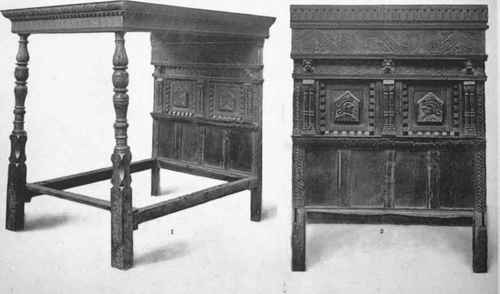
Plate XX. I - Oak Bedstead 17th Century 2 - Head Of Bedstead
It is a proof that there was no sudden leap from the stuff-hung carved bed to the four-posted, disguised prop of textiles or embroideries (Plate XXI.). The woodwork of the panels is undecorated, and there are very slim poles for pillars. The only carved ornament is a border along the rail of the bed-post of the short upright flute pattern, somewhat as found on the lintels of Apethorpe. The great feature is the stuff decoration. At the corners of the tester are large pineapple-shaped projections or finials covered with velvet - the precursors of the huge plume erections of the early eighteenth century.1 A deep ornamented fringe hangs from the tester, the whole cornice of which is covered with velvet, and there are curtains at each corner of the bed. It is said that it is part of a suite which was prepared for the reception of Queen Anne when she visited Forde Abbey. Other objects were a settee, chair, and stool, all in the style of Charles II., and covered with Mortlake tapestry.
1 Plumes were also used in the seventeenth century. See p. 65.
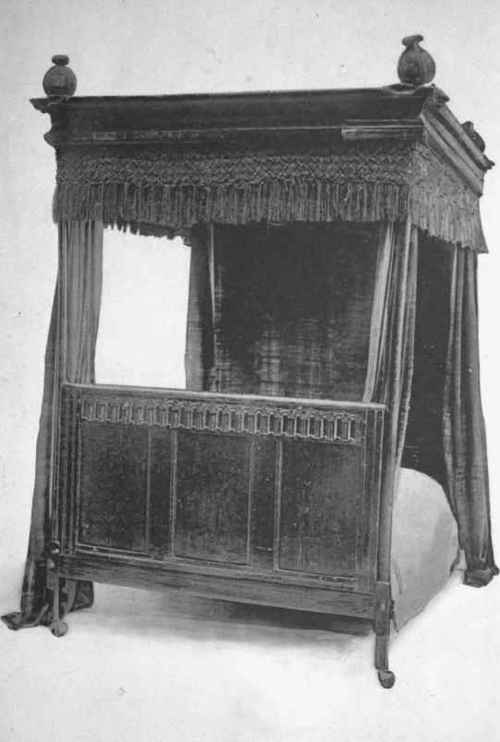
Plate XXI. Bedstead, Oak About 1640
Continue to:


My Books

