


The Sheraton Period. Part 5
Description
This section is from the book "French And English Furniture", by Esther Singleton. Also available from Amazon: French And English Furniture.
The Sheraton Period. Part 5
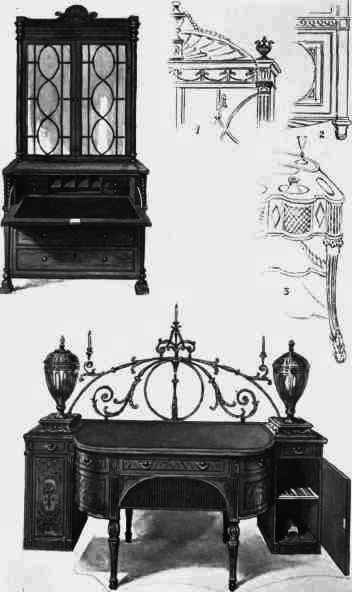
The cellaret sideboard and sideboard with drawers which became fashionable under Heppelwhite are still more developed in Sheraton's early period; but in his last period there seems to be a return to the old "sideboard table" without drawers. The cellaret sideboard was always supplied with a partitioned place for bottles of wine. "In large circular sideboards," Sheraton tells us, "the left-hand drawer has sometimes been fitted up as a plate-warmer, having a rack in the middle to stick the plates in, and lined with strong tin all round, and on the underside of the sideboard top, to prevent the heat from injuring it. In this case the bottom of the drawer is made partly open, under which is fixed a small narrow drawer, to contain a heater, which gives warmth to the plates, the same as in a pedestal.
"In spacious dining-rooms the sideboards are often made without drawers of any sort, having simply a rail a little ornamented, and pedestals with vases at each end, which produce a grand effect. One pedestal is used as a plate-warmer, and is lined with tin; the other is a pot cupboard, and sometimes it contains a cellarette for wine. The vases are used for water for the use of the butler, and sometimes as knife-cases. They are sometimes made of copper japanned, but generally of mahogany.
"There are other sideboards for small dining-rooms, made without either drawers or pedestals; but have generally a wine-cooler to stand under them, hooped with brass, partitioned and lined with lead, for wine-bottles, the same as the above-mentioned cellarette drawers."
On Plate LX., No. 3, is a pattern of a "sideboard table" which has four marble shelves at each end. "These shelves," he explains, "are used in grand sideboards to place the small silver ware on."
"It is not usual to make sideboards hollow in front, but if a sideboard be required 9 or 10 feet long, as in some noblemen's houses, and if the breadth of it be in proportion to its length, it will not be easy for a butler to reach across it." A hollow front, Sheraton thinks, would "obviate the difficulty and take off the appearance of great length. Besides, if the sideboard be near the entering door, the hollow front will sometimes secure the butler from the jostles of the other servants."
"The pedestal is used to signify that part in cabinet furniture made nearly to the proportion and figure of a pedestal in architecture. These are generally placed at the end of sideboards, and are designed for holding plates for dinner; for which purpose there are two wooden racks, generally made of oak, in which the plates are placed. The plinth part of these pedestals is generally formed with a drawer, containing an iron stand and heater, which diffuses a warm air to the plates and keeps them in proper temperature at the time of dining. These pedestals are lined with tin completely over on the inside to prevent the heat from injuring the wood. And it may be necessary further to observe, that when there are two pedestals to a sideboard, one of them is generally fitted up in the inside, either with plain drawers or as a cupboard. On such pedestals is generally placed a vase." This vase is usually a knife or spoon case. On Plate LXI. a sideboard with pedestals is shown. The pedestal parts are made separately and screwed to the sideboard, and the top is one large piece screwed to the pedestal. Under the long drawer of the front is a cupboard enclosed by a tambour shutter.
The ornament at the back, is of brass "intended as a stay for silver plate, and has branches for three candles." If preferred the centre "may have a glass lustre hung within it as an ornament."
Sheraton gives two designs for knife-cases, one concave, the other convex. In one of them the corner pilasters have "small flutes of white holly or other coloured wood let in, and the middle pilasters have very narrow cross bands all round, with the panels japanned in small flowers. The top is sometimes japanned, and sometimes has only an inlaid pattern. The half-columns of the right-hand case are sometimes fluted out, and sometimes the flutes are let in. The feet may be turned and twisted which will have a good effect."
"Cellaret amongst cabinet-makers denotes a convenience for wine, or a wine cistern." These were mostly in the form of a sarcophagus, "an imitation of the figure of ancient stone coffins. "They are adapted to stand under a sideboard, some of which have covers, and others without." Sheraton gives one design supported by dolphins, whose heads form the foot, while the tails curve upwards. The other design is supported on lions' paws, and ornamented with lions' heads. He recommends rings at each end of the cellaret, so that the servants can conveniently move these pieces about. "The rings and heads should be cast in brass and lacquered, and also the dolphins and lions' paws."
"Buffet, anciently an apartment separated from the rest of the room by small pillars or balusters. Their use was for placing china and glass ware, with other articles of a similar nature. In houses of persons of distinction in France, the Buffet is a detached room, decorated with pictures suitable to the use of such apartments, as fountains, cisterns, vases, etc. These ancient buffets seem in some measure superseded by the use of modern sideboards, but not altogether, as china is seldom, if ever, placed upon them: and we therefore think that a buffet may, with some propriety, be restored to modern use, and prove ornamental to a breakfast room, answering as the repository of a tea equipage. Under this idea, we have given a design of one intended to be executed in the following style. The lower part is to be inclosed with doors, having silk curtains, with worked brass or wire before them. The upright border on the top of the lower part is of brass, together with those round the china shelves. These shelves are supported at each end with four brass columns, made very light. The lights on each side are of brass, and may be unscrewed and taken away occasionally.
Continue to:


My Books

