


The Sheraton Period. Part 6
Description
This section is from the book "French And English Furniture", by Esther Singleton. Also available from Amazon: French And English Furniture.
The Sheraton Period. Part 6
As these buffets would suit well to be placed one on each side of the fireplace of a breakfast room, they might very conveniently hold such branches with the addition of one on the top, which may be screwed into a socket; or a small figure holding a light may be placed upon it. Under the cornice is a Gothic drapery and fringe above it." This design, dated 1803, is represented on Plate LIX.
"There are three kinds of dumb waiters, but they are all made of mahogany, and are intended for the use of the dining-parlour, on which to place glasses of wine and plates, both clean, and such as have been used." The one represented on Plate LXI., No. 3, is "partly from the French taste, on the top of which, where the glass is represented, is a slab of thin marble, which not only keeps cleaner, and looks neater than mahogany, but also tends to keep the wine cool, when a bottle for present use is placed upon it. The shelves below are for plates and a knife tray. The holes for the decanters have cases of tin fit into them, and are japanned white, which shows through the front panel in the rail, and makes it look lighter."
Another dumb waiter that Sheraton recommends is a table similar in general form to No. 1 on Plate LX. The drawers are used for knives, etc. In the centre a shelf or waiter rises on a stem, and below it are four trays for decanters, glasses and small plates. The drawers are lined with "a tin case to fit loose in and japanned white, to have the plate trays with the balusters. These are easily taken out, and may be cleaned and replaced when necessary. And the workman must observe that the waiters turn round on the pillars; for the under pillow has a beechnut let into it, and the upper part screws itself home into it, so as to admit the waiter to turn.
"The plate trays ought to be 11 inches in diameter in the clear, and the opening for the hand 4 1/2 inches. There is a turned astragal for the top rail and the bal-luster."
A supper tray called a "Canterbury," Sheraton says is " made to stand by a table at supper, with a circular end, and three partitions crosswise, to hold knives, forks and plates at that end, which is made circular on purpose." An Archbishop of Canterbury is said to have invented this piece of furniture.
Sheraton made a great variety of beds. They include French beds, state beds, dome, canopy, alcove, and sofa beds. The former are very intricate. He describes them as follows: "Beds of this kind have been introduced of late with great success in England. The dome is supported by iron rods of about an inch in diameter, curved regularly down to each pillar where they are fixed with a strong screw and nut. These iron rods are covered and entirely hid by a valance, which comes in a regular sweep, and meets in a point at the vases on the pillars. Behind this valance, which continues all round, the drapery is drawn up by pulleys and tied up by a silken cord and tassels at the head of the pillars. The headboards of these beds are framed and stuffed, and covered to suit the hangings, and the frame is white and gold, if the pillars and cornice are. The bed-frame is sometimes ornamented, and has drapery valances below. Observe that grooves are made in the pillars to receive the headboards, and screwed at the top, by which means the whole is kept firm, and is easily taken to pieces. Square bolsters are now often introduced, with margins of various colours stitched all round.
The counterpane has also these margins; they are also fringed at bottom, and have sometimes a drapery tied up in cords and tassels on the side."
Of the large bed on Plate LXIII. Sheraton says: "This design requires no explanation, except that which relates to the tester. The cove of the tester is to be formed by the ribs; one at each mitre, and other short ones joined to them with the rest about five inches apart from each other. At the upper part of the cove is a square tester into which the ribs are fixed. On the edge of this tester, which is made very light, is fixed a small moulding mitred all around. The cove being formed, the ribs may be covered with strong board-paper, both inside and out, which may either be japanned to match the furniture, or it may be covered with the furniture itself. The circular part above the cove is nothing more than a straight board fixed on to the upper tester. For the sake of easy conveyance, the cove may be made in four parts, mitering at each corner, and the ornament intended to be at each mitre on the outside running entirely up to the feathers, will hide the joint.
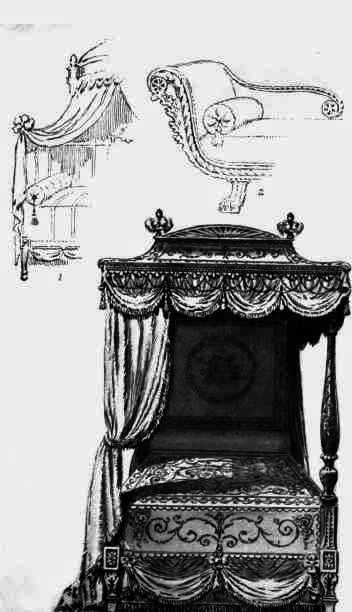
"The swags of silk that appear on the drapery should be fastened to the back part of the cornice in order that they may hang easy. The pillars are to be japanned. The panel that hides the screws are made to slip into a groove at the bottom, and being bevelled off behind at the top, when raised up a little from their place, by pressing the finger on the front, can easily be taken away to come at the screws. The valance and drapery both together slip on to a lath as in common." It may be interesting to note that Sheraton preferred a "firm bed" to the soft down or feather. He recommends first a straw mattress covered with a flock mattress, upon which are placed a feather bed and then a hair mattress.
"The alcove, or recess," he writes, "is used in Spain for seats and sometimes for beds of state. The English have imitated these by sometimes fitting up the end of long rooms in this style; which may answer both for ornament and to bring any apartment of undue length into proportion. In forming such an alcove for a place of retirement to rest on, a couple of Corinthian columns may be placed on each side of the room, so as to leave a spacious entrance into the alcove. The columns should not be placed less than six feet from the end of the room, nor more than nine, except in extraordinary cases. The seats are made low to receive their cushions, and drapery valances are fixed to the under edge of the frame. From surbase height the walls are covered with silk quilted, or disposed into uniform pannels, in any other manner to suit the rest of the room. In the space between the surbase are placed back cushions, or a stuffed back, framed to fit all round and screwed to. From the frieze of the cornice below the ceiling is fixed draperies, either with or without tails: such alcoves when properly applied have a pleasing effect.
Continue to:


My Books

