


The Bed. Part 6
Description
This section is from the book "Furniture", by Esther Singleton. Also available from Amazon: Furniture.
The Bed. Part 6
Some of Chippendale's sofas can be turned into beds when desired. He describes one as follows: "A Chinese Canopy, with Curtains and Valances tied up in Drapery, and may be converted into a Bed by making the front part of the seat to draw forward, and the sides made to fold and turn in with strong iron hinges and a proper stretcher to keep out and support the sides when open. The curtains must be likewise made to come forward, and when let down will form a Tent." Another is a "Chinese Sopha with a canopy over it, with its curtains and vallens all tied up in drapery. This design may be converted into a bed by having the Sopha so made as to come forward, the curtains to draw to the front of the Sopha, and hang sloping, which will form a sort of tent, and look very grand. The ornaments are designed for burnished gold."
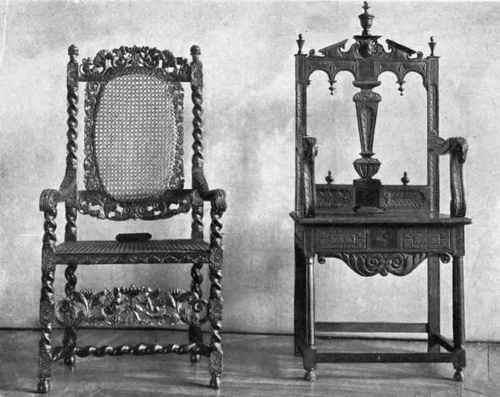
Plate LXXIX - Sixteenth Century Flemish Arm-Chairs Louvre
The framework of Heppelwhite beds is much lighter in appearance than Chippendale's.
According to Heppelwhite's Cabinet-Maker and Upholsterer's Guide, " Beds are an article of much importance, as well on account of the great expense attending them as the variety of shapes and the high degree of elegance attending them. They may be executed of almost every stuff the loom produces. White dimity, plain or corded, is peculiarly applicable for the furniture which, with a fringe or gymp-head, produces an effect of elegance and neatness truly agreeable. Printed cottons and linens are also very suitable, the elegance and variety of patterns of which afford as much scope for taste, elegance and simplicity as the most lively fancy can wish. In general the lining to these kinds of furniture is a plain white cotton." The same authority contains: "In state rooms where a high degree of elegance and grandeur are wanted, beds are frequently made of silk or satin, figured or plain, also of velvet with gold fringes," etc. The Vallance to elegant beds should always be gathered full, which is called a Petticoat Vallance. The cornices may be either of mahogany carved, carved and gilt, or painted and japanned. The ornaments over the cornices may be in the same manner, and carved and gilt, or japanned, will produce the most lively effect. Among Heppelwhite's designs were "Venetian, or waggon-top beds," "dome-top beds," "square dome-top beds," "press-beds," and "field-beds." The pressbed is a folding-bed in the shape of a wardrobe, and the field-beds, "single-headed" and "double-headed," are nothing more nor less than the French lit a tombeau. "Sweeps for field-bed tops " received a great deal of attention from the firm of Heppelwhite. Urns form the finish to the bedposts. An ordinary American bedstead of the Eighteenth Century which survived into the succeeding one appears on Plate LXXV., and is of a type familiar to many of the present generation.
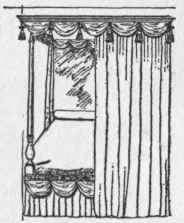
Heppelwhite Bed, 1788
The bed that the Marquise de Pompadour had at Marly, draped in a lovely silk of blue and white stripes, upon which bouquets of flowers were also woven, anticipates the new style, for, as has been noted, the designers who were responsible for the coming Louis XVI. style were already at work in the days of Louis XV. Of all beds in the Louis XVI. period, the alcove, sofa and niche beds were the favorites. Ranson, Delafosse and Salembier made many drawings of beds, in all of which drapery was of the greatest importance. The beds called a la polonaise, a la turque, a la chinoise, a tombeau, a double tombeau and a Vanglaise were all varieties of the sofa, supplied with a decorative canopy, two bolsters and curtains. The canopy became smaller and smaller until the curtains were held by a ring or crown. The lit a couronne, as it was called, long remained popular; but the lit a la dauphine, which was light and graceful, and had a dome, enjoyed but short favor.
Beds were sumptuous in the reign of Louis XVI. and some of them were extraordinary in price. The King had one bed that cost, with its curtains, 82,000 livres, and Marie Antoinette had one that cost more than 130,000 livres.
A handsome specimen of this period appears on Plate LXXVI. The woodwork is carved and gilt and the tapestry consists of garlands and flowers in various colors on a white ground. The curtains are white silk.

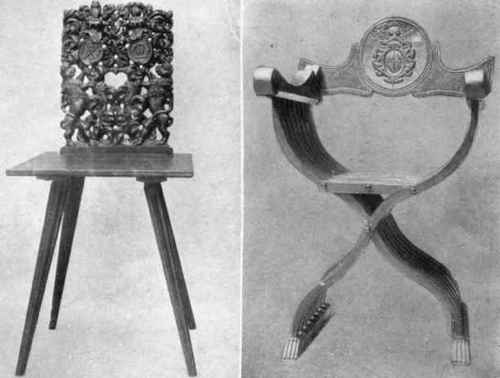
Plate LXXX Sixteenth Century Chairs - Flemish, covered with Leather, Cluny Museum
French, Carved Louvre - Swiss Sgabello Metropolitan Museum - Italian Folding-Chair Cluny Museum
The "lit anglais" or "sofa-bed," was the most popular, and there were many varieties of it. In 1773, M. Carre, Rue d'Enfer, has for sale a yellow damask "lit a Vanglaise," which is also a sofa, being five feet wide and six feet long, the woodwork of walnut, carved and strengthened with iron. In 1785, a "cane bed, with three backs, that can serve as an ottoman in a summer drawing-room " is offered for sale.
In a long list of beds owned by rich Parisians, we read of a lit a housse of crimson velvet embroidered with gold, Marechal Due d'Estrees (1771); lit a la polonaise, of blue damask and moire, Boucher the painter (1771); lit a housse of green damask, Madame Favart (1772); embroidered muslin bed, the Due de Bouillon (1772); lit de perse, white background with cut-out figures, the Duchesse de Brissac (1773); Indian damask, Chevalier d'Hestin (1775); crimson velvet with gold braid, Due de Saint-Aignan (1776); yellow satin embroidered with gold flowers, Marquise de Courcillon (1777); five beds of yellow damask (one costing 24,000 livres), in 1779; and crimson and white moire, la Comtesse de Berulle (1779). From 1780 to 1787 we hear of blue and white damask, crimson and white brocade, blue and white moire, blue satin embroidered with gold, blue and white brocade, green damask, blue damask and many Oriental stuffs. The Marquis de Menars had a beautiful bed of blue moire embroidered in various subjects in 1787; the Due d'Orleans a lit a la duchesse of silver velvet with flowers and fringe of gold, and in 1787 the financier Beaujon, had a dome-bed hung with Gobelin tapestry.
Continue to:


My Books

