


The Chest. Part 2
Description
This section is from the book "Furniture", by Esther Singleton. Also available from Amazon: Furniture.
The Chest. Part 2
"Many ancient chests are still to be found in the chapterhouses and vestries of ancient churches, where they were receptacles for vestments, hangings for festival decorations and the preservation of archives, deeds, etc. A good example of the Thirteenth Century was formed of oak planks, two inches thick. The uprights clamping the sides are unusually broad, exceeding the intervening space. Its only decoration is constructive, consisting of iron straps one and three-quarter inches wide and one-eighth of an inch thick. These are admirably distributed for gaining the greatest possible result, both from a constructive and decorative point of view, with the least amount of material. The two bands crossing the lid also descend the back and form the hinges. All the bands terminate in bifoliations, and the tip of each bifoliation is secured with a mushroom-headed nail. The front is distinguished by two bands crossed which form the heraldic cross moline, but it is here no doubt decorative. The ends are furnished with chains and rings, which could be raised above the lid for slinging the chest on a pole." 1
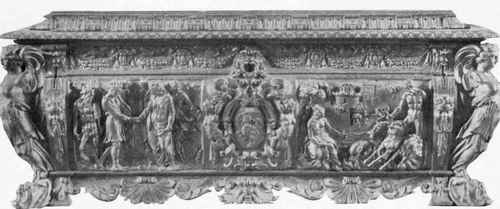
Plate XLVI - Sixteenth Century Italian Marriage Coffer - Cluny Museum
The most famous of all Fourteenth Century chests is in the Cluny Museum and is represented on Plate I. (see page 9). About this time chests were decorated with the black and white inlay in geometrical designs that was known as certosino chiefly made in Italy and Portugal. Pictures in colored woods were often called tarsia (see page 11).
It was in the beginning of the Fourteenth Century that the richly carved chests were introduced; for plain chests and iron-bound chests were not in accord with the rich furniture and panelled walls with which the interiors were now adorned.
Coffers and chests of the Fourteenth and Fifteenth Centuries were in most instances of fine proportions, ingenious in their interior arrangements and characterized by rich carving that reveals the various developments of Gothic tracery. The locks and keys were often most intricate in design and artistic in workmanship.
The panels of the chests were much decorated with the favorite linen-fold design.
In the Fourteenth and Fifteenth Centuries, the so-called "Tilting Coffers" were produced. Their dates are determined by means of the style of armor in which the figures ornamenting the panels are dressed. Architectural motives are carved on their frames and knightly contests are represented on their front panels. A famous example from the Cluny Museum appears on Plate II. (see page 10). South Kensington Museum owns a small one upon which two knights are tilting furiously and one in the Ypres Cathedral shows St. George fighting the Dragon.
1 Charles Clement Hodges.
In France, the chest with the rounded top was called bahut and that with the flat top, huche. The chest was the most important piece of furniture in the house, and in it valuables were kept. In fact, the kings and princes of the Fourteenth and Fifteenth Centuries gave the name Garde-huche to the officer in charge of their table-silver, or, as we should call it, the silver-chest. In this, the French followed the precedent of the old Romans.
The huchiers were a guild apart from the carpenters and made all the fine woodwork of the house - such as the doors and window-frames. Maitres-Huchiers-Menuisiers was the title Mazarin gave them in 1645.
A favorite way of decorating chests and coffers in Italy in the Fourteenth and Fifteenth Centuries was known as gesso duro. This was a preparation of whiting mixed with size or glue and spread thinly and evenly over the surface of carved wood or modelled ornaments. The raised ornaments were then painted and gilded. Gesso was also much used as a decoration for the Spanish chests of the Fifteenth Century, which are now so rare.
The large chests used in Spain were similar to those of Italy and were decorated with Gothic or Renaissance carving like the choir-stalls and ornamented with iron-work. In the province of Cataluna, they were inlaid with ivory in imitation of Florentine and Milanese work.
Late in the Fifteenth and during the Sixteenth Century, Italy produced most elaborate and sumptuous coffers; and upon the marriage coffer, or cassone, both artists and artisans bestowed their best energies. The bride's dower was carried to the bridegroom's house in the cassone, which varied in sumptuousness according to the wealth of the family. Some of the chests were of carved wood; some were inlaid; some were covered with velvet ornamented with richly gilt metal-work; the handsomest of all were painted by such celebrated artists as Andrea del Sarto. In fact, some of the most beautiful Italian pictures that have come down to the present day were originally panels for marriage-chests. Gozzoli's Rape of Helen in the National Gallery, London, is one of these.
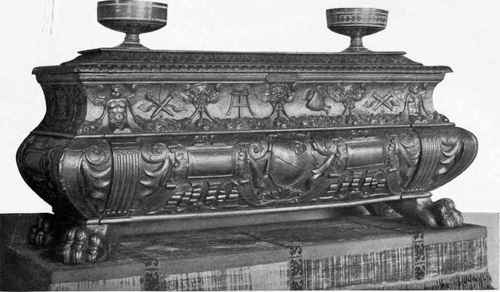
Plate XLVII - Sixteenth Century Italian Marriage Coffer Louvre
The marriage-chest sometimes bore the inscription "Quae nupta ad cerum tulit maritum."
"It was in such a marriage-chest that the beautiful Genevra dei Benci, whose portrait exists in the fresco by Ghirlandaio in Sta. Maria Novella, hid while playing hide and seek the evening before her marriage. The cassone was of carved wood and the heavy lid closed upon her, snapping the lock fast. All search for her was in vain, and the old tale says that her fair fame suffered at the hands of malicious women, jealous of her exceeding beauty. Years afterwards, when the chest was forced open, the remains of the lovely Genevra were found, still, it is said, preserving traces of beauty, and with the peculiar scent she used still lingering about her long, fair hair; in her right hand she grasped the jewel her bridegroom had given her to fasten the front of her gown. In Florence the bella Genevra is still talked about among the common people as the ideal type of woman's beauty." 1
1 J. Ross.
Continue to:


My Books

