


The Chest. Part 3
Description
This section is from the book "Furniture", by Esther Singleton. Also available from Amazon: Furniture.
The Chest. Part 3
A fine example of Venetian work of the Sixteenth Century is the marriage-chest from the Cluny Museum, on Plate XLVI. The front and sides are beautifully carved with mythological and Biblical subjects relating to marriage, and ornamented with chimerical figures, mascarons and shields in high relief. Trophies and garlands adorn the frieze, and at the corners are large female figures with extended wings. In the centre is the richly framed shield. The human forms are carved with the utmost grace and delicacy. Another marriage-chest appears on Plate XLVII. This is of Italian workmanship and is preserved in the Louvre.
Compare these with the chest on Plate XL of the same period with its graceful female figures supporting the central shield and terminating in leafy scrolls that frame chimerical beasts and birds. This fine piece of the Italian Renaissance is in the Metropolitan Museum, New York.
Cuir bonilli was also much used as a covering for chests and coffers in the Fifteenth and Sixteenth Centuries in place of carving. The leather was first prepared by being steeped in melted wax and essential oils or spirits, and boiled; and after the leather was thus prepared, it was delicately embossed and incised and painted and gilded. Sometimes, too, the leather was cut away and pieces of velvet or other rich materials were laid underneath the leather in the spaces, for the sake of the bright effect. Of course, the carver made use of the leather-straps for a motive. The cuir, variously cut and plaited, or interlaced, was a decoration that found particular favor with the Flemish. The strip of leather sometimes flat and sometimes rolled, was often accompanied by birds, flowers, animals and fruits. (See Plate XLVIII.)
The coffer, or chest, of the Sixteenth Century was as a rule made with a flat top. The wood was oak, walnut, or lime. It had been the principle in decoration to divide the anterior into a certain number of arches; in the second half of the Sixteenth Century panels took their place divided from one another by caryatides. Some coffers were made with the swelling front - especially those of small size - and decorated with marquetry and fine inlay work of white paste "a la moresque" a style of decoration that was used also for the dressoirs, armoires and chairs by the huchiers of Lyons.
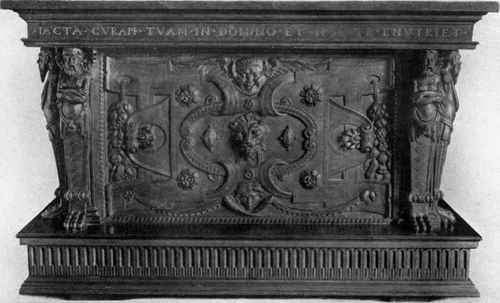
Plate XLVIII Sixteenth Century Carved Chest. Lyonnais
In the Sixteenth Century the chest in the Low Countries was decorated with panels carved with subjects from the Bible, Greek myths, allegorical subjects, architectural motives, arabesques, pilasters in the form of terms, mascarons, fluted columns and Kiches filled with figures. Flemish chests were in great demand in France, England and across the Pyrenees.
The chest was always found in the Dutch home in the Seventeenth Century. One or two large chests invariably stood in each bedroom and in these both linen and clothing were kept. Many Dutch chests were made of lignum-vitae or sacredaan fastened with brass or silver locks and hinges. The Dutch chest was generally neatly lined with linen. One reason that the yellow sacredaan was a favorite wood for chests was because its sweet, strong odor was hateful to moths.
The word coffre was also used in France to describe the wooden case, ordinarily covered with ornamental leather, fastened with large silver-headed nails, and also those made of various kinds of wood variously decorated. Coffres de Chypre were ornamented with mother-of-pearl inlay and were often very rich; those termed a la neapolitaine were of ivory marquetry on a background of walnut. Those of Flanders were, as a rule, strengthened with metal bands, or ornaments.
The smaller chests, coffers and caskets varied much in shape and material and were made in gold, silver, ivory, mother-of-pearl, and were variously carved, ornamented with precious stones, or chased, or enamelled on copper. They were used for locking up jewels and other small valuables. Handsome dressing-boxes were also made in this form.
For the sake of greater convenience, the chest was placed on a frame that rested on short, square legs, or flattened ball feet. The next development consisted of one long drawer, or two short drawers, below the chest proper. As more drawers were added to the simple box or trunk, the original chest became extended into a chest-of-drawers, a nest-of-drawers, a case-of-drawers, a chest-with-drawers, a press, a cupboard-press, a chest-upon-chest. The simple chest is, therefore, the parent of many pieces of furniture, and often appears almost in its original form in unexpected places. Chippendale's clothes-presses are made, for example, on the old model.
"The clothes-presses which Chippendale gave us are somewhat reminiscent in outline of the old Spanish dower-chests; they were used to store clothes, linen, curtains, and so on; but judging by their rarity, we may safely assume that they did not come into great favor. They rested on deep feet or short legs, approximately one third of the whole design in pitch. The carcase would be sometimes square, at other times bombe in form, but it seldom displays the amount of garnishment we should expect to find on it after a perusal of Chippendale's book of designs. The feet were linked together by a narrow frame, and upon this the body of the piece reposed." 1
1 Wheeler.
Continue to:


My Books

