


Boxes of various kinds
Description
This section is from the book "A History Of Furniture", by Albert Jacquemart. Also available from Amazon: A History Of Furniture.
This section is from the "" book, by .
Boxes of various kinds
Under this head we shall include articles in all sorts of material: soft and hard porcelains, Dresden enamels, Japanese lacquer, carved ivory, ecailles fondues, etc. Were we to divide them all into as many classes as there are styles, we should have to multiply our descriptions indefinitely. Suffice it to say that in this heterogeneous mass virtuosi may find specimens most interesting for the history of the art. Europe, in her search for a fine and white pottery analogous to that of the Chinese, made these trials in small pieces of workmanship, of which the encyclopaedias speak with contempt; but the cane-handles, the bees a corbin, and the snuffboxes, to which they refused the name of porcelain, give us precisely proofs of the efforts and of the genius of our ancestors: Rouen, Saint-Cloud, Chantilly, Mennecy, reveal themselves to us by the most charming compositions; Dresden, and Capo di Monte offer us examples of a perfection and taste which we seek in vain in the great vases. The mountings, more or less rich, of these specimens have fortunately rescued them from neglect and destruction. To the value of their mountings too it is that we owe the preservation of precious Oriental works of this sort, Indian betel-boxes converted into snuff-boxes, which else had perished with the fashion in boxes.
One word upon this fashion, which was pushed on to folly. We have not to go back to the origin of tobacco, the name of which is derived from Tobago, one of the Antilles, nor to its introduction into Europe by Nicot; still less shall we occupy ourselves with the violent discussions which its use raised among the learned, useless discussions which have left us only an amusing tirade of Moliere. Notwithstanding Fagon and science, snuff was received by the great, and, naturally, it required that the recipients destined to contain it should be objects of luxury. The fact admitted, fashion rendered it compulsory that people, whether they took snuff or not, should have boxes for every season; the rage went even further, and required that the box should be changed every day; the more refined carried upon them several at a time. In his interesting memoirs upon the goldsmith's art, M. Paul Muntz relates that the Prince de Conti, at his death, left nearly eight hundred boxes to his heirs. One understands that there was in this wherewithal to excite the criticism of the philosophers. The most charming women of the court, including Madame de Pompadour, bought, or caused to be mended, at Devaux, their snuff-boxes of gold, hard stones, or porcelain of Vincennes. Many among the victims of fashion, doubtless, did not find the harsh and pungent flavour of snuff agreeable, and caused it to be perfumed. This was a pretext for the invention of double boxes (a deux tabacs), of which the compartments were divided in the length of the box, with a cover opening at each extremity, upon a central hinge, or with the boxes superposed, the box, with double face, having a cover decorated below as above.
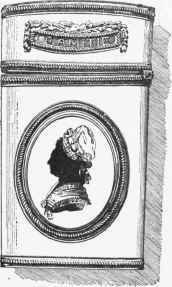
Carnet (card ease) of ivory with silhouette portrait. Period of Louis XIV. (Doctor Piogey'a Collection.).
Nor let us neglect a last warning to give to the cautious amateur. The license of manners had suggested to painters the idea of reproducing a host of erotic scenes taken from mythology, or borrowed from the secret literature of the moment. The collectors of this class of works had yet sufficient modesty not to disclose their taste, and they caused to be enclosed in a double bottom to their snuff-box, the enamel or miniature to be concealed from general view. We shall not attempt to give an idea of the form of the boxes, it depended in a great measure on their destination. The bonbonnieres were more particularly circular, with rounded surface; the patch-boxes, smaller, also circular, had a flat top. As to snuff-boxes, those with twisted outline and sharp point are almost all of the Louis XV. period. Under Louis XVI. the oval form or rectangular with truncated angles prevailed, but from many conceptions and varieties, one understands soon that the form is only one of the elements of a safe determination of the period and style.
Continue to:


My Books

