


Oriental Tapestries
Description
This section is from the book "A History Of Furniture", by Albert Jacquemart. Also available from Amazon: A History Of Furniture.
This section is from the "" book, by .
Oriental Tapestries
It would be difficult to say what was originally the nature of the oriental tapestries. It was scarcely before the introduction of Islamism, that the marvellous art of the Asiatic people was displayed in an industry which is indispensable to them, since the carpet serves as hanging, oratory, seat and bed. If we are to believe the poet Ferdousi, it was Tamouraz, an ancient king of Persia, who first taught the art of weaving tapestry.
At any rate, Persia and Asia Minor are the countries of the finest fabrics of tapestries known. Khorassan, Kirman, and especially Yezd, furnish the most esteemed kinds. The royal factories produced more particularly the marvellous tissues of silk and wool, in which gold and silver thread were introduced. Wall hangings are made at Guerdesse, in Asia Minor, while foot carpets come chiefly from Oushak.
In the Mussulman textiles figures are often enough introduced, notwithstanding the prohibition of the Koran. Fatimite caliphs of Egypt in the tenth and eleventh centuries made use of tapestries, some of which represented the series of the various Mussulman dynasties, with the portraits of the sultans and distinguished persons; others the different countries of the earth, with their mountains, rivers, and cities. But the subjects of most frequent occurrence are rich arabesque ornamentations, among which are introduced quadrupeds, birds, and flowers, at times also inscriptions, usually nothing more than votive sentiments complimentary to the owner, or else passages from the more celebrated poets, the interest of such inscriptions being of course immensely enhanced whenever they embody a date or the name of a sovereign.
One feature in the composition of these works calculated to cause surprise is the persistence of symbols borrowed from the old religion of the Persians, notably the representation of the struggle between the two principles of good and evil, symbolised by the fight between the lion and the bull, that of the lion attacking the gazelle, or even a bird of prey victorious over the hare, or some web-footed fowl. It is also well-known that the oriental love of the chase often inspired certain animal scenes emphatically forbidden by the Koran, such, for instance, as the pursuit of game by hounds, creatures otherwise regarded as impure. But this passion alone would not suffice to account for the above mentioned combats, recurring, as they do so constantly and in an almost stereotyped form, accompanied most frequently by the equally symbolical cypress. Herein must therefore be recognised the last vestiges of the old Sassanide art, the deeply-rooted principles of which neither the power of the conqueror nor the precepts of a new religion could eradicate.
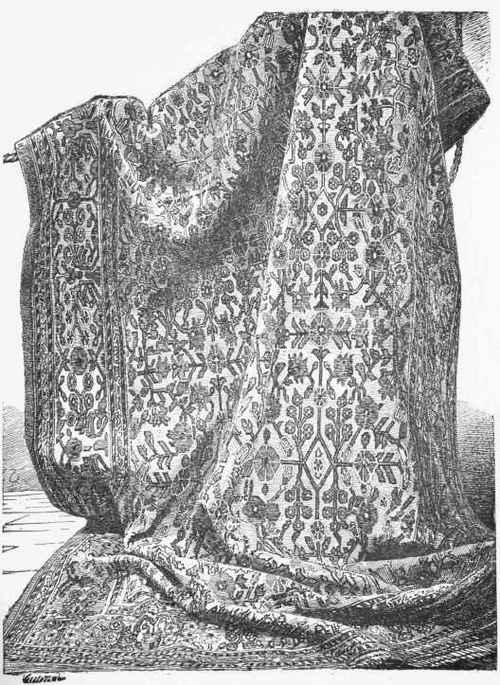
Large carpet on gold ground - Persian workmanship, of a remote epoch. (Collection of M. H. Barbet de Jouy).
The observer is strangely perplexed by the sight of these oriental tapestries. Most of them are of velvet surface; in other words, the wools and silks are tied and cut above, some being left very long, others so short that the tissue looks almost smooth. It was this disposition that caused the name of Turkey carpets to be applied to the velvet piled kinds which Henry IV. wished to have imitated at the Savonnerie. But there are some rather rare descriptions woven with a smooth surface, and others again all in silk, and so velvet like that it becomes difficult to say whether they are to be regarded as tapestry or true velvets. One of the finest types was that marvellous piece in the Saint-Seine collection. Nothing could be imagined more soft and harmonious than its red ground relieved with arabesques of large flowers, and its central medallion of a green passing from a pale to a bright hue according to the play of light, and setting off some delicate arabesques and palms of a vivid tone.
An extremely beautiful tapestry, producing a most sumptuous effect, is that belonging to M. H. Barbet de Jouy; it is worked on a gold ground, which gives to the ornaments a surprisingly soft and brilliant tone.
It may again be asked whether we should class with the tapestries or the tissues, certain fabrics of thick closely woven silk, such as were seen in the Saint-Seine collection. The fawn-coloured tones of the ground have the appearance of gold; the reds are of dazzling brightness; and the rich ornamentations of arabesque flowers, palms, rosettes and foliage, are treated with a vigour rivalling the finest worsted velvets. A detail may be mentioned, as likely perhaps some day to throw light on the centre whence came these materials. Among the meanders common in Persian compositions, are groups of symmetrical clouds and ribbon knots, such as the Chinese employ in their symbolical compositions.
The prayer-carpets are easily recognised by their irregular disposition. At one of the extremities is seen, if not the Caaba itself, at least a sort of horseshoe, symbolising it in the eyes of the believer. Placed in the direction of the east, it shows him the situation in which he should pray. We have even seen this direction rendered perceptible, by the degradation of the colours towards one extremity of the carpet.
There would seem to be no doubt that the Indians also had their tapestries. To satisfy ourselves on this point, we need but study with a little attention the miniatures in which we see them spread before the masnad of the prince, or among the guests at a repast. Painting, however, is insufficient to express the style completely, and it would be somewhat rash to decide whether these carpets are of the same description as those of Persia, or whether they are embroideries, or simply printed materials.
In the Celestial Empire, tapestries, in the strict term of the word, are very rare, and would seem to be used only as wall-hangings. We have seen a very old specimen in high-warp, belonging to M. Dupont-Auberville, and representing children performing the principal actions of life, a symbolical subject, recurring in painting, embroidery, and even on vases. M. Gauche/. is the owner of a more recent and surpassingly beautiful tapestry, of quite a similar character. In this piece, the gold is blended with the brightest silks. M. Henri Cernuschi possesses the largest hanging we have met with. In it among trees of good omen, are depicted philosophers and men of letters, poring over antique documents, and endeavouring thence to draw the precepts of deep philosophy. This also is a scene frequently repeated in all the devices available to art.
These high-warps are on a deep blue ground, and arc remarkable for the harmony of the skilfully contrasted colours. They appear to advantage, even by the side of the most elegant embroideries, and serve as a ground for brilliant porcelains, bronzes heightened with gold and silver, jade or cloisonne enamels.
Among the Chinese tapestries, we do not include the unbleached felts, joined in breadths, and embroidered to serve either as banners, or for ornamenting the imperial palaces.
Top of box of enamelled bronze, from India.
Continue to:


My Books

