


Tapestry in Brussels. Continued
Description
This section is from the book "A History Of Furniture", by Albert Jacquemart. Also available from Amazon: A History Of Furniture.
This section is from the "" book, by .
Tapestry in Brussels. Continued
Besides these marks, there are others of which mention was made in the edict of Charles the Fifth; first, there are the arms and emblems adopted by the manufacturing towns, then the signatures, and finally private ciphers, the explanation of which would be of evident interest.
Connoisseurs may have remarked at the Exhibition of the History of Costume, a tapestry representing, on pieces of different sizes, a history of Diana, of good design and careful execution, and which the owner, M. Bezard, asserted to have been made to ornament the chateau d'Anet; the subjects being simply an allegory intended to commemorate the name of the celebrated Duchesse de Valentinois. We will not dispute this attribution; but the distance which separates the date of the death of Diane de Poitiers, 1566, from that inscribed on the tapestries, 1610, permits us to suspect its accuracy. The important interest for us lies in the fact that the tapestry unites the fundamental mark of Brussels the signature FRANCISCVS SPIRING1VS and SP1R1NVS FECIT ANNO 1610 the escutcheon of a town?



and, finally, a constant mark embroidered in white on the blue margin, and generally on the right side. The signature is woven in white, on a yellow thread, which separates the lower border from the subject; the Brussels mark is sometimes on the left-hand border. As for the silver escutcheon with a pale sable? it is accompanied by the initials HD, the meaning of which escapes us; this double initial would seem to us to prove that it is no municipal stamp (there is already that of the duchy of Burgundy), but perhaps the arms of some manager of the manufactory.
As we have said, the fabrication is carefully executed; gold, silver, and silk abound in the tissue, and the borders answer the description we gave of those in the tapestries of the Vatican. Flowers and fruits surround with their groupings niches or cartouches with small mythological figures; there are Paris and Helen, Pyramus and Thisbe, Ulysses and Circe, Leander and Hero, Mars and Venus, Jupiter and Calisto, Mercury and Herse.
In a series of pieces with subjects taken from ancient history, and exhibited by M. Recappe, there was found, in addition to the fundamental mark, the ciphers the piece bearing the latter was distinguished from the others by the border, worked in sacred subjects; there was Susanna surprised by the old men, and a woman bathing, doubtless Bathsheba, to whom a servant is presenting a note inscribed with characters which may stand for some signature.

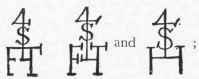
As for the tapestry of Gombault and Mace, the Rabelaisian legends of which we will not reproduce, besides the escutcheon of gules with the two B's, it bears this sign in which the letter D figures under three different forms. This sort of signature, so different from the others, may possibly be Flemish, or perhaps a copy of a French cipher, as the subject itself is the reproduction of the French cartoon of Dumee and Guyot.

We have met with no tapestry signed by Franchois Guebels, who worked about 1571; in the seventeenth century, names are more frequently seen, besides Francois Speering whom we found at Lille in 1588, before he came to Brussels to execute the history of Diana, we see in 1613 a piece of tapestry representing acts of the life of Alexander the Great, by Jean Raes, from cartoons of the Rubens school. Johannes Franciscus Van den Hecke, who sometimes signs I.-F. Vanden Hecke, depicts the Passage of the Granicus, the Magnanimity, and the Triumph of Alexander, from the compositions of Lebrun.
But a series worthy of being mentioned above all others, is that woven in 1663 by A. Auwercx, from the cartoons of Van Kessel and Herp, representing subjects taken from the history of Martin I., King of Aragon, who became King of Sicily on the death of his son. These subjects relate to services rendered to the king by G. R. de Moncada, Lord of Airola, in Sicily, and the tapestry was expressly made for one of the descendants of that nobleman. It is admirably finished, notwithstanding some anachronisms of costume; the backgrounds, especially the sea views, are of charming lightness, and the broad borders, in which armorial bearings stand out from among emblems of every description, arms, fruits, flowers, etc, are of a boldness and truth which nothing approaches.
We may also mention some "verdures" representing the seasons, and signed Marcus de Vos and I. F. V. Hecke, and above all the charming tapestries belonging to M. Gauchez, which are in the ornamental style of our manufactory at Beauvais: the principal subject is an escutcheon surmounted by a ducal coronet, beneath which is Time enchained by Love. The background represents a carpet with flowers and wreaths, the corners of which are upheld by Cupids. Here we have a double signature, that of the painter : D. Teniers jun. pinx., 1684, and that of the tapestry worker: Gill. Van Loefdael fecit.
Let us add the names of Roellans, of Jean de Melter, who doubtless worked more at Lille than at Brussels, and finally a name very much injured by the effects of time, but which we thought might read as F. IFVNIERS. It was beneath an equestrian figure of the seventeenth century.
Ought we to attribute to Brussels itself the manufacture of some tapestries of a secondary rank, specialised by Flemish inscriptions, such as the four pieces belonging to Count Adrien de Brimont, representing episodes in the life of Saint Rombaud? Their dimensions and style of workmanship would rather induce us to see in them a provincial work.
We cannot conclude without also mentioning some very singular tapestries executed, it appears, at Brussels, from Italian cartoons of the Modena school; they represent the months under the form of the deity to which each of them is dedicated; we see Apollo and Bacchus with brilliant aureolas, and surrounded by ornaments and grotesque figures on very bright grounds. The brilliancy of the colours, and the complication of the ensemble, certainly announce a great manufactory; but the heaviness of the design, and the hard and barbarous aspect of the whole, leave the mind in a sort of uneasiness; we cannot, as far as we are concerned, assign any date to this work.
Continue to:


My Books

