


The Goldsmith's Art. Part 4
Description
This section is from the book "A History Of Furniture", by Albert Jacquemart. Also available from Amazon: A History Of Furniture.
This section is from the "" book, by .
The Goldsmith's Art. Part 4
We have also here a tenth century plaque in silver repousse, belonging to the treasures of St. Denis, which represents the visits of the holy women to the sepulchre after the Resurrection. This Greek relic is of great value. It is to Cluny again that we must go if we wish to see one of the most ancient relics of the goldsmiths' art, ornamented with figures. We allude to the celebrated golden altar given to the Cathedral of Bale, in the early part of the eleventh century, by the Emperor Henry II. In its monumental panels Christ is represented as giving the benediction, with the thumb, fore and middle fingers of the right-hand raised, that is to say, according to the Latin ritual, and holding in his left-hand a globe : his feet rest on a hillock, on which kneel Saint Henry and his wife, the Empress Cunegunda; while on the right side are the archangel Michael, and Saint Benedict, founder of the Abbey of Monte Cassino; and on the left, the archangels Gabriel and Raphael. All the heads are surrounded by the nimbus, the nimbus is embellished with precious stones mounted in relief. Above, on the pediment, are personified the four Virtues - Prudence, Justice, Temperance, and Fortitude. Elegant inscriptions complete the monument. There exists considerable uncertainty as to its origin; some authors regarding it as Byzantine, chiefly on account of the Greek words which occur in the inscriptions, while the greater number attribute it to a Lombard origin, comparing it rather with the high altar of the Basilica of St. Ambrose at Milan. These latter authorities see in it, by reason of the architectural style, indications of a Rhenish origin. Authentic evidence from these far distant epochs is too rare for us to pronounce a decided judgment. Nevertheless, this master-piece marks an important stage, and brings us naturally to works essentially French in character - those executed by order of Suger, and which have been so long preserved in the treasury of St. Denis. Here we may note a curious fact, viz., how national processes are preserved unchanged during a great number of years. Suger had to adorn art-products, brought for the most part from the East. Here, for instance, we have a patera in serpentine engraved with golden fishes; the circumference is ornamented not only with cabochon stones set in cells, but also with those tablets of purple glass which we find already in the time of Childeric, and with cylinders of the same glass which form a border round the edge. The vase of Eleanora, with its delicate filigree work, was perhaps, inspired by the Byzantine school, but the vase of ancient sardonyx, transformed into an elegant ewer, is assuredly the fruit of Oriental inspiration, or, to speak more precisely, an offshoot of Persian Art. As for this vessel (buire) of Egyptian porphyry, which the setting has converted into an eagle, it presents an excellent example of the French twelfth-century style; as it is entirely original in character, and the boldness of the composition, as well as the vigour of the workmanship, give the highest idea of the talent of the artisans of the period.
From the beginning of the twelfth century, the art of the goldsmith is closely connected with architecture, and follows its evolutions more or less closely. It adopts all the various processes: casting, chasing, repousse, and kindred modes of working, stamping, punching, drilling, even intaglio work, applications of filagree, precious stones, niello and enamels. In fact, it was in the laboratory of the goldsmith that the discoveries of greatest value to art were elaborated, and real progress made. The monasteries - where all were workers, where the manuscripts afforded descriptions of whatever was most deserving of notice in the civilised world - the monasteries preserved the traditions of the past, and prepared the discoveries of the future, and served as centres of intelligence, destined later to be replaced by the guilds and corporations, and by the royal workshops, which were to foster industries until, sure of themselves, they could rely on their own individualism.
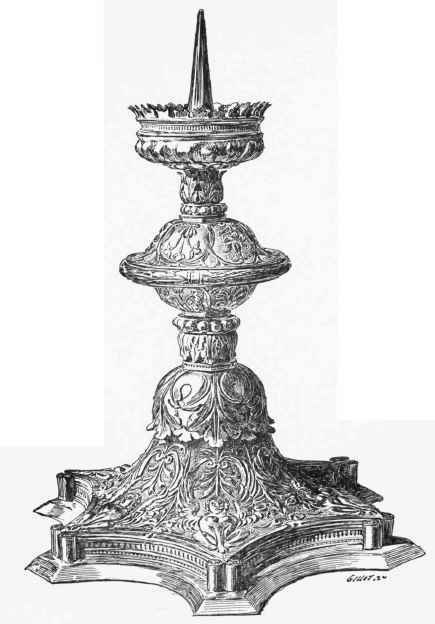
Candlestick of repousse copper, chased and gilt, Italian work of the Fifteenth Century. (M. E, Bonaffe's Collection),.
In order to follow with any degree of certainty the progress of the goldsmith's art, we must include among his works certain pieces in which copper, both cast and chased, and enamels are employed along with precious materials. In this series, we shall find in the Louvre collection a number of most curious objects. Of the eleventh century, we have first of all the beautiful box for holding the Gospels, which forms part of the treasury of St. Denis, and displays a rich combination of repousse and filigree work, with enamels and precious stones. Then we have the reliquary of the arm of Charlemagne, German work, subsequent evidently to the opening of the tomb of the saint, probably between 1155 and 1190, as Frederick Barbarossa is thereon represented as Emperor, with his wife, the Empress Eudoxia, and his ancestors.
To the twelfth century, again, belongs the shrine of St. Potentien, which presents an excellent example of the architectural constructions usually adopted in the ecclesiastical gold and silver plate of this period. This shrine was made for the church of Steinfeld.
To the latter part of the same century, we may assign the reliquary cross, with double transverse beams, as they were generally made, in order to preserve fragments of the true cross. This specimen of French workmanship is ornamented with filigree work, and stamped foliage, with cabochon stones and pearls. On the lower transverse beam is fixed a figure of Christ wearing a crown, the loins covered with folds of ample drapery. The foot, which is very elaborately worked, is embellished with miniature figures of solid silver. Beneath is the following inscription: Crus Hugonis abbatis. It is probably the same mentioned in a historical MS. of the Abbey of Saint Vincent de Laon, as having belonged to this Abbey. It must, in this case, have been made for the Abbot Hugues, who presided over it between the years 1174 and 1205. M. Darcel besides observes, that in 1131 this monastery possessed a manufactory of gold and silver work.
Continue to:


My Books

