


The Goldsmith's Art. Part 5
Description
This section is from the book "A History Of Furniture", by Albert Jacquemart. Also available from Amazon: A History Of Furniture.
This section is from the "" book, by .
The Goldsmith's Art. Part 5
In the thirteenth century, the Limoges enamels are in full splendour, as we shall see from the cup signed by its maker, Master Alpais, and the town of Limoges where he worked. Here we have a Christ represented in the act of giving the benediction, executed in repousse copper, chased and gilt, and ornamented with pearls of enamel, and glass so exquisite in execution, as to rival gold itself; then come crosiers, on which leaves and flowers, occidental in character, form the basis of the ornamentation, still further embellished with glass cabochons, taking the place of hard stones. We do not dwell on that class of works, which belongs rather to the category of champleve enamelling.

Hanap in the form of a chimaera, the body formed of a horn, mounted in silver-gilt; the triton bears the Montfort arms German work of the Sixteenth Century. (Imperial Treasury, Vienna.).
As a specimen of genuine goldsmiths' work, we may mention the clasp of the mantle of St. Louis. The ground of silver, engraved and enamelled in blue, is seme with innumerable fleur-de-lys, and supports a large fleur-de-lys superposed, composed of precious stones set in collets or mounted on claws. Of these six amethysts, six emeralds, and eleven garnets yet remain. The frame itself is embellished with twenty-six additional garnets and two sapphires. This gem, which is bold in form, is remarkable from its rich and severe character, due to the employment of cabochon garnets arranged in symmetrical order, and M. Barbet de Jouy observes that there used to be a similar clasp on a statue of Philip Augustus, and that Charles V. possessed, in 1379, twenty-six clasp ornamented with golden fleur-de-lys.
The Louvre presents us with another precious relic - the casket {cassette) of Saint Louis. This box is of special interest from the plaques in relief, which alternate with the enamels. M. Barbet de Jouy remarks that the subjects of these plaques are intended to represent the evil passions which man should resist and overcome. This is doubtless the case, but what interests us specially is the altogether Oriental character of these figures. There is a man attacking a species of hydra; but again, further on, we find two birds, back to back, with necks crossed over each other, as in the Arabian monuments; there it is a bird of prey attacking some wild animal, and all the various designs which we find so frequently repeated in Oriental tissues and silks.
Of the fourteenth century, we find a valuable type in the Louvre: we allude to the reliquary group of the Virgin Mary, carrying the infant Jesus, in silver gilt. The chased pedestal is ornamented with enamels; in the niches and buttresses which surround it, are twenty-two statuettes representing the prophets of the new dispensation. In the medallions reserved between the reliefs, of which the ground is resplendent with a fine blue translucent enamel, rendered still more brilliant by hatchings made in the silver in an opposite direction, are subjects engraved and wrought as if in niello, representing the Annunciation, the Visitation, the Nativity, the Appearance of the angels to the shepherds, the Adoration of the Magi, the Presentation in the Temple, the Flight into Egypt, the Massacre of the Innocents, the Resurrection of Lazarus, the Kiss of Judas, the bearing of the Cross, the Calvary, the Resurrection, and Jesus taking the Just out of Purgatory. On enamel plaques "applied" at the angles of the reliquary are the united blasons of France and Evreux; being those of Charles le Bel, and Jeanne d'Evreux, his wife. A fine Gothic inscription, engraved and enamelled in blue, confirms this in these words: "Ceste ymage donna ceans ma dame la Royne Jehe devreux royne de France et de Navarre compaigne da roi Challes, le XXVIIIe jour d'avril, lan MCCCXXXIX".
The fifteenth century, the epoch of the development of Gothic architecture, naturally gave a monumental tendency to the art of the goldsmith. This is plainly visible in the reliquaries and other ecclesiastical pieces where we may see it twisting the gold and silver into crenelated volutes, perforating them into flamboyant mullions, superposing pinnacles to niches, embellishing the whole with precious stones and enamels, and peopling them with figures, whose flesh tints are often painted or enamelled. Of this style no better type can be found than the reliquary in the museum of the Louvre which was given by Henry III. to the altar of the Order of the Saint Esprit.
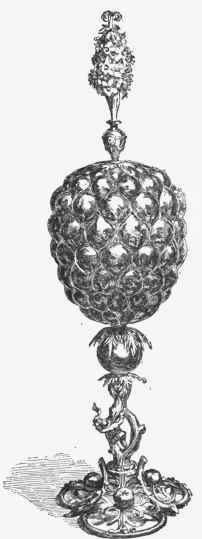
Drinking-Vasc in silver-pilt repousse, partly in silver. German work, early part of the Sixteenth Century.
(Museum of the Louvre).
The Cluny collection is equally rich in examples of fifteenth-century gilded copper; but its most remarkable monument is the Shrine of Saint Anne, formed of a group in enamelled silver, and enriched with precious stones, the work of Hans Greiff, the celebrated Nuremberg goldsmith. The saint, seated in a canopied arm-chair, has the Holy Virgin, and another child, whom the German legends claim to be intended for her brother, on her lap. The two together support a shrine containing the sacred relics. We must also pause a moment before the two great shrines in silver, partly gilt, which belonged to the Treasury of Bale; as they afford an excellent type of the architectural ornamentation in Germany in the latter part of the fifteenth century.
We cannot treat of this epoch without stopping a moment at the Italian artists, and saying a word of the Renaissance, which was about to set in. And this is the proper place to do so, inasmuch as in Italy this transformation of art is the work of the goldsmiths; sculptors, even painters, had all handled the precious metals. But after a long struggle between two influences, the Gothic, which came from France, and that of the Antique, the latter won the day, and naturally carried along the new adepts towards the works of statuary, architecture, and high-class decoration, so that early examples of Italian goldsmiths' work, and we may almost say, do not exist. We must come to the sixteenth century in order to find in Benvenuto Cellini, the real history of what condition Art was in when he first made his appearance, and to judge of what it became through his influence. France, in our opinion, has not received credit for her fair share in the movement.
Continue to:


My Books

