


The Goldsmith's Art. Part 6
Description
This section is from the book "A History Of Furniture", by Albert Jacquemart. Also available from Amazon: A History Of Furniture.
This section is from the "" book, by .
The Goldsmith's Art. Part 6
Before following the foreign schools, before Matteo del Nassaro had mounted his gems, or Benvenuto Cellini had created his vases and jewels, the French artists, notwithstanding the taste of Georges d'Amboise for the Italian school, did not want either for orders or encouragement. The edict of Louis XII., which limits the weight of the metals used in each piece, and that which makes affixing the mark compulsory, suffice to prove this.
The works which survive, moreover, show us that the French school, even while submitting to the influence of foreign artists who sought to impose on it their taste, was able to preserve its old independence unimpaired. It borrowed from the Renaissance merely what suited it, and succeeded even in imparting to the inspirations drawn from the revival of the antique such an individual character, an air so thoroughly personal, that no objection could be offered to them.
French Art of the Renaissance period may then be classed into two distinct divisions+: that of the Italians who were brought into France by the great nobles, and were soon absorbed by the taste of the country; and the national school, which drew from antiquity and from foreign productions whatever suited its temperament. Unhappily, it is not easy to offer practical demonstrations of these facts by reason of the limited number of monuments now existing.
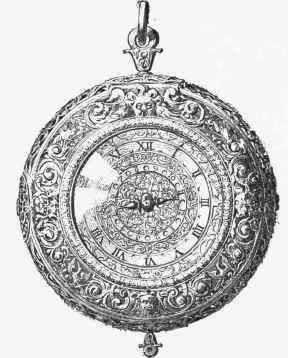
Silver Watch, chased and gilt. Period of Henry IV. (Collection of M. Dutuit.).
Let us, however, examine those which are contained in our museums. In the chapter on arms, we have already spoken of the sword of Francis I. with its hilt in gold stamped with the Salamander and enamelled. This is evidently one of the pieces made by the Italian artists, as we recognise in it their style and processes. But, in addition to this, we have a figure of Fame, the bust undraped, mounted on a horse whose caparisons are inlaid with niello and enamels. Fame herself wears a brocaded dress, and necklace and bracelets also in niello work: this recalls the style of Germain Pilon. A processional cross with fleur-de-lys furnishes a type of the ecclesiastical goldsmith's work, and two cups, one surmounted by a Neptune, the other borne by a Bacchus, as also a dish with the arms of Gondy, show us specimens of the table plate of the period.
It would require a special study, and pages innumerable, were we to attempt to seriously analyse all the phases of this great epoch of the German and Italian Renaissance. Where are all the works in repousse of Caradosso, whose merits were such as to make Cellini pride himself on having discovered their secret? where are the great vases of Lucagnolo de Jesi? Our collections afford too few examples of these interesting epochs to enable us to form any adequate idea of their abundance or the fertility of the masters. There are some branches of the Italian stock whose vigour we do not even suspect until chance has placed its fruits under our eyes; such, for instance, is the Portuguese branch, easily distinguished by its repousse work almost in high relief, which recalls the disposition of the ancient metal work. Some few fine examples shown at the exhibition of Costume, have allowed us to appreciate their elegance; and how many others are there in private collections whose filiation we should like to know? Of the German goldsmiths, we possess a most curious specimen, dated 1536. It is the ewer with its salver representing the victory of Charles V. over the Moors, and the capture of the fortress of Goleta, a subject represented in different materials and always with great pomp and circumstance. As a general rule, the German school deserves the reproach of being somewhat heavy in style; yet the goldsmiths have known how to impart to their work, and specially to certain vidercomes, a stateliness truly monumental. Amid this crowd of pieces which have survived the shipwrecks of time, there is, assuredly a choice to be made; but we may yet find types worthy of taking a place among the furniture of a sixteenth-century connoisseur. Among the specimens of German goldsmiths we may mention certain marvels of mechanical genius such as the ship (nef) in silver gilt, enamelled, in the Musee de Cluny, in which Charles V. is represented seated on his throne and surrounded by all his court. A clock, placed on the deck, marks the hours, and ingenious mechanical wheels set in motion all the personages and the ship itself, fire cannon, which roar, trim the sails, and make the musicians sound a flourish of trumpets, while the dignitaries defile before the Emperor, who returns their salute, and then they retire into the poop, from which they had previously issued.
Pieces such as this, which in our day are considered as simply child's-play, were then of immense value, and used to be given as presents from one monarch to another.
Was it through some recollection of ancient times, and of those singular ewers in bronze of the thirteenth century, composed of monsters, or horses with heroes or warriors astride on them, that the Germans have made vessels for holding wines, in silver-gilt, representing stags which fly over a ground covered with flowers, or other animals running at full speed. These pieces, which are of frequent occurrence, arc of considerable size, and sometimes repousse and artistically chased.
As for the purely French style, there is nothing more interesting than the works of the time of Henry II. When France, notwithstanding the intermeddling of foreigners, and the influence exercised by the Florentine Catherine de Medicis, not only reasserted its own individuality, but even succeeded in imposing its taste and art on that enlightened and enthusiastic woman. Was not Guillaume Arondelle her goldsmith? and was it not of two other Frenchmen, Gilles Suramond and Jehan Doublet, that her consort commanded the plate for the royal table? That the Italian Renaissance has exercised an influence on the French, nothing is more true; however, while receiving beyond the Alps the signal of a return to the antique, the French artists knew how to retain their national originality, and even created a charming outline in their figures, borrowed from the models of sculpture.
Continue to:


My Books

