


The Goldsmith's Art. Part 7
Description
This section is from the book "A History Of Furniture", by Albert Jacquemart. Also available from Amazon: A History Of Furniture.
This section is from the "" book, by .
The Goldsmith's Art. Part 7
The seventeenth century saw Art undergo fresh transformations. Architecture had grown heavy in character; bricks in part took the place of stone, with carved embellishments; dress assumed a fulness of breadth very different from the elegant effeminacy of the sixteenth century. The goldsmith's art naturally followed the course of fashion. It is not very easy, in the absence of examples of these modifications, to make them clearly understood by words. The influence of the sixteenth century made its influence felt for a long time, and it was only by degrees, by almost imperceptible transitions from Charles IX. to Henry IV. and Louis XIII., that the work of the goldsmith arrived at the stateliness of style characteristic of the reign of Louis XIV. If we seek for an example of this transitional period, we may find it in the casket, designed, according to tradition, as a gift from Cardinal Mazarin to Anne of Austria, Queen of Louis XIII. The delicate scroll-work, ornamented with natural flowers, which the unknown artist has chased superbly in gold, presents a perfect type of the same taste displayed in the painted enamels, furniture, and other productions of the same epoch.
In order to give a correct idea of the condition of the goldsmith's art under Louis XIV., we must first of all put aside jewellery, which, too, underwent a transformation; inasmuch, as the delicacies of art were replaced by the lavish display and costliness of precious stones and pearls.
The art of the goldsmith showed in power down to the disasters of the end of this reign, by the abundance of the metal, and the amplitude of its forms. Cardinal Mazarin had fire-dogs and brasiers of silver, lustres of crystal and goldsmiths' work, mirrors ornamented with plaques of gold and silver. Towns presented their governors with large basins, flambeaux, and ewers, chased by the celebrated artists of the period. Then the Lescots were the initiators of the style; but the person who realised the ideal splendour dreamed of by Louis XIV. was Claude Ballin, of whom M. Paul Mantz says so pertinently, that he was in harmonious keeping with the group of artists who worked for the king. "He gives his hand to Lebrun; he speaks the language of the brothers Marsy, of Mansard, of Le Notre."Perrault, in his "Hommes Illustres," says that there were by him, "tables of such exquisite carving, and so admirably chased, that the material, massive silver though it was, hardly constituted one-tenth part of their value: there were cressets, and huge gueridons some eight or nine feet in height, for supporting flambeaux or girandoles; large vases for holding orange-trees, and great barrows for carrying them about; basins, chandeliers, mirrors, all of such splendour, elegance, and good taste in workmanship, that they perhaps seemed to give a more correct idea of the grandeur of the prince who had had them made." All these marvels have disappeared in the melting-pot, and have passed through the die of the mint. We are lucky enough to be able to form some idea of them from a splendid piece of tapestry, which represents Louis XIV. as visiting the manufactory of the Gobelins, and seeing defile before him all these treasures destined for his Palace of Versailles.
The Gobelins was, in fact, the grand school in which, drilled by Lebrun, the artists learned to give up their own individuality to the centralising genius of the painter to the king. However, do not let us exaggerate anything. There is no question, but that the Arts, regarded collectively as a whole, were never at any other epoch submitted to a stricter discipline. But in the absence of the works of many of the goldsmiths of the reign of Louis XIV., we may at all events recognise their individual ideas, in the collections published by them for the use of their fellow-craftsmen. We may see there revealed many ingenious conceptions, in the models of Etienne Carteron in 1615, Esaias Van Hulsen in 1616, Jean Toutin of Chateaudun in 1618, Gedeon and Laurent Lesgare in 1623, Balthazar Lemercier in 1625, George Mosbach in 1626, Pierre Marchant in 1628, Jacques Caillard in 1629, Pierre de la Barre and Antoine Hedouyns in 1623, Pierre Boucquet in 1634, Francois Lefebvre in 1635, Louis Rouper of Metz in 1668, and lastly of Daniel Marot, who shows us the condition of the art at the period when Louis XIV. was beginning to grow old.
But even while encouraging luxury by lending the force of example, the king suddenly bethought himself that the patrimony of families was being absorbed by such prodigality, and on the 31st January, 1669, he issued a decree, prohibiting absolutely the use of gold plate, and limiting the weight of that of silver, compelling those in possession of objects in the precious metals to take them to the mint.
To this first blow aimed at the art of the goldsmith, succeeded a second. The exigencies of war compelled the king to levy a royalty on the raw material, which soon raised the price very considerably, and excited protests from those interested in the business. Accordingly, it was relieved from the double tax; but the days of prosperity were gone by, the finances became more and more embarrassed, and some prompt action had to be taken. What this action was, we are all aware : it was the Decree of the 3rd of December, 1689, which consigned to the mint all silver plate used in apartments, such as mirrors, fire-dogs, girandoles, and vases of all kinds. The king set the example of this terrible sacrifice, which swallowed up so many master-pieces, and realised only the insignificant sum of three millions.
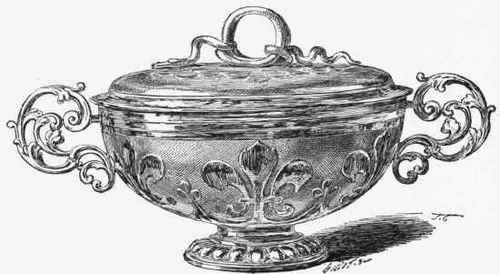
Cup with cover in silver-gilt ornamented with a fleur-de-lise crown. (French work of the Seventeenth Century.).
Although the church was spared, specimens of the church gold and silver plate of the Louis XIV. period are somewhat rare. We need not lay stress on the scarcity of articles for civil use, inasmuch as the only pieces extant must have been preserved by stealth. However, the Universal Exhibition showed us some fine examples belonging to Baron Pichon, specially some vases by Loir, a chocolate-pot of Etienne Balaguy, and some flambeaux by Outrebon. We may also mention the exquisite looking-glass frame in the possession of the Baroness Rothschild, which is a perfect masterpiece of elegance and taste. The Louvre shows us one of those ewers in the form of a group of German conception; the subject is a centaur carrying away a woman. We have also a pedestal cup of cast silver, repousse, chased and gilt, and embellished with those allegorical designs so dear to the Renaissance, besides some specimens of ecclesiastical gold and silver plate.
Continue to:


My Books

