


Adam, Sheraton, Empire. Part 3
Description
This section is from the book "The Old Furniture Book", by Hannah Hudson Moore. Also available from Amazon: The Old Furniture Book.
Adam, Sheraton, Empire. Part 3
He claims, and indeed with absolute correctness, "to unite elegance with utility and blend the useful with the agreeable."
In Figure 31 is shown one of a pair of card-tables, Hepplewhite design, made of mahogany and inlaid with ebony and satin-wood. They belong to Mr. William M. Hoyt of Rochester, N. Y.
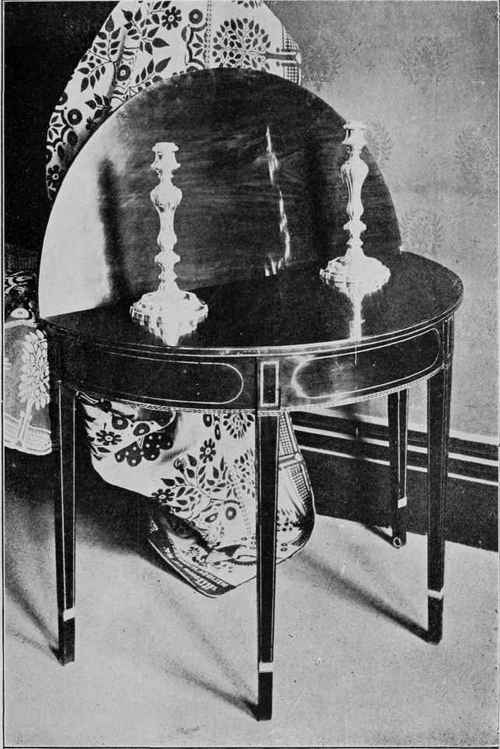
Figure 31. HEPPLEWHITE CARD-TABLE.
Like Adam, Hepplewhite made great use of satin-wood for whole pieces of furniture. He used his well-known and characteristic shapes in chair-backs and little sofas, cabinets and workstands, table stands, harpsichord cases, and commodes. Satin-wood had been but recently introduced from the East Indies and was instantly popular. Even mantel-pieces were made of it, to match the furniture, and there was a fancy to have the drawing-rooms and boudoirs very light and elegant. Clothes had shrunk in dimensions, no more hoops and farthingales embarrassed their wearers, the stiffness was banished from coat-tails, and consequently the furniture had shrunk too. Chairs were small and narrow, and window-seats, made in abundance by Hepplewhite, were deservedly popular, and the coverings were in accord with the gaiety of the woodwork. Figure 32 shows two Hepplewhite settees with shield-shaped backs. The upper one is of mahogany with low relief carvings on the tops, and the lower of satin-wood, with cane seat and the woodwork beautifully painted. The elegance of this painted satin-wood has long been admired. Unfortunately it has caught the popular taste, and it is now reproduced in such large quantities that it is freely offered for sale by dealers in our large cities.
The pieces shown in our illustration are both fine specimens of the original maker and are owned by the Waring Galleries, London.
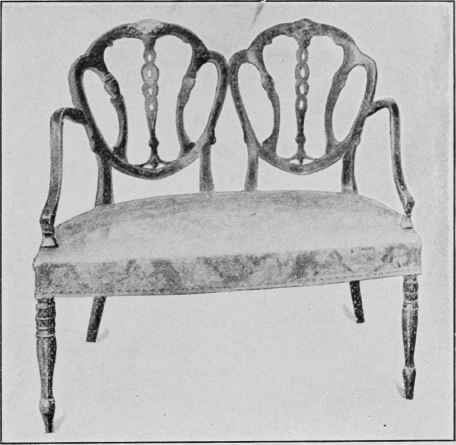
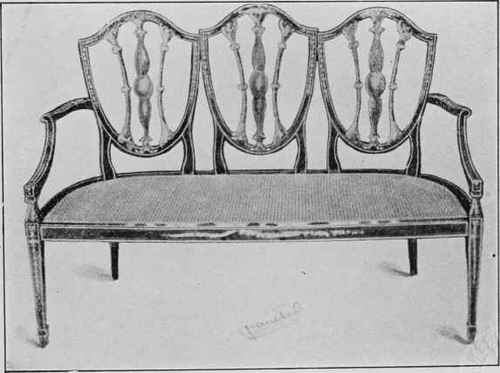
Figure 32. HEPPLEWHITE SETTEES.
It was no longer necessary to make the legs of chairs of such stout proportions, and as the bodies of the chairs were lighter so the legs dwindled exceedingly and were given only a semblance of solidity by the use of the "spade-foot" so much affected by Hepple-white. Their appearance of fragility was farther enhanced by groovings and flutings, but they are always pretty.
Although his characteristic chairs have shield-shaped or oval backs, he gives in his book eighteen designs of bannister-backed chairs, to be carried out in mahogany.
The general dimensions given by Hepplewhite for his chairs are as follows:
"Width in front, 20 inches; depth of seat, 17 inches , height of seat frame, 17 inches; total height, about 37 inches."
He gives most definite directions about coverings. Mahogany chairs should have the seats of horsehair, plain, striped, checkered, etc., according to taste; or cane bottoms with cushions which should be covered with the same material as the bed and window curtains. He was fond of the "Duchess," which consisted of two Barjeer or armchairs with a stool between them, all three pieces fitting together at pleasure and making a lounge from six to eight feet long. His press-beds vary little in appearance from wardrobes, but it was in smaller and daintier pieces that his particular talent found play. His knife-boxes are extremely elegant, particularly when in urn shape with a rod in the centre to prevent the top of the urn from being removed. All the handles and knobs on his larger pieces of furniture are round, but on sideboards frequently oval, his double chests of drawers have either French or block feet.
Tripod reading-desks, urn-stands, beautiful tea-trays, caddies and tea-chests are richly inlaid or painted. We find him not only making very ornate and richly inlaid card-tables, but "Pembroke tables" as well, with either round or square tops. Such tables have leaves, but, instead of the legs moving out to support the leaves, small arms come out from the table-frame.
His writing-tables and desks have tambour tops, that is strips of wood pasted on cloth, so that they roll back into receptacles provided for them, and are filled with secret drawers and flat cupboards for deeds or papers. Among his other small pieces which are distinguished by their grace are dressing-glasses, shaving-tables with glasses and without, "bason" stands, designs for brackets, fire-screens, wash-hand-stands, cornices, lamps, girandoles, and looking-glasses. His larger designs show dressing-tables and bureaus with curved and swell fronts, beds, four-posters, and field-beds with very graceful sweeps and much variety of design. His stuffed furniture is comfortable in the extreme, and the tall easy chairs with cheek pieces must have been well calculated to protect from searching draughts. Many of these easy chairs found their way to America, and as their cost was not extortionate moderate homes enjoyed them as well as wealthy ones.
After the Revolution, in all the seaboard towns and the more settled places near cities, there was a still greater call for all styles and luxuries popular in England. Indeed the former Colonies presented very curious and marked contrasts, being, as it is tersely put, "rolling in wealth or dirt poor." In Philadelphia there had been much style and "gentility" for many years. The English officers had, no doubt, brought some comforts with them, and they found others awaiting them. Major Andres letter describing supper at the "Mischianza," May 18, 1778, gives a vivid picture of the festivities of the times.
"At twelve, supper was announced, and the large folding-doors being suddenly thrown open discovered a magnificent salon of 210 feet long by 40 feet wide, and 22 in height, with three alcoves on each side which served for sideboards. Fifty-six large pier-glasses ornamented with green silk artificial flowers and ribbands; one hundred branches with three lights in each trimmed in the same manner as the mirrors; eighteen lustres each with twenty-four lights suspended from the ceiling and ornamented as the branches.Three hundred wax tapers disposed along the supper-tables, four hundred and thirty covers, twelve hundred dishes, twenty-four black slaves in Oriental dresses with silver-collars and bracelets ranged in two lines, and bending to the ground as the General Howe and the Admiral appeared together." All the lustres, mirrors, etc., with which the room was adorned, were borrowed, says Watson, from the townsfolk, and all were returned uninjured.
Continue to:


My Books

