


Adam, Sheraton, Empire. Part 6
Description
This section is from the book "The Old Furniture Book", by Hannah Hudson Moore. Also available from Amazon: The Old Furniture Book.
Adam, Sheraton, Empire. Part 6
After the French Revolution of 1790 furniture became markedly different. Greek models were chosen once more; the tripod became a favorite support. Mahogany was freely used, but so were coarse woods, in which case they were carved and profusely gilded. The most valuable book, for cabinet-makers, on "Empire " furniture, was published by the architects Per-cier and Fontaine in 1809. It was not filled with fanciful designs merely, as we have seen was the case with some of the catalogues of English makers, but every design shown in it had been carried out before it was published. Many of the drawings were adapted from classic models preserved in the Vatican. In many ways this style has not much to recommend it. It is apt to be heavy and stiff, particularly when made by English makers. The French decorated it with exquisite forms in metal (treated in another chapter), but the English contented themselves with cast brass. It was far preferable under the manipulation of American cabinet-makers, who restricted the use of brass and allowed the handsome woods to show themselves to the best advantage.
The Dutch, who also were not behind hand in the adoption of this and Napoleonic style, made tables, secretaries, chairs, etc., severe and regular in form, but enriched with their admirable marquetry, and with heads and feet of animals sparingly used. Sheraton and Shearer were swept along by the tide of fashion and drew Empire designs.

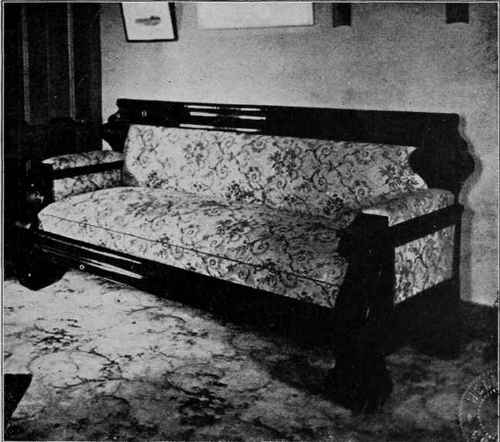
Figure 40. EMPIRE SOFA.
Gillow, the inventor of the extension-table, whose firm was established as early as 1800, made many fine designs and had orders from the best patrons. His firm is still carried on under the same name.
In 1808 George Smith was made "Upholder Extraordinary to H. R. H., the Prince of Wales." He published a book, of course, having a hundred and fifty-eight designs. They included bedsteads, tables, chairs, bookcases and commodes, and other articles of furniture copied from the French, like escritoires, jardinieres, chiffoniers, showing how the fancy for French things was increasing. He gives very definite rules as to how and when to use various woods.
- " Mahogany, when used in houses of consequence, should be confined to the parlour and bed-chamber floors.
"In furniture for these apartments the less inlay of other woods, the more chaste will be the style of work. If the wood be of a fine compact and bright quality, the ornaments may be carved clean in the mahogany. Where it may be requisite to make out panelling by inlay of lines, let these be of brass or ebony.
"In drawing-rooms, boudoirs, ante-rooms, East and West India satin-wood, rosewood, tulip-wood, and the other varieties of woods brought from the East, may be used. With satin and light-coloured woods the decorations may be of ebony or rosewood; with rosewood let the decorations be ormolu and the inlay of brass."
Figure 39 shows a handsome sofa of carved mahogany, Empire style, before it had arrived at its heaviest stage. The carving is extremely handsome, both rails of seat and back being decorated with dolphins. The foot is of the bear shape, and the arms are graceful in curve. This piece is of English make.
While we miss in the late Empire styles - say from 1810 to 1825 - much of the lightness and grace which had been contributed by the carving and inlay which were so freely used in the preceding period, yet there was a solidity and massive dignity which was not without a certain charm. Then, too, these pieces were generally veneered, and in them the beautiful grain of the mahogany, which was the favorite wood, showed to greatest advantage. The sofa in Figure 40 is such a piece. It is of unusual length, the top of the arm is stuffed, thus doing away with "squabs," as the cushions which were used on sofas, long and narrow, were called.
The wood, which is largely shown, is of that dark rich hue inclined to red, with veining many shades darker, and it is in a fine state of preservation. This piece belongs to Anthony Killgore, Esq., Flemington, N.J.

Figure 41. PIER-TABLE.
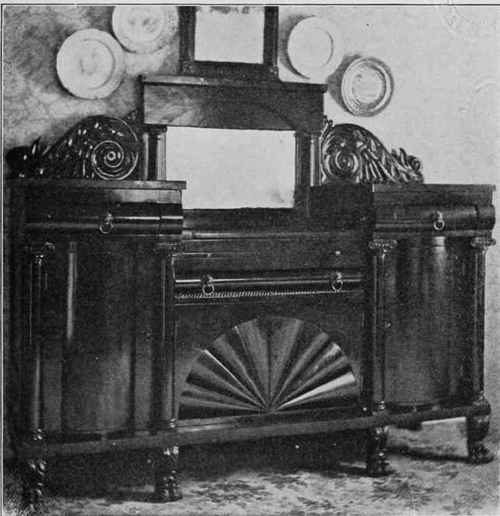
Figure 42. EMPIRE SIDEBOARD.
To about the same period does the pier-table belong (Figure 41), which is not usual in design, because of the third pier which starts from a circular shelf in the middle of the base. The swan piers at each end are very graceful, and the handsome grain of the mahogany is shown to great advantage. This piece belongs to the Misses Killgore, of Flemington, N. J., as does the sideboard shown in Figure 42. The doors of the lower part, with the fan, are solid mahogany, the carving on the legs and ornamental scrolls is fine. The middle of the top is raised to permit the insertion of a looking-glass, and the capitals at the tops of the pillars are of fine brass-work. Above the middle drawer, a shelf draws out for use in serving meals. The whole sideboard sets back on a little shelf above the bear's feet, a feature not unusual in the finer boards of this period.
The surroundings of this fine old piece of furniture are in keeping with its importance, the china showing above it on the wall being the Staffordshire blue made during the first quarter of the nineteenth century, while the mirror directly above it is of equal age.
Environment has a great deal to do with bringing out the true beauties of this stately old furniture. It must be surrounded with objects of approximate age and of equal dignity, otherwise it looks as unseemly as an ancient dame with a pink rose in her hair. The work-table shown in Figure 43 belongs to the same period, but of a little earlier date than the last pieces shown. The legs are richly carved, as is the central pillar. This also belongs to the Misses Killgore.
Not many pieces of such solidity were required in a room, and in those days overloading did not stand for elegance. In 1800, when the spacious Tayloe house in Washington was built, the furniture of the great drawing-room was a set of ash, sixteen pieces. There were twelve chairs with chintz cushions, and two card-tables; there were also a centre table and one upholstered couch, and a settee, but not one so-called easy-chair. Much furniture like that shown in Figures 40-43, is to be found in the old houses of such places as Cherry Valley, N. Y., where there is little changing about, and furniture has descended from one generation to another and still stands in its old familiar home.

Figure 43. EMPIRE WORK-TABLE.
Continue to:


My Books

