


Chippendale. Part 4
Description
This section is from the book "The Old Furniture Book", by Hannah Hudson Moore. Also available from Amazon: The Old Furniture Book.
Chippendale. Part 4
In the next forty years fashions changed, - they changed slowly in those days, - and among other things laid at the door of "Good Queen Anne" may be added the hoop-skirt. Flowered and damask gowns were worn over it, and in the "Spectator" of 1712 a number of gowns are advertised for sale, all the property of Mr. Peter Paggen, of Love Lane, near Eastcheap, London. Among them is an "Isabella-coloured kincob gown, flowered with green and gold; a purple and gold Atlas gown with a scarlet and gold Atlas petticoat edged with silver."
A little later in the century a lady's gown was all ruffles and flounces, in fact "every part of the garment was in curl, and caused a lady of fashion to look like one of those animals which in the country we call a Friesland hen."
The reigns of the first two Georges had Hogarth for their illustrator, and in the set of drawings called "Marriage a la Mode" we see the hoods, skirts without trains, unruffled and often accompanied by a sack, or something between a cloak and a gown, and called a mantua. During the reign of George I. there was no queen to set the fashion, so it changed little. In 1735 Caroline, queen of George II. on the king's birthday appeared in a "beautiful suit made of silk of the produce of Georgia, and the same was acknowledged to excel that of any other country." The ladies who accompanied her wore flowered silks of various colours, of a large pattern, but mostly with a white ground, with wide short sleeves and short petticoats. These gowns were often pinned up behind in fantastic fashion, and generally quite narrow. It was also a la mode to wear gold or silver nets on the petticoats, and to face and guard the robes with them and even to wear them on sleeves. Lady Harcourt, a famous beauty of Caroline's court, wore on one occasion a "white ground rich silk, embossed with gold and silver, and fine coloured flowers of a large pattern."
What we know as a morning-gown they called, in the middle of the eighteenth century a nightgown, and we read of a "garnet-coloured lustring nightgown with a tobine stripe of green and white, trimmed with floss of the same colour and lined with straw-coloured lutestring." A gay garment truly.
These were the styles in vogue when Chippendale began to design and make furniture for his patrons, whom he desired to see among the most fashionable. While the ladies were so gay, the gentlemen were quite as elegant, with three-cornered hats, wigs and patches, embroidered waistcoats, with stiffened skirts to their coats, knee-breeches, silk stockings, and snuff-boxes. Such modish people could not bestow themselves comfortably in chairs with arms, so chairs without arms, and tabourets, as they were called, were quite necessary for comfort. The fashionable ailment of the day, for men at least was gout, and we find designs for "gouty stools," in which the top could be raised or lowered as best suited the needs of the patient. His designs for sofas made these articles of great size; they ran from six feet nine inches to ten feet long. His ideas as to decoration seem amusing, for he mentions that the carvings on the sofa should be emblematic of Watchfulness, Assiduity, and Rest.
Wine-coolers for which Chippendale made many designs, sometimes had brass bands around them which had the effect of making them look very heavy and clumsy. Coolers of this style were round or oval, but some of better design were oblong or square. Numbers of beautiful little tea-tables, or tea-poys, as they were often called, were also made by Chippendale, and what he called in his book of designs "candle stands" were no doubt sometimes put to this use, though their height - he says they should run from three feet six inches to four feet six inches, -rendered the taller ones awkward. Figure 23 shows a very beautiful example of one of these stands richly carved. The post is three feet .seven and a half inches high, and the hexagonal top has a standing rim of very delicate carving. The little tea-stand next to it has also a slight rim, and some carving on the pedestal and feet. The music-stand is not a usual piece, and has a cupboard and drawer to contain the sheets. All three piece's are of mahogany and belong to the collection at Memorial Hall, Philadelphia.
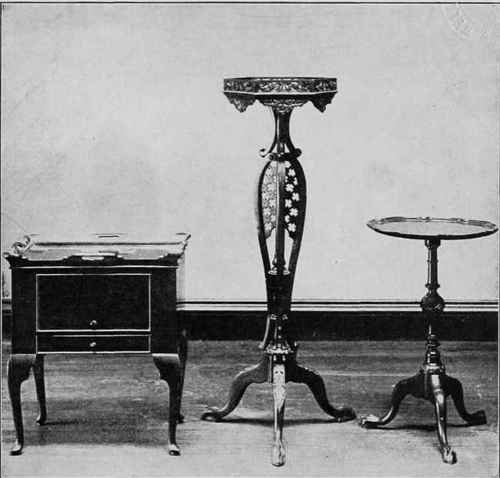
Figure 23. CHIPPENDALE CANDLE, TEA AND MUSIC STANDS.
Many of these tables or stands made their way to America, for tea-drinking was a great resource for the ladies. As early as 1720 Bohea tea was selling at Philadelphia for thirty shillings a pound. Its great cost prohibited its common use, and it was not until much later that it became common, so the greatest treat that could be offered to a neighbour was a drink of tea, particularly if the proud housewife could serve it out of a tiny porcelain cup without a handle, such cups being almost as great a rarity as the tea.
The little rim which set up above the edge of the table was intended to prevent the tea furniture from falling off. These tables are occasionally seen in America in their simpler forms. There are special ones made to order for customers by Chippendale, which are seldom allowed to leave the families for which they were originally made. There are two such tea-tables made in "Chinese taste ' with fretwork legs, sides to the table, and the little standing rim to protect the china. One of these tables was made for the great-grandmother of the present owner, by Chippendale, and has come down in a state of perfect preservation. It is held in England, is thirty-nine and three-eighths inches high, the top is thirty-two by twenty-one and five-eighths inches.
Chippendale, in his book, gives very elaborate directions for preparing the wood from which this fretwork carving was to be made. In order to have it as strong as possible he advises the use of three thin sheets of wood glued together, the grain to run in opposite directions, and the fret carving to be made in this. He particularly recommends this use of glued wood for such pieces as China-cases, which were largely fretwork with pagodas on top and hanging ornaments at the sides.
Continue to:


My Books

