


Chippendale. Part 5
Description
This section is from the book "The Old Furniture Book", by Hannah Hudson Moore. Also available from Amazon: The Old Furniture Book.
Chippendale. Part 5
Card-tables were also made in great varieties and numbers by this same maker, and his graceful designs were copied by other and less well-known makers, so that these tables, at least in "Chippendale style," are not uncommon. His card-tables were of two styles, with leaves which folded together on top when not in use, and a plain oblong table without leaves. As card-playing was one of the most fashionable pursuits of the day in England, which fashion was followed with becoming promptitude by us. It is seen that many of these tables were needed to accommodate the gay world. Those most esteemed were the kind with leaves, which could seat a larger party than the oblong ones, and which, when not in use, could be folded together and set against the wall. Both styles, when made by Chippendale, were decorated only with carving. During the last half of the eighteenth century there were probable few families who did not own at least one card-table.
Gambling at cards had always been an amusement at courts, and there were many games in vogue.
Ombre had been introduced in the previous century by Catherine of Braganza, and quadrille was another favorite game of hers. Pepys under date of February 17, 1666-7, alludes to the fact that Catherine played not only on week days but on Sundays as well.
"This evening, going to the Queene's side to see the ladies, I did find the Queene, the Duchesse of York, and another or two at cards, with the room full of great ladies and men, which I was amazed at to see of a Sunday, having not believed it, but contrarily, flatly denied the same a little while since to my cosen Roger Pepys."
The next reign, that of James II., saw basset introduced, and it retained its popularity through several reigns and was still the mode when Queen Anne occupied the throne. It broke "into her hours by day as well as by night," and the drain on the privy purse was excessive, for the queen was a good loser. The Cocoa-Tree Club, at No. 64 St. James Street, London, was, during Queen Anne's reign, a regular gambling-den. Walpole says:
"Within this week there has been a cast at hazard at the Cocoa-Tree, the difference of which amounted to £180,000."
By George II.'s reign cards were universal. The preface to the "Court Gamster " says:
"Gaming has become so much the fashion that he who in company should be ignorant of the games in vogue would be reckoned low-bred and hardly fit for conversation."
The Princess Amelia Sophia, daughter of George II., was an inveterate snuff-taker as well as gambler. Horace Walpole, who was often invited to make one at her card parties, has left many graphic pictures of her. At Bath the card-tables were one of the chief attractions, and the sums of money staked during a single night seem prodigious. But of all the Georges, George IV. had the most reckless propensities. Before he was twenty-one years old he had lost £800,000, one of his boon companions being that confirmed gamester, Charles James Fox.
Almack's was a famous gambling-club, opened in 1764. The gamesters began by pulling off their velvet and embroidered coats, putting on frieze garments, and pulling leather sleeves over their lace ruffles. High-crowned, broad-brimmed straw hats were worn to shade their eyes from the light, to keep their hair from being tumbled, and perhaps to conceal their emotions.
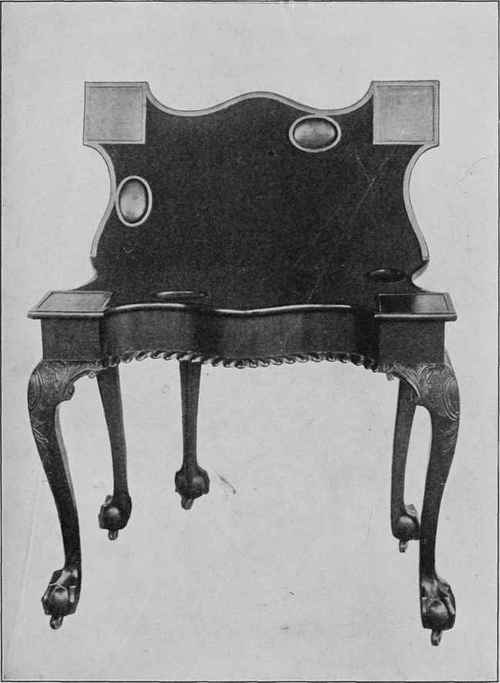
Figure 24. CHIPPENDALE CARD-TABLE.
George II. was still on the throne when Chippendale published his "Director," and in such a gambling age it is no wonder that he made many card-tables in order to please his patrons. Not alone at court were they in demand, but one has only to read such transcripts of the times as Jane Austen's or Miss Burney's novels to find that nearly every country family sat down of an evening to a quiet hand at cards. Following at a -distance, but as well as they were able, the fashions set at court, Americans too played cards, and Chippendales tables were sent across the ocean and were copied by colonial cabinet-makers, who by this time had become very successful workers themselves. Contemporary letters, which describe the propensity of the ladies to play loo all day as well as all night were, no doubt, too extravagant. On the great plantations at the South, gambling was said to be a favorite diversion, and piquet, ecarte, faro, hazard, and basset were played, as well as less exciting games. Besides the tables with plain polished surfaces, some were covered with a green cloth. Others had pockets to hold the counters, which were old silver Spanish pieces or were made of mother-of-pearl. These tables were valued highly, the early ones being walnut, the later mahogany.
In some of the inventories already quoted mention is made of various styles of playing-cards which were imported by the gross, as well as "pearl fish," which were the fashionable counters.
In Figure 24 a very beautiful Chippendale card-table is shown. It is of mahogany, richly carved on the knees, and with a heavy carved moulding. It is unusual in having five legs, one of which moves out to support the second half of the top. The feet are ball-and-claw, and within the lid is lined with cloth, has depressions for counters, and also four flat panels, one at each corner, where the candle-sticks stood. It belongs to Miss Sarah Frost, Rochester, N. Y., and has been in her family over 100 years.
Most of Chippendale's furniture presents certain characteristics that are easily mastered. First may be mentioned the ball-and-claw foot, and the cabriole leg which he adopted from the Dutch, and which he used so freely before he introduced the straight leg. Then the backs of his chairs are quite distinctive, whether the splats run up and down, or become cross-braces, or are elaborated into very ornamental ribbon-work. The top bar is generally extended on each end into what, for a better name, we will call "ears.
Continue to:


My Books

