


Chippendale. Part 6
Description
This section is from the book "The Old Furniture Book", by Hannah Hudson Moore. Also available from Amazon: The Old Furniture Book.
Chippendale. Part 6
Chippendale never used inlay on any of his pieces, preferring to produce the decoration by carving. In his very ornate carvings we have mentioned the long-billed bird, the falling-water effect, and the familiar ribbon-work which is often introduced into backs with such good effect. There are a number of patterns for carving shown in the designs in his book, and used by him over and over again, with which we have become well acquainted. Little carved bands were quite universally employed to decorate the rims of his card-tables, and in his fine chairs the front bar of the seat often had a shell or other ornament carved upon it. The very finest chairs by this maker are seldom found in America, though furniture was imported freely. In Smith's "History of New York " for the year 1756, two years after Chippendale published his work, there is the following statement:
"In the City of New York, through our intercourse with Europeans, we follow the London fashions, though by the time we adopt them they become disused in England, Our affluence during the late French war introduced a degree of luxury in tables dress, and furniture with which we were before unacquainted. But still we are not so gay a people as our neighbours at Boston, and several Southern colonies."
This is the first time possibly that the descendants of the Pilgrims have gone on record as a "gay people."
When the seats of Chippendale's pieces are stuffed, it will be noticed that the material is usually drawn over the rails, and sometimes adorned with gilt-headed nails set in a pattern or straight. See Figure 19. He says in his catalogue that he considers this the handsomer fashion; but in some cases, where the seats were covered with set work or crewel work, they were set in the wooden frame. There are two such chairs made by Chippendale and given by the fourth Duke of Marlborough in 1790 to an ancestor of the present owner. The seats of these ribbon-backed chairs were worked by the famous Sarah, Duchess of Marlborough, and are still in a fresh and blooming state of preservation. These arm-chairs are very handsomely carved, and rest on large ball-and-claw feet. The carving is not confined to the knee alone, but runs down the leg to the end of the claw. These are owned in England.
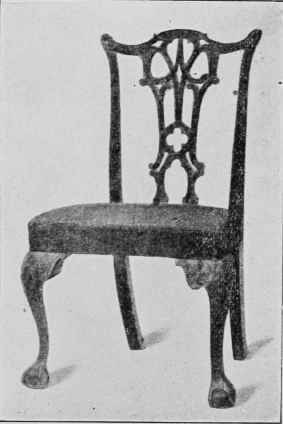
Figure 19. CHIPPENDALE CHAIRS.
That quantities of this furniture are changing hands all the time is evident from reading the records of sales which go on at all the large auction rooms in Europe. It is safe to say that fully half of it comes to America, and that it is possible to buy here choice specimens of the works of all the famous cabinet-makers. Even the well-known Battle Abbey has been despoiled, and while much of the furniture was Flemish and German, and not of particularly good quality, there were also some pieces of both Chippendale and Adam Bros., the latter being represented by several mirrors. Chippendale chairs of undoubted authenticity bring easily at these sales $200 each, while one of distinctly inferior quality sold for $335, owing to the authenticity of its history.
At a sale of furniture held within the year at Christie's, in London, a genuine surprise was furnished when a set of mahogany Chippendale chairs brought $5,225. A few weeks later two chairs, apparently out of the same set, appeared at another sale, also at Christie's and about an hour before the sale they were withdrawn. These chairs, says the catalogue, were given by a lady to the vicar and church wardens of a parish church in Lincolnshire. The lady died, and her executors held that they were lent, not given, and the sale was stopped until the rightful ownership should be established by law. But there was also in the catalogue still another chair which was said to belong to the same set, yet which was of a different wood and more boldly carved. This chair brought but a little more than $100. The removal of the two previously mentioned chairs from the sale, and the whole mystery which surrounds them, has given rise to wild rumours, and all kinds of reports are circulated which makes one very cautious about buying at auctions. In fact catalogues at auctions are little to be relied on, as one will often find pieces heavy with inlay, or of undoubted American make, boldly marked Chippendale, while Sheraton is made to shoulder the baldest imitations of his style and design.
It must always be a matter of regret that furniture-makers so rarely signed their work. If they had realized that individual specimens would bring as much as fine paintings, they would not have left their work clouded with an uncertain pedigree.
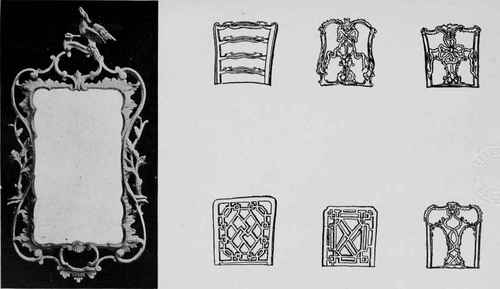
Figure 26. CHIPPENDALE CHAIR-BACKS AND MIRROR-FRAME.
Chippendale did not make sideboards. He made side or serving-tables but the sideboard was a later growth, due largely to three cabinet-makers who succeeded Chippendale, - Shearer, Hepplewhite, and Sheraton, all of whom, like Chippendale, published catalogues of their designs. The nearest approach which Chippendale made to a sideboard was a table with a shallow drawer for linen. He did not make any of those pieces of furniture with drawers and cupboards which are so often called by his name.
It may be seen that on Chippendale's title-page he refers to "frames for marble slabs." These were generally tables, - side or serving tables we should call them, - and they were elaborately carved on legs and edges. Nor were they unknown in this country, for inventories as early as the middle of the eighteenth century refer to sideboard tables with marble tops, as well as marble-topped parlor tables.
In Figure 25 is shown an unusually elegant marble-topped parlor table. The profuse carving is in Chippendale's very best style, not flamboyant, but elegant and graceful. On each of the long sides is a grotesque mask, and the legs, carved over the knees with shells and flowers in low relief, end in a ball-and-paw, the hair on the foot being most delicately carved. The wood is dark, rich mahogany; the marble top is of brown tint with light veinings. This fine piece is at Memorial Hall, Philadelphia.
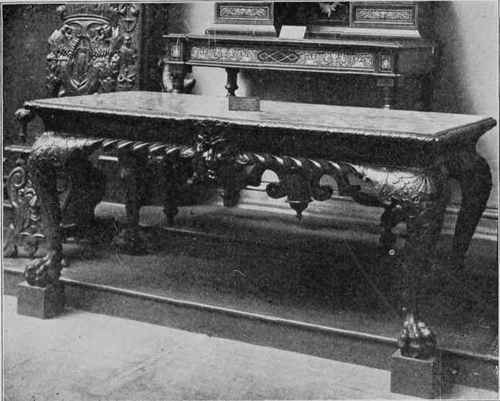
Figure 25. CHIPPENDALE MARBLE-TOPPED TABLE.
Continue to:


My Books

