


Colonial And Later Periods. Part 14
Description
This section is from the book "The Old Furniture Book", by Hannah Hudson Moore. Also available from Amazon: The Old Furniture Book.
Colonial And Later Periods. Part 14
Game and wild fowl abounded in the woods, and the rivers were full of fish. There is on record a single catch in one night of 6,000 shad and 90 salmon, six men being at work. Each householder was required to keep at least three sheep, and these, with the fields of flax, supplied bedding and clothing.
The Wayside Inn, South Sudbury, Mass., is still standing to show what a handsome and hospitable dwelling one of these old-fashioned inns was. In Figure 18, facing page, is shown the old dining-room, looking to-day pretty much as it did a century ago. On the left is a handsome lowboy with carving, and from the little alcove on the right many a steam-ing glass of flip or negus was served to cold and weary travellers. The dining-room was the centre of hospitality in the later Colonial days, as the kitchen had been in the earlier period. There was no handsomer or more hospitaple entertainer than John Hancock, of Boston. In September, 1778, he gave a dinner to Count D'Estaing, the French Admiral, and his officers and other dignitaries. There was such a large company that the spacious ball-room at the Hancock House was not large enough, so Faneuil Hall was engaged for the occasion. All contemporary accounts agree that it was a very splendid affair and went off with great eclat. The following amusing glimpse behind the scenes shows Mr. Hancock's anxiety about the provisions for this same dinner.
"Monday Noon, 30 Aug. 1778.
Dear Sir - The Phillistines are coming upon me on Wednesday next at Dinner. To be Serious, the Ambassador, etc., etc., are to dine with me on Wednesday, and I have nothing to give them, nor from the present prospect of our Market do I see that I shall be able to get anything in Town. I must beg the favr of you to Recommend to my man Harry where he can get some chickens, Ducks, Geese, Hams, Partridges, Mutton or anything that will save my reputation in a dinner, and by all means some Butter. Be so good as to help me and you will much oblige me. Is there any good Mellons or Peaches or any good fruit near you? Your advice to Harry will much oblige me. Excuse me, I am very troublesome. Can I get a good Turkey? I walked in Town to-day. I dine on board the French Frigate to-morrow, so you see how I have Recovered. God bless you. If you see anything good at Providence, do Buy it forme.
"I am Your Real Friend"
"John Hancock."
Apparently the friend came to his assistance. The appearance of* the company must have been very gay, for bright apparel was not confined to ladies alone.
Seven years later James Bowdoin, the Governor of Massachusetts (1785) on a review day at Cambridge, wore a grey wig, cocked hat, white broadcloth coat and vest, red small-clothes, and black-silk stockings.
Thomas Jefferson wore a white coat ane red breeches.
The ladies were looked out for also, and "a neat assortment of women's and children's stays, also hoops • and quilted coats, also men's and women's shoes from England " were advertised in the "New York Mercury." As early as 1761 Mr. H. Levy offered for sale Hyson tea, coffee and chocolate, and English-made shoes.
The "New York Gazette " of May 15,1789, describes a gown of the prevailing mode as follows:
"A plain but celestial blue satin gown over a white satin petticoat. Over the neck was worn a large Italian gauze handkerchief. Headdress a pouf of gauze in form of a globe, the head-piece of which was made of white satin having a double wing which was trimmed With a wreath of roses. The hair was dressed in detached curls. and a floating chignon."
At this same period in winter weather the gentlemen wore muffs of bearskin with knots of scarlet ribbon, while the hats of the ladies were so immense that it was suggested that a larger style of umbrella be invented so as to protect them.
From 1750 the decoration of the fireplace became of importance, and marble chimney-fronts, blue and white tiles, and beautifully variegated marble hearths in different colours are freely advertised. Carved and openwork mahogany mantelpieces could be had by 1765, and elegant grates and Bath Stoves are imported from England. Fire-dogs or andirons of many patterns are advertised for sale. In Figure 57, facing page - , there will be seen in the fireplace a pair representing marching soldiers.
We have seen in many inventories how the elegances of the East crept in among stouter and more practical goods. In Figure 66 are shown two fine examples of Oriental lacquer-work ornamented with gold and inlaid with mother-of-pearl flowers. The chair is lacquered on some exceedingly light and porous wood, and has a cane seat. The table, which is of a very ornate design, has a heavy base to prevent its tipping over. Both belong to the Erastus Corning Estate, and are now at at the Albany Historical Society Rooms. Music-stands were also made of lacquered wood and decorated with gilt patterns and mother-of-pearl.
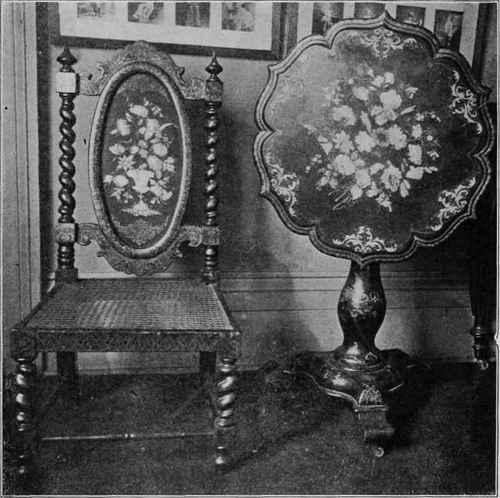
Figure 66. INLAID AND LACQUERED TABLE AND CHAIR.
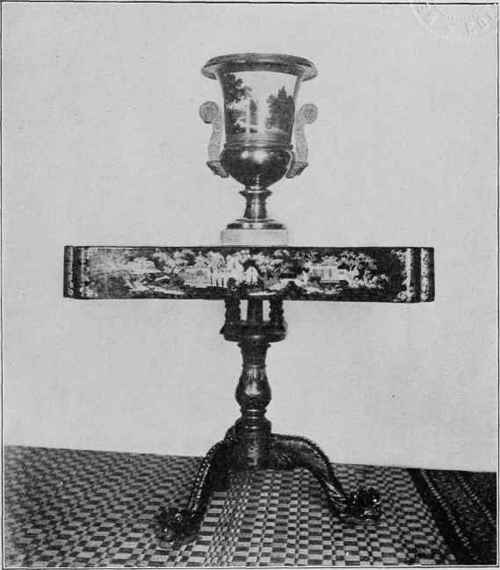
Figure 67. LACQUERED TABLE.
Another very beautiful example of lacquer-work is shown in Figure 67. This is gold lacquer on black and special attention should be given to the Oriental rendering of the pillar and claw feet of the table. The carving is very fine, the dragon's head in which each foot terminates being quite a work of art.
The vase which stands on the table is Sevres, made under Napoleon's direction as a gift to the Emperor of Russia. It never reached its destination; for Napoleon himself went to Russia, and his mission was not to give, but to take. The vase was secured in Paris by-Mr. William Bayard, and presented by him to his brother-in-law, General Stephen Van Rensselaer, the eighth patroon of Rensselaerwick.
Bureaus with flat tops, upon which stood either lacquered or wooden dressing-glasses, were in use during the latter part of the eighteenth and in the early part of the nineteenth centuries. Sometimes the glasses were attached to the bureau itself, which then had an extra set of small drawers above the larger ones, set back so as to leave a shelf in front of them. Such a piece of a very ornate character is shown in Figure 68. It is of mahogany with gilt mountings of very beautiful design on the pillars of the front. The drawer which swells out has on it a splendid Empire gilt ornament. Above this the rail across the front is painted black and has a pattern in gold upon it. The curved supports to the mirror are carved and then painted with gold, as is the mirror-frame itself. The handles are glass, with bosses of gilt, completing an unusually handsome piece of furniture. The glass handles place the date of this bureau as not earlier than 1820.
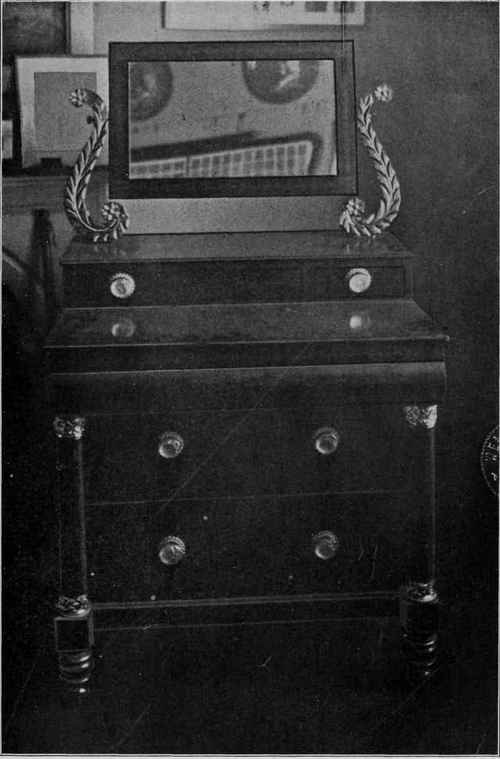
Figure 68. MAHOGANY BUREAU.
Continue to:


My Books

