


Colonial And Later Periods. Part 13
Description
This section is from the book "The Old Furniture Book", by Hannah Hudson Moore. Also available from Amazon: The Old Furniture Book.
Colonial And Later Periods. Part 13
An unusually elegant example of the French bed is the one given in Figure 63. This bed is of rosewood, with legs of splendidly carved dolphins, and on the side rails and rolling ends are very rich ormolu decorations cut from solid brass. The medallions directly over the legs show Fame blowing her trumpet, and the rams' heads terminating the head and foot boards where they rest upon the wood above the stars are solid brass also. This bed has been many years in this country, and stood in the bridal chamber or guestroom of the old Van Rensselaer Manor Plouse at Albany, N. Y. This room was situated on the ground floor to the right of the front door.
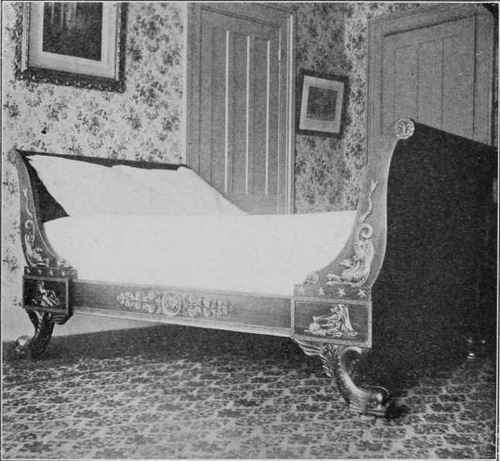
Figure 63. FRENCH BED.
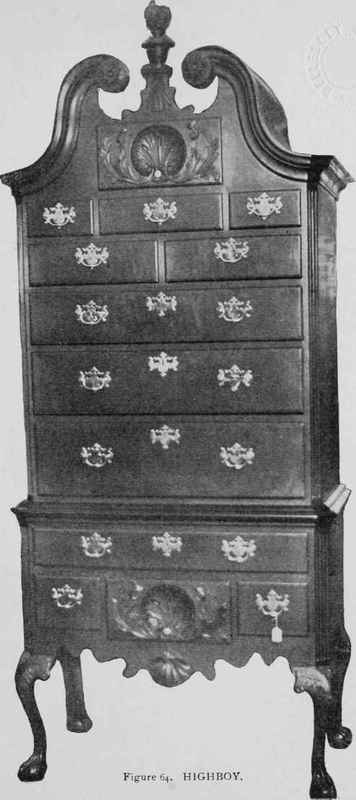
A most necessary piece of furniture which every housekeeper endeavoured to own was some form of "highboy," as it has come to be called, or a chest-on chest of drawers. Figure 64 depicts a fair example of the highest style of perfection to which these articles reached. Few are found more ornate than this. The wood is mahogany, and is richly carved on the knees, with the upper and lower drawers ornamented with shell and scrolls. The escutcheons and handles are original, and the only defect is the loss of the two ornaments which decorated either side of the top. The date of this chest of drawers is anywhere from 1750 to about 1780, the overlapping drawers making it more likely to approximate the earlier date. Belonging to about the same period is the corner cupboard shown in Figure 65. This is of cherry, with the broken arch-cornice and Gothic door. It has turned posts with rosettes which Sheraton often used, and the cupboard doors overlap and are panelled. The back of the cupboard is of pine, as are the shelves. The wood is a rich dark colour and unpolished.
Similar pieces, though not exactly in this form, are to be met with in Virginia and are doubtless of native manufacture.
American makers used not only mahogany, cedar, ash, elm, pine, maple, cherry, poplar, and walnut, but could inlay with "King, tulip, rose, purple, snake, zebra, Alexandria, panella, yew, and maple." There were cabinet-makers in every town, and many of them put out as handsome work as their contemporaries in London. In Chapter V (Colonial And Later Periods) mention has been made of the cabinet-makers of the eighteenth century, but furniture was made in the Colonies even before that. The native joiners began to work as early as 1622, for Phineas Pratt, of Weymouth, Mass., was what we now call a cabinet-maker, and before 1700 Boston had at least 25 cabinet-makers whose names appear in various records. We have also spoken of Connecticut chests, and their manufacture somewhere in that State. There is also another style known as the Hadley chest. Mr. Lockwood, in his fine work on furniture, places the date of these chests as ranging from 1690 to 1720. They come in one-, two-, and three-drawer patterns, varying in height from 32 1/2 inches in one-drawer size to 46 inches for the three-drawer style. The peculiarity of these chests is their decoration, their shape being similar to other chests of the same period. In addition to being carved they are stained as well, - red, mulberry, and black being the colours chosen.
On the central panel of the front the. initials of the.owner were usually roughly carved; the decoration of the chest, confined to the front, being a rude vine, while the sides are panelled. The top, body of drawers, and back of chest are always pine, the thrifty New England craftsman saving his hardwood for places where it would show. There is a very fine specimen of these Hadley chests in the Museum at Deerfield, Mass. Several more are in collections gathered in Massachusetts or adjoining States. The black-stained pine ornaments do not always mark a piece as of domestic manufacture, for pear-wood was used by the Dutch, and even occasionally by the English, stained black to imitate ebony, which was always more or less costly.
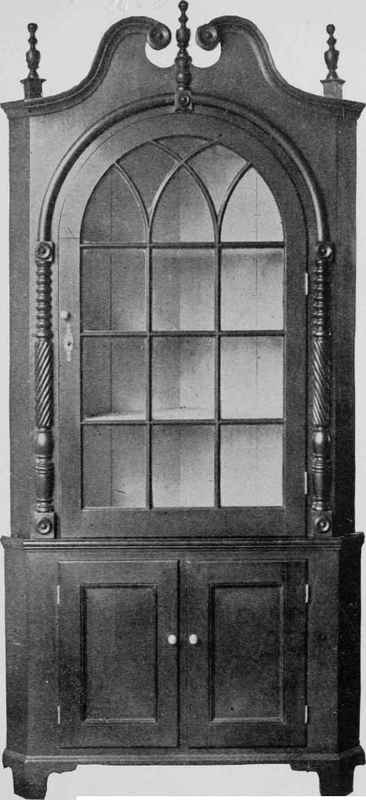
Figure 65. CORNER CUPBOARD.
After 1725 there was considerable travel by merchants, and to a small extent by others bent on pleasure. Inns became of importance, and brought in good incomes to their owners. Abel Chapin kept a tavern at Chicopee, Mass., in 1730, and some few-leaves of his account-book still remain. The records of the bar are the most numerous entries, and he sold there "Rhum & Cyder", bowls of punch and mugs of flip, and sometimes "Shugar, seed-corne, salt, and molasses." When this prosperous innkeeper died he left personal property valued at £400, and his real estate was worth £1,300. There were six hundred items mentioned in his inventory among the household furnishings, including iron, pewter, and brass ware with some china and glass. There is also special mention of "36 linen sheets, sixteen blankets, eleven woolen sheets, 6 table cloths and 21 towels." The inventory of his wardrobe shows richness for those days, and justifies his mother's statement that she had one son who was too rich. The inventory begins with; "2 Great Cotes, 1 srait Body Cote, 1 pare Iether Britches, 1 pare shues, 4 pare pumps, 1 hat, a black Velvet Vest, 1 pare Velvet Britches, 9 pare hose, 4 fine shirts, 6 common shirts, shoe Buckles."
His brother, a bachelor, died in 1747, and also had much worldly geer. He had "cotes and jackets of Camlet, serge and Broadcloth", and "some shirts, some more shirts, and some fine shirts."
There was no longer such great stress for the necessaries of life, in the Connecticut Valley at least, though there was still hardship and danger a plenty.
Continue to:


My Books

