


Colonial And Later Periods. Part 12
Description
This section is from the book "The Old Furniture Book", by Hannah Hudson Moore. Also available from Amazon: The Old Furniture Book.
Colonial And Later Periods. Part 12
The inventory does not state his business, but we trust from appearances that he kept a " public." Another list reads:
"Three cupboards of Dutch make as good as new, also three large Bibles i Dutch and 2 English."
David Harriott, of Middlesex County, was completely stripped by the enemy. Among many items were "a set of Homespun curtains wove with damask flowers, one ditto of white in large damask flowers, and one ditto of double dimons."
Napkins, quilts, bedspreads, and sheets, as well as large-flowered damask table-cloths and linen covers testify to the .industry of the women of the family. The good wife lost her long gowns and short gowns, her "shifts of 500 linen," handkerchiefs of gauze, lawn, and linen, aprons of new flowered lawn, fine linen and homespun, 3 caps of cambric and lawn, all new, and even two bibs for a child. They took all of David's clothes and his silver teaspoons and buckles, smashed his windows and doors, broke down his partitions, drove off his cattle, and did not leave him so much as "a bed, a piggin, a trammel, or a gridiron."
Jacob Hyer was another sufferer. His house must have been one of considerable size and well furnished. There are many items, among them "5 fluted brass candlesticks, 2 pr. common ditto, 1 doz. iron ditto, 10 pr. snuffers; 11 feather beds with bolsters and pillows, etc."
The enemy left him nothing, even taking his " Iron chain for Smoke Jack." Much of the furniture listed in these inventories was evidently of American make, for the woods mentioned are bilstead, gum pine, walnut, cherry, or red cedar. The last was the favorite. "Bilstead" was maple.
The beds were chiefly of three styles, field beds, high four-posters with testers and valance, and low four-posters, with an occasional "English" or "French" bed. There were beds much plainer than the carved ones we so much admire, but in any case the bed was the most valuable household possession, as it had always been. In 1640 William Southmead's house in Gloucester, Mass., is valued at £8, and his feather-bed, bedstead, and appurtenances at the same sum. In 1628 a pair of sheets was furnished to each Massachusetts Bay Colonist. Linen and flannel sheets were the ones in use. After spinning became universal and flax abundant, homespun sheets abounded, - "20 and 1 pr." is not an unusual number; and where there were several daughters whose chests had to be filled, the number was many times greater. Table linen also was of domestic manufacture.
One of the fashionable patterns of beds shown in the English books imported into the Colonies, and made by American cabinet-makers, was known as the "field bed." The one shown in Figure 61 is in the Whipple House, Ipswich, and is draped with the netting curtains, heavily dotted and fringed, which were customary in its day. Early in 1700 there was an auction sale 6f Governor Cornbury's effects in New York, and the following advertisement concerning them:
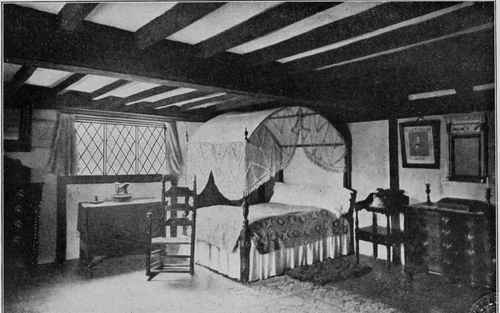
Figure 61. FIELD BED.
"A fine yellow Camblet bed lined with silk and trimmed with fine lace, which came from London. One fine field bedstead and curtains. Some blue cloth lately come from London for liveries and some broad gold lace. A very fine medecine chest with a great variety of valuable medecines. A parcel of sweetmeats and jelfy glasses. A case of 12 knives and 12 forks with silver handles. A large iron fireplace and iron bars all to be seen at the Fort.
It seemed as if the field bed had been made here, as it is specified that several of the other articles came from London. "The Journeyman's Cabinet & Chair-makers Philadelphia Book of Prices' gives in 1795 the price of a mahogany field bed, with sloped roof, at £1 7s., while one of poplar, with the roof sloped each way, cost but one pound. The carving of the posts was of course extra and was to be paid for according to time. Each inch that the bed was longer than six feet and wider than four feet was to be charged for at the rate of two pence per inch. This may be the reason why many of the beds were so narrow. It is often stated that the field bed was in use for a few years only, about the middle of the 18th Century, while in fact it was here, imported and of domestic make for fully one hundred years, and I am by no means sure that Governor Cornbury's was among the earliest.
Great attention was paid to the draping and arranging of the curtains, valances, and testers of the high four-posters. Heavy materials of silk and woollen were used, as well as cotton stuffs. Men paid great attention to the colourings of their bed furniture, as we have seen in several inventories, and Horace Walpole chose for his own bed at Strawberry Hill purple cloth lined with white satin, and bunches of feathers on the tester. Hepplewhite spent much pains on the details of his beds, and recommended that the valance be made very full, in which case it was called the " petticoat valance." There were also elaborate details for tying back the curtains and trimming them with gimp and fringe. The bed-drapings, even in early days, were often very valuable. Col. Francis Epes, of Henrico Co., Va., has in his inventory dated October 1, 1678: "One large new feather bed with camlett curtains and double vallins lind with yellow silke, bolster, pillow, counterpane, Rodds and hooks tops and stands, 1 curtaine and some Fringe damnified £24 ssod."
The low-post bed was also a very handsome piece of furniture, and in many cases the post was surmounted by a pineapple, like the example shown in Figure 62. This bed has passed through a career of violent contrasts, and it is only within a year that the four posts were rescued from a barn, where they afforded convenient roosts for poultry. The side and head and foot boards had passed entirely out of sight, no doubt in some moment of stress they had fed the family cooking-stove. The missing parts have been restored in solid mahogany, and it makes a very handsome piece of furniture. It belongs to Mr. William M. Hoyt, of Rochester, N. Y. The acanthus leaves on the lower parts of the legs are unusually handsome. The posts are 63 inches high, and the brass drops which conceal the screw-holes have been restored from a bed of the same period.

Figure 62. LOW FOUR-POST BED.
Continue to:


My Books

