


Colonial And Later Periods. Part 11
Description
This section is from the book "The Old Furniture Book", by Hannah Hudson Moore. Also available from Amazon: The Old Furniture Book.
Colonial And Later Periods. Part 11
William Melbourn advertises also, in 1774, over a hundred items, among them are the following, showing that "small wares" were easily to be obtained:
"White and green ivory table and desert knives and forks. Ditto with silver caps and ferrils. Ditto black ebony with caps and ferrils. Also Black horn, camwood, centre-bone split buck, sham stag table knives and forks. Carving and oyster knives. Neat mahogany and fish skin knife boxes. Mahogany and fish skin razor cases. Plated coffee pots and spoons. Mahogany tea chests. Merry Andrew, Harry, and Mogul's playing cards, Pearl and ivory fish and counters, Mustard and Marrow spoons."
In Memorial Hall, Philadelphia, is a set of table knives with green ivory handles, like those advertised in the first item, and looking at the end of the blades we can no longer doubt that the use of two-pronged forks was supplemented by a dexterous manipulation of the knife-blades. Writing-desks or scrutoirs, or desks and bookcases, or even desks fitted into the drawers of a bureau, had become pieces of furniture that were found in every well-to-do home.
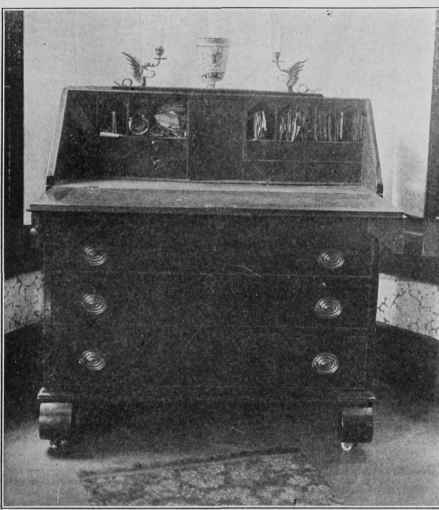

Figure 59. MAHOGANY DESK AND CHEST OF DRAWERS.
In Figure 59 is shown one of the early styles of make, about the middle of the eighteenth century. This particular desk was brought from England, is of mahogany, and is in good condition except that the front feet have been restored. It still has the original brasses and the overlapping drawers. It has several secret drawers where during the Revolution the private documents of the owner were concealed. During the Civil War its secret drawers were again in use, and effectually concealed papers of value. It has never passed out of the possession of the family whose ancestors brought it over, and it belongs to Miss Hite, of Waynesboro, Va. The two-drawer chest beside it is of a much earlier period. The mouldings make the chest part resemble two drawers, but the top opens as is usual. The handles on the desk are of the shape used so much by Hepplewhite on his bureaus and sideboards, while those on the chest are an earlier form of the well-known willow pattern of brasses and are fastened in by wires. The earliest patterns of handles were the knob and drop, which were used on furniture before 1700. These were succeeded by others which were fastened in by wire, and these again were replaced by handles which were affixed with nut and screw.
On page 224 are shown the different styles of handles, and their approximate dates. The chest is of mahogany, with bracket foot. This is a most unusual and interesting piece.
At the time of the Revolution there was comfort generally in most of the large cities at least. In 1776 there were sent to Cold Spring, for the use of the army, the following:
"2 Mah'y tables, 6 Rush Bottom chairs, 4 Mah'y Rush Bottoms, and 2 small bedsteads, a kitchen table, a new case of bottles, a Coffee Mill, Brass Scales and Waights, 2 Kitchen Tramels, 2 pickel Tubs and 2 Wash Tubs, an Iron hooped Pail and a soap barrel mostly full of soap and the Ticke of a Stra bed. Value £ 20."
The works at Cold Spring were destroyed, and the goods were never used, but the Government's strongbox paid for them.
Cornelis Van Santvoordt, who lived at Esopus, near Kingston, N. Y., when it was burned by the British October 16, 1777, put in a claim for damages for £54 17s 3d. The items which made up this account cover a large variety of goods, as may be seen from the following list:
£ | s. | d- | |
"I Fether bed Holl'd Tick, 1 Boulster, 1 Pillow, 1 Coverlin to | |||
bed ...... | 14 | 0 | 0 |
1 Bedsted 20S.-1 Green Rug 55s. | 3 | 15 | 0 |
2 large Rose Blanckets .... | 1 | 8 | 0 |
1 large lookinglass . | 6 | 0 | 0 |
2 chaina Teapots .... | 16 | 0 | |
8 Burnt China Chocolate Cups , . , | 10 | 0 | |
1/2 Doz Teacups and Saucers . . . | 14 | 0 | |
4 tea plates .... | 4 | 0 | |
2 large Cream Couler sauce cups. | 4 | 0 | |
1/2 doz blew chaina plates .... | 6 | 0 | |
1/2 " cream couler " . • | 2 | 6 | |
1 dining-table black cherry wood... | 1 | 4 | 0 |
1 Teble larg .... | 1 | 0 | 0 |
1 large Copper Kittle • • • • | 3 | 13 | 9 |
£ | s. | d. | |
I Brass Kittle ..... | 1 | 12 | o |
6 Flat back chairs ..... | 1 | 16 | o |
1 Holland cubberd neatly adorned with Waxwork | 10 | o | o |
I Barrel soap ..... | I | 12 | o |
3 Wine Canters ..... | 6 | o | |
4 " glasses ..... | 6 | o | |
1 chest wt. Clothing and linen...... | I | IO | o |
1 " " Sundry books & 1 large Dutch Bible. | 3 | o | o |
I large Kibbe, 1 Sermon book some of the others Divinity & some History . | 1 | 12 | o |
I New Spinning Weale .... | 1 | 12 | o |
12 pictures w't Glass over . . . | 18 | o | |
1 larg Knot Bowl Cost . • • | I | 4 | |
2 ,, ,, ,, | 2 | o | |
2 beds with Straw • • • • | 2 | IO | |
2 fine worked Baskets , • • . | l6 | o | |
1 Tapend Water Crane • • • • | 6 | o | |
54 | 17 | 3 |
This inventory is somewhat unusual from the number of "Chaina" articles enumerated, and among all the items there are but six chairs and not a stool. This claim, with many others, is recorded in the "New York Records of the Revolution," and it was paid out of the "strong-box." This box was not a mythical object at all, but a veritable chest. Gerard Bancker was State Treasurer for twenty years. During the Revolution the iron chest moved about from one place to another like the Continental Congress, and the Treasurer went with it. According to a custom of the times Mr. Bancker took the chest with him when he retired from office. His family kept it for a hundred years, but with many other relics it was sold in Philadelphia, in 1898, by one of his descendants.
There were various patterns of combinations of desks and bookcases, and of desks and bureaus. There were the high, wide ones of Chippendale or Sheraton, that would almost fill one side of a room. There were small ones with desk below and shelves above, and occasionally there were such great ones as that shown in Figure 60. This piece of furniture is so tall and massive that it could not have been accommodated in any save a large house. It is over eight feet tall and five feet three inches wide. It is of a light mahogany, with pillars of Empire style and very handsome brasses. The lid of the desk folds back on itself and below it is a drawer and cupboard. The handsomest things about the bookcase are the glass doors with Gothic tracery. The date of this piece is about the first decade of the nineteenth century. The four legs on the front are of unusual elegance. It belongs to the Historical Society at Albany.
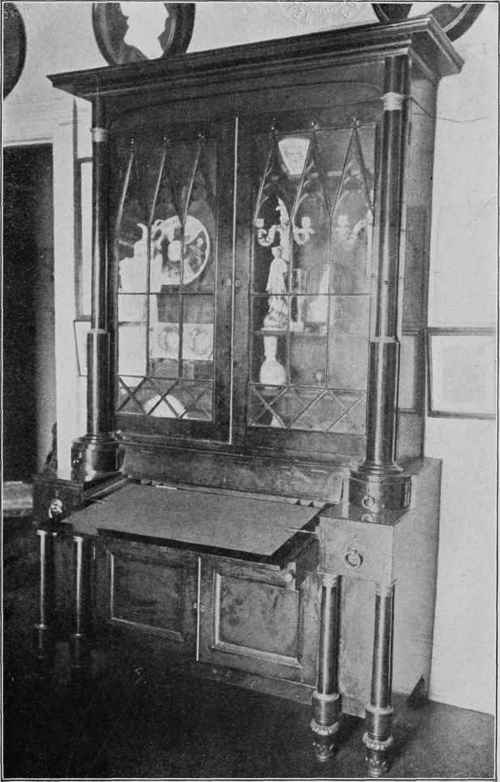
Figure 60. COMBINED BOOK CASE AND DESK.
Quite as interesting as the inventories of property left by will are some old records in the State Library, New Jersey, called a "Record of the Damages done by the British and their adherents to the Inhabitants of Middlesex Co., New Jersey." This contains the inventories made by six hundred and fifty persons who suffered from the depredations of the plundering Hessians and the English soldiery. The lists extend over the years from 1776 to 1782 inclusive, but the worst mischief was done in the time from December, 1776, to June, 1777. There were eighteen hundred horses taken, and these form a single item. That the settlers were good livers the following inventory of one patriot shows. He lost "4 hogsheads of cider, 1/2 pipe of madeira, 10 gallons brandy, 7 gallons Jamica brandy, 1/2 barrel cherry Rum, barrel Porter."
Continue to:


My Books

