


Musical Instruments. Part 6
Description
This section is from the book "The Old Furniture Book", by Hannah Hudson Moore. Also available from Amazon: The Old Furniture Book.
Musical Instruments. Part 6
Madame Malibran, who achieved such a success in opera in New York about 1825, used to accompany herself on the harp when she sang in response to an encore. But it can never be considered a popular instrument.
In Dwight's "History of Music in Boston", he says that at the beginning of the nineteenth century the population of Boston numbered about six thousand families, and that not fifty pianos could be found. Only a few of Boston's churches had organs, while those in country parishes were, almost without exception, without them. The use of instruments had crept slowly into the choir, and if they had a flute and a bass viol they considered they did well. Very often a clarinet usurped the place of the flute. The bass viol was, however, the most popular instrument, and when, some years later, concerts began to be given, and musical societies formed, the bass viol was lugged about, notwithstanding its ponderous size, and duly performed its part in the accompaniment.

Figure 89. BASS VIOL.
The bass viol shown in Figure 89 is an interesting one. It was made by Deacon Justin Hitchcock, and used by him in the choir of the Congregational Church, Deerfield, Mass., in 1778. Both it and the pitch-pipe used by him as leader of the choir are now resting silent in Memorial Hall. Deacon Justin did not confine his musical performances to psalmody and the accompanying of hymns. Like all the Deerfield men of that day he was a fighter, as who should not be who was brought up among those silent hills which had seen so much of "ye barbarous enemy" and knew the tales of French invasion? The stories of warfare and captivity were still fresh in the minds of the people of Deerfield when Deacon Justin responded to the Lexington alarm. His fife it was that inspired the weary Deerfield minute-men to press on to Boston to meet the British. Nor was this the only campaign in which he played a part, for he never wearied of displaying the trophies captured after the disastrous experience of Burgoyne, when, harrassed and in flight, he abandoned his baggage.
A very similar bass-viol, but of German manufacture, was played during the latter part of the eighteenth century in a church in Stonington, Connecticut. The sisters of the Hospital General in Montreal, before the conquest of Canada, imported several of these instruments from France for use in the convent choir. So they must have been played upon by women sometimes.
An instrument that is interesting rather than handsome is the glass harmonica shown in Figure 90. It has thirty-five bowls or glasses arranged on a central rod. Some of the glasses are now missing, but originally it had a compass of three octaves. The case is three feet nine and a half inches long, and one foot four and three quarters inches wide. The interest in this class of instruments arises from the fact that it was invented by Benjamin Franklin. It has about as much capacity for produciug music as the "musical glasses ". One of these latter instruments consists of twenty-four glasses closely resembling finger-bowls and standing in a wooden table-like case. They are partially filled with water, and the performer produces notes by rubbing on the rim with the finger. They were occasionally to be met with, and date about the first decade, possibly a little later, of the nineteenth century. There is one in a perfect condition in Rochester, N. Y. The case is of handsome mahogany, and the instrument belongs to Mrs. James McKown.
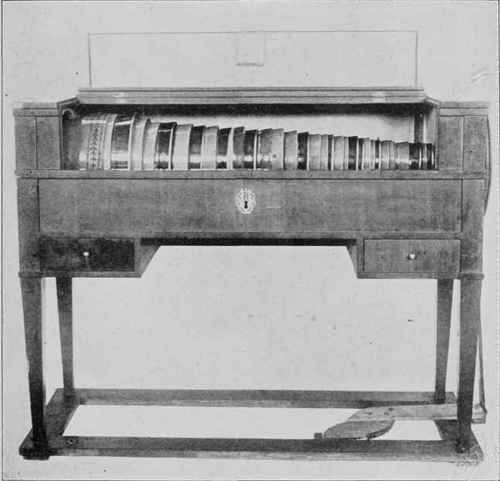
Figure 90. GLASS HARMONICA.
Up to 1760 pianos were made in the wing shape, like the harpsichords, but at that date a man named Zumpe made a square one. By 1800 there were a number of makers in New York, and they turned out many very handsome instruments. Astor, Broadwood, and Clementi were three great makers in London, and sent many pianos over here. There is a slender-legged, fragile, Clementi piano in Memorial Hall, Deerfield, which was given by a father to his daughter. The story still clings to it that he sold a house in order to buy it for her.
John Geib, and his sons, John H., Adam, and William, were among the best-known early makers of pianofortes. They opened a shop in Maiden Lane as early as 1807, and advertised not only pianos of their own manufacture, built on a new plan, but those of London makers as well. They held this shop in Maiden Lane, with a brief interruption of one year, till 1828, when W. Geib moved up to the corner of nth Street and Third Avenue. It was from this establishment that he sold the handsome piano shown in Figure 91, which is now at the Historical Rooms, Albany. The name-plate over the keyboard has the following inscription.
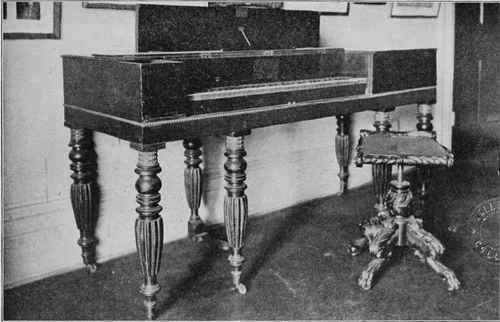
Figure 91. GEIB PIANO.
"W. Geib, Third Avenue, Corner iith St. New York. Manufacturer of Cabinet, Grand, Harmonic, and Square Piano Fortes, Church and Chamber Organs."
This piano is mahogany inlaid, and has a handsome brass moulding and brass ornamental bands at the tops of the legs. It has six legs and a pedal, and the top of the lid has a small rest for the music. The stool, very richly carved with pillar and claw feet, belongs to an earlier period than the piano, this shape dating from about 1810-20.
Indeed, from its ornamentation, the stool would seem to go more fittingly with the very elegant piano shown in Figure 92. This is of rosewood, and was made by Robert and William Nuns, and sold by Du Bois and Stodard, New York. It was probably made about 1823-25, for in pattern of carving, moulding, drawers for music, etc., it is very similar to the pianos made at this time by the Geib Brothers. At the top of each leg is a richly engraved band of brass, and rosette, to conceal the place where the pin held the leg to the instrument. The drawer knobs were doubtless brass also, for these are not the original ones. The panel above the keyboard is beautifully painted in metallic lustre, and has two carved panels besides, over velvet. The legs are boldly carved with the acanthus leaf, and everything about the piano is as elegant as possible. By the time these last two instruments were made music had taken a decided advance. Musical societies were organized in all the large cities; there were the Handel and Haydn Society; the New York Philarmonic Society; the New York Choral Society; Beethoven Society of Portland, Maine; Philadelphia Musical Fund; Harmonic Society of Baltimore, and equally flourishing musical organizations in several cities of the South, notably New Orleans and Charleston.
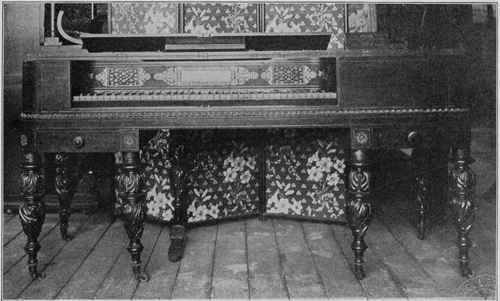
Figure 92. NUNS PIANO.
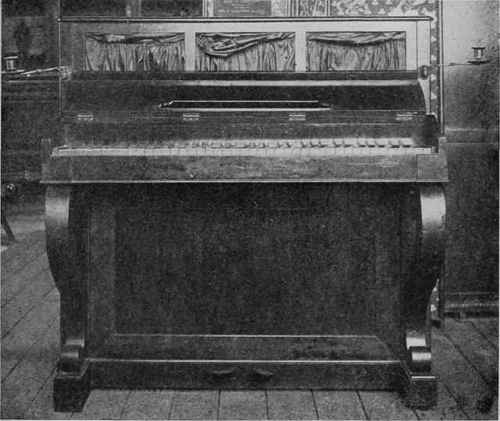
Figure 93. UPRIGHT PIANO.
Music-dealers all over the country advertised their wares; there were instruction-books and sheet music to be had: "Overtures, battles, sonatas, duets for four hands, airs with variations, rondos, songs, glees, catches, sacred songs, original Scotch airs, little ballads, marches, waltzes, dances, and Mozart's songs."
In view of the selection of good music that could be obtained, it is amusing to know how popular were such ditties as " Mary's Tears," "Apollo, thy Treasure," and "Sweet Little Ann," written by Shaw, the blind singer of Providence. They seem hardly an advance upon " Bid Me, When Forty Winters," " Little Sally's Wooden Ware," and the "Comic Irish song ' Boston News' which were used as concert selections a quarter of a century earlier.
In Figure 93 is shown an upright piano made by Julius Fiot, Philadelphia, in 1827. The heavy veneered Empire curved posts are noticeable, and an extra old-fashioned appearance is given to it by the movable candle-brackets fastened to either side. In the upper part were little silk curtains to cover the mechanism, and their arrangement does not seem to have been particularly neat. This was a very early example of the upright shape, and is now in Memorial Hall, Philadelphia.
Continue to:


My Books

