


A Workshop
Description
This section is from the book "Woodworking For Beginners: A Manual for Amateurs", by Charles G. Wheeler. Also available from Amazon: Woodworking For Beginners.
A Workshop
A small building, like that shown in Fig. 386, from 8' to 12' wide by 12' to 18' long, will be suitable for a workshop or for various other purposes.
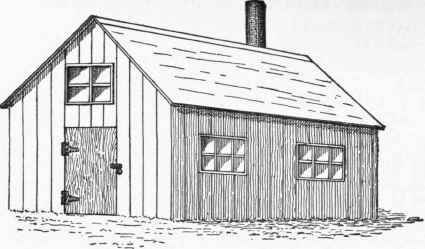
Fig. 386.
While it will do for a little play-house without a floor, like those described at first, to rest directly upon the ground, a better structure like this should have some sort of underpinning.
It is not customary to lay a stone or brick and cement foundation for such a structure as this, because the building is not usually worth it. It can very well be rested upon stones at the corners and middle of the sides or upon posts set in the ground. If the soil is sandy and large stones abundant, it can be rested upon piers of stones. So far as supporting the building for one season is concerned, simply resting it upon stones laid on top of the ground is sufficient, but the action of the frost will move the stones and heave the building more or less out of place, which will require it to be occasionally levelled and blocked up. A hole can be dug to a depth of about three feet, so as to be below the action of the frost, and a pier of flat stones built up. If the soil is of clear, well-packed sand, a pier of this sort will last for some time before being thrown out of shape by the frost, although, of course, if laid in cement (or if bricks laid in cement are used), it will be much more permanent. If the soil is clayey, the foundation, of whatever kind, should be carried to a depth of three feet or more and cemented, and even then it will be liable to be heaved by the action of the frost. This involves considerable labour and perhaps expense, and for such a small building it will usually be better to rest it upon fiat stones laid on the surface, or to block it up in some way so as to be clear of the ground, and then level it whenever necessary, which is not difficult with so small a structure.1
While brick piers built upon a foundation of stone laid in cement and carried to a depth of three feet or more is doubtless the best underpinning you can have (next to a regular foundation wall), it is not always advisable to incur the necessary expense and labour, and a common and usually satisfactory way for a building of this sort is to rest it upon posts set in the ground. But before placing the posts the exact position of the building must be determined.
Having fixed upon the position of the building, proceed to
'If you have only small stones or blocks upon which to rest it, the building can be put together directly upon the ground, the sills being rested temporarily upon any material at hand, and then the supports adjusted underneath.
Stake it out. First measure off with the tape, or rod, or even a string, the length of one of the sides of the building, and drive a stake at each end of the line. Stretch a line between these stakes and measure off the length of the end of the building from each stake, as nearly as possible at right angles with the first line. You can do this approximately with the help of a "mason's square," or large triangle, which you can make yourself of thin strips of wood nailed together in the form of a right-angled triangle with sides 6', 8', and 10' long, or the sides can be 3', 4', and 5' long.1 Whatever method you use, be sure that the figure is rectangular, and move one or two of the stakes, if necessary, until the diagonals are of equal length.
If the ground is uneven, keep the tape horizontal when measuring, and to determine the points required drop a plumb-line from the end of the tape which is raised from the ground.
1 You can mark a point on one string 3' from one stake and a point on the other string 4' from the same stake, and then increase or decrease the angle made by the two strings until another string exactly 5' long will just reach from the marked point on one string to that on the other. This process is based on the principle of mathematics that if the two sides of a right-angled triangle are respectively 3 units and 4 units in length, the length of the hypothenuse will be 5 units. Another way, if you are fond of mathematics, is to find the length of the diagonals of the plan of the house by extracting the square root of the sum of the squares of the two sides. (The square described on the hypothenuse of a right-angled triangle is equal to the sum of the squares described on the other two sides.) You can measure the diagonal directly from a plan if you understand mechanical drawing well enough to make an accurate plan on a scale of perhaps 1/2" or 1" to a foot. Then take one tape, or string, measuring the width of the building, with one end held on the stake C (Fig. 387), and another tape measuring the length of the diagonal, with the end held on the stake D. Drive the stake A at the point where the two tapes meet when brought together. Reversing the positions of the tapes will give in the same way the fourth corner B. The distance A B should equal C D,
Having in this way accurately fixed upon the lines for the four sides of the house, continue these lines a few feet (perhaps 4 or 5 feet) beyond the corners to the points marked E (Fig. 388), and drive a stake at each of these points. You can easily get these eight stakes in line by sighting from the four first driven. Next drive in one of these outside stakes (the one where the ground is the highest in case the surface is uneven) until it sticks out of the ground a few inches, and then drive the other seven until their tops are level with the top of the first. This you can determine by applying the level to a line stretched taut from the top of one post to the top of another. Drive a nail into the top of each stake to hold the string, or cut a notch for the same purpose. Now if strings are tightly stretched between these stakes, they will intersect over the four stakes first driven at the corners of the house. These four stakes you can now remove when you dig the holes for the posts, and the exact position of each post and its height above the surface will be determined by the intersection of the strings from the outside stakes. The strings can be taken off while you are digging and replaced when you are getting the posts in position.
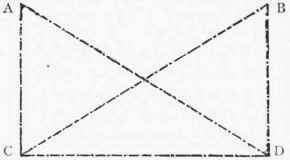
Fig. 387.
Next dig a hole at one corner, about 18' in diameter and about 2 1/2' or 3' in depth. In this hole set a post about 6" in diameter, sawed off squarely at the upper end, and of such a length that when pounded down to a firm and upright bearing the top of it will reach the string stretched between the levelling stakes. When you fill up the hole put in only a little earth at a time, " tamping " each layer compactly around the post with an iron bar or stick before adding more earth. Contrary to what one might naturally think, the earth can be tamped more compactly with a bar or stick than with a heavy joist.
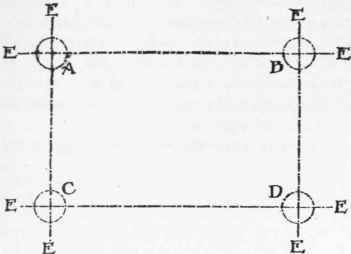
Fig. 388.
Continue to:


My Books

