


Play-House Or Cabin
Description
This section is from the book "Woodworking For Beginners: A Manual for Amateurs", by Charles G. Wheeler. Also available from Amazon: Woodworking For Beginners.
Play-House Or Cabin
The house shown in Fig. 372 can be put together in the way already shown.
Before beginning work read carefully Marking, Rule, Square, Satv, Plane, Nailing, Screws, Painting, in Part V., and look up any other references.
The ground dimensions can be 5' or 6' x 7' or 8'. The ends must be made higher than the sides, as shown, to allow for the slant of the roof. Mark lines, using a straight-edge, to give the slant for both sides of the roof, and saw the boards off by these lines. A short cleat can be added at the top in the middle to stiffen these top boards.
After the sides and ends are put together, get out two boards, of the shape shown in Fig. 373, to rest in four rectangular notches cut in the front and back sides of the house. These pieces are to support the roof-boards, and their upper edges are to be cut at the same angle as the top of either end of the house. Nail these pieces firmly in place at each end (Fig. 374).
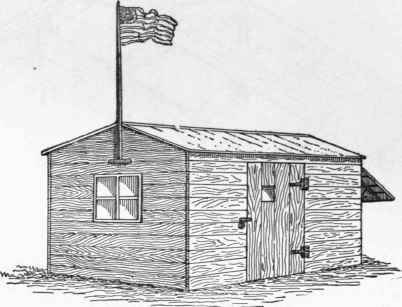
Fig. 372.
Now get out boards for the roof, to run from end to end and about 4" longer than the house. Begin to nail them on at the top, and have the roof overhang the sides and ends 2" all around.
You can easily put in the window-sash, either by hinging it so as to swing open, or by having it slide to the right or left on strips nailed above and below it, as shown in Fig. 369.
The roof-boards can also be laid the other way by putting in a ridge-piece in the form of a piece of studding or joist of any size not less than 2" x 2" (Fig. 377), or even a board on edge, to which the upper ends of the roof-boards can be nailed.
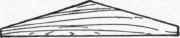
Fig. 373.

Fig. 374.
Another form of roof, but arranged in the same way, is shown in Fig. 375.
You will require a compass-saw for the curves, or you can have them sawed by a band-saw, or the wood can be trimmed to the line with the hatchet and draw-knife or chisel (see Paring).
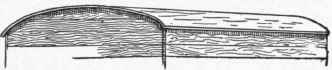
Fig. 375.
Another way to put any such little structure as this together is to have the sheathing run up and down and the cleats horizontally. This makes a neater structure than the way just given. The general principle of the construction is the same, the four sides being made separately and then fastened together.
Continue to:


My Books

