


Farm Gate
Description
This section is from the book "Shop Projects Based On Community Problems", by Myron G. Burton. Also available from Amazon: Shop Projects Based on Community Problems.
Farm Gate

Materials
Yellow Pine (Chap. III., Par. 48).
7 pcs. 7/8"x4"xl2' S 2 S 5 dozen 8d common nails.
2 pcs. 7/8"x4 1/2"xl2' S 2 S 6 pcs. 7/8"x4"x 5' S 2 S
28-1/4"x2 3/4" carriage bolts, with washers and nuts.
Introductory Statement
In visiting farms throughout the country it is not uncommon to find the large gates in bad repair. Many a farmer has been dragging or carrying a gate open and shut for several years when a few minutes' work would so repair the gate as to cause it to swing freely on its hinges.
The purpose of this lesson is to show how a large gate can be constructed so as to have the greatest strength and the longest endurance. The size of the gate is determined by the opening for which it is intended, but the principle of the construction, such as the bracing and bolting, should not be neglected.
References:
U. S. Bulletin No. 126, Practical Suggestions for Farm Buildings. Concrete Fence Posts. Atlas Portland Cement Co., Chicago. Concrete for the Farmer. Universal Portland Cement Co., Chicago. Studies in Concrete, in Soils and Fertilizers, Quear, Muncie, Ind. Ideas for the Handy Farmer. Scientific Am., May 29, 1909. Stables and Outbuildings. Country Life in America, April, 1906. Gates, Fences and Bridges. Orange-Judd Co., New York. Farm Conveniences. Orange-Judd Co., New York. 7-Voc.
Farm Gate
Suggestions For Original Design

For Extra Wipe Gate.
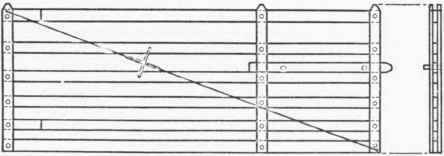
Wired To Prevent Sagging
Farm Gate Specifications
In making a farm gate it is not customary to use absolutely first-class and clear material. Sound material, although it may have some knots, is very satisfactory. It is not good economy to use strictly clear selected stock for a gate.
The Slats
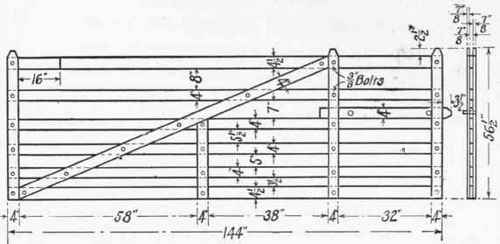
On the drawing, it will be noticed that the bottom and top slats are 4 1/2" wide, while all the others are only 4" wide. These slats are a little wider than the others in order to give greater strength to the strip which must withstand the most strain.
Plane the edges of all the slats perfectly straight and square (Chapter II., Paragraph 4); cut the slats the proper length.
The Uprights
Cut the six upright pieces exactly the same length; plane their edges; shape their tops.
Assembling
If you do not have a long pair of saw horses on which to build your gate, you may lay the material flat on the floor very satisfactorily. On the upright pieces, lay out the spacing of the strips. Although this work is to be assembled with bolts, you will find it convenient to assemble it by driving one nail through the upright into each slat. The nails must not be driven near the centers where the bolts are to be, or they will interfere with the boring. When all of the slats and the uprights have been properly assembled, make sure the gate is perfectly square; test in several places with the long steel square; measure the length and cut the braces. These braces should be made to fit very accurately.
Note: They are to be bolted through each slat. Sometimes braces are housed; that is, notches or footings, as they are sometimes called, are cut in the uprights to receive the ends of the braces.
If you care to make your gate for some particular opening at home, measure the opening, and change the dimensions of this drawing to suit your need.
Continue to:


My Books

