


Gained Or Housed Joint
Description
This section is from the book "Shop Projects Based On Community Problems", by Myron G. Burton. Also available from Amazon: Shop Projects Based on Community Problems.
Gained Or Housed Joint
Paragraph 61. The gained or housed joint is very similar to the plain butt joint except that in one piece of material (B) a gain, or dado, is cut the full size of the end of the other piece (A), This makes it possible for the end of the one piece to enter the gain and be supported on each side. This joint is usually assembled with nails or screws. It has an advantage over the plain butt joint in that it affords strength against downward pressure, for it does not depend entirely upon the nails or screws for its support.
This joint is used frequently in installing partitions in trays and boxes. It is used in various kinds of shelf construction, in building permanent shelving in store buildings, and in installing shelves in cabinet work, such as bookcases or china cabinets. To lay out this joint cut the end of the piece of material A perfectly square. With the try-square square a line across the face of the material B. Square another line across the face of the material B sufficiently distant from the first line to provide room for the thickness of material A. On each edge of material B gauge the depth of the gain, with a lead pencil and finger. If a marking gauge is used, do not gauge farther than is necessary and thus mar the edge of material B. With a try-square square the two lines on the edges to the gauge line. With a back saw saw on the two lines which are on the face of the material to the gauge line (it is well to saw on the inside of the mark so as to make sure the material A will fill the gain tightly). With a keen-edged chisel cut out the portion between the sawed lines, test with the edge of the try-square to make sure that the bottom of the gain is perfectly level. Assemble by bringing the end of the material A into the open gain, and nail through from the outside of the material B.
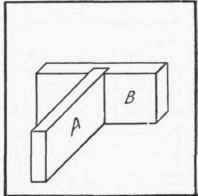
Figure 46.
Continue to:


My Books

