


26. Trusses
Description
This section is from the book "Constructive Carpentry", by Charles A. King. Also available from Amazon: .
26. Trusses
Trusses. It is not within the province of this book to discuss the stresses which a truss is called upon to resist, or to enter upon the engineering problems which are necessary to be solved in order properly to design a truss; we will, however, endeavor to say something of the different forms of trusses with which the carpenter has to deal in the ordinary course of his work, and the details of their construction.

Fig. 36. - Girder stiffened by Rods.
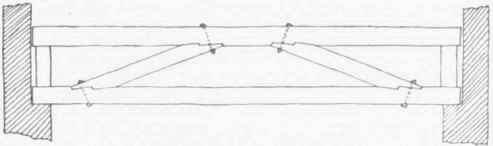
Fig. 37. - Built Trussed Girder.
(A.) A trussed girder, or belly rod truss (Tig. 35), is an efficient method of strengthening beams and girders. Fitting the rod in the depth of the beam, as in Fig. 36, does not add a great deal to its strength, because if loaded to its limit, the beam will generally fail on the upper edge first, the fibers crushing by compression, before the bottom fibers break under the tensile strain.
(B.) A satisfactory form of trussed girder is shown in Fig. 37, which may be used in places where it is desirable that as little vertical space be occupied as possible.
(C.) A flitch plate girder (Fig. 38) is sometimes used where it is desirable that the girder shall be contained in the thickness of the floor. This consists of iron plates bolted between floor joists. An iron I beam when available is used generally for this purpose.

Fig. 38. - Flitch Plate Girder.
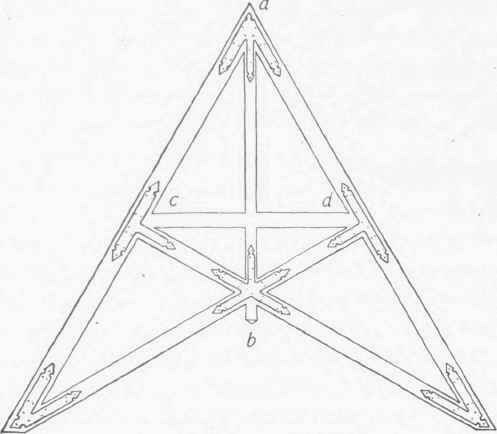
Fig. 39. - Scissors Truss.
(D.) The scissors truss (Fig. 39) is used a great deal in the construction of churches and other buildings where it is necessary to obtain all the height possible at the center. The kingpost (ab) and the tie beam (cd) should be very carefully planned, as these members are depended upon to hold the truss in shape, and to prevent the building from spreading at the eaves. This truss may be built of small timbers; if the maximum of strength is desired, an iron plate should be made to extend for a sufficient distance at each side of all the joints and should be securely bolted in place there.
(E.) The Howe truss (Fig. 40) is the form generally used in constructing the roofs of large buildings where there is no middle support, as a truss of this type may be made to support a roof of any pitch.

Fig. 40. - Howe Truss.
It is in accordance with the best modern practice to build important trusses of steel, as they may be made lighter in appearance and weight. The strength of a steel truss may be estimated more accurately than that of one built of wood, and but slight variation is caused by shrinking.
The above forms of trusses are capable of variation in design, but the simple trusses built by the carpenter are usually based upon one of these. Unless the builder has the training to design an economical and efficient truss, he should not attempt to design one by guesswork, but should engage the services of an engineer.
Continue to:


My Books

