


25. Porch Construction
Description
This section is from the book "Constructive Carpentry", by Charles A. King. Also available from Amazon: .
25. Porch Construction
Porch Construction. The floor joists of a porch should run parallel with the house (see Fig. 33), as the floor boards should be laid square with the front, and should pitch 1" in 5' in order to allow water to run off easily.
Porch floor boards should be not over 4" wide, and should be laid open about 1/8" to assist in ventilating underneath the porch. This is not always done. Laying a porch floor in this way has its disadvantages and, if the porch is well ventilated otherwise, it will be unnecessary. A tight-jointed porch floor should be laid of well-seasoned matched boards, and the joints well leaded before laying.
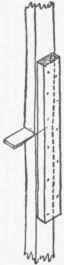
Fig. 32. - Straightening a Crooked Stud.
It is a good plan to leave the porch open underneath, but if it is to be boxed up, lattice work should be used or open-jointed boards laid in order to allow a free circulation of air, the most effective preventive of decay.
In general the porch floor should be one step lower than the floor of the house, especially in northern climates, as it will, to a great extent, prevent snow from driving under the door, or piling up against it. This also gives more height to the porch, or more pitch to the roof, which is apt to have less pitch than it requires, its rise being limited by the second story windows.
The foundation of a porch is liable to be neglected, as it is generally a light structure; but a careful builder will see that it is well supported below the frost line.

Fig. 33. - Porch Construction.
The porch roof and floor should be fastened to the building by some method similar to that illustrated in Fig. 33.
The height of a porch ceiling ordinarily should not be less than 8'. If it is too low, the roof excludes light from the house; if too high at the eaves, the roof may have insufficient pitch to allow the water to run off freely.
The required details of the cornice and frieze of a porch govern the construction above the columns and at the eaves, but the illustration indicates a common method of constructing a box-finished porch roof.
A metal roof should be used if the pitch is less than 5" to a run of 12'. If a flat metal roof is to be walked upon, it should be protected by a movable wooden floor.
As the porch usually is the entrance to a house, and a prominent feature, it is more or less embellished. There are many different designs for the details, but where straight rails are used, the work is practically the same. There should always be a wash pitched about 1" in 7" upon the top and bottom rails. The top of the top rail may be about 30" from the floor, but it often is not more than 26". The bottom rails should be placed about 3" above the porch floor, so that water may run under them easily, and sufficient room be left for sweeping.
If a ramped rail is used (see Fig. 34), the joint between a and b should be made very strong; rail bolts (c) and dowels (d) should be used to insure rigidity. The ramp (a) is made usually of one piece, worked by machine to the same molding as the rail. The holes (J) should be plugged up after the rail is together. All joints should be fitted carefully, and well doped with white lead.
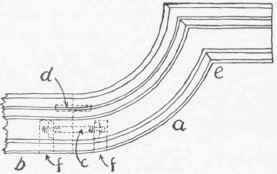
Fig. 34. - Ramped Rail.

Fig. 35. - Trussed Girder.
Continue to:


My Books

