


How To Find The Length Of A Rafter. Continued
Description
This section is from the "Educational Woodworking For Home And School" book, by Joseph C.Park . Also see Amazon: Educational Woodworking For Home And School.
How To Find The Length Of A Rafter. Continued
13. Plumb And Level
A plumb and level consists of two level glasses mounted as shown in Fig. 11. The level glasses are mounted in cherry, mahogany, or rosewood blocks, or in a built-up metallic frame. When only one level glass is used, as in Fig. 12, it is called a level, or a "spirit level." A plumb and level is used in testing horizontal and perpendicular surfaces.
Fig. 12. Level.

Fig. 13. Level glass (showing setting).

Fig. 14. Plumb glass (showing setting).
14. Marking Gauge
The marking gauge (Fig. 15) is used in drawing a line parallel with a straight edge. The parts are called the bar, head, thumbscrew, and point. The bar has graduations in inches. The head and bar are made of apple wood, mahogany, boxwood, or rosewood, while the point is made of steel.
15. Mortise Gauge
The mortise gauge (Fig. 16) is used in drawing two parallel lines parallel with a straight edge. It is con-structed like a marking gauge except that it has two points, one fixed and a movable point. Its principal use is in the making of mortise and tenon joints, from which its name is derived.

Fig. 15. Marking gauge, a, bar; 6, head ; e, thumbscrew ; d, point.

Fig. 16. Mortise gauge, a, bar; 6, head; c, thumbscrew; d, fixed point; e, movable point; f, set screw for movable point.
16. Gauge Attachment
Fig. 17 shows a Stanley improved gauge with patent attachment. The object of this attachment is to enable one to run a gauge line with perfect steadiness and accuracy around curves of any degree, and either concave or convex. It will be observed that the gauge head is reversible, and the flat side can be used for ordinary work. The patent attachment can, however, be used on nearly every make of gauges.
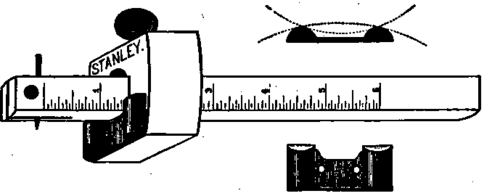
Fig. 17. Stanley gauge with patent attachment.
17. Dividers Or Compasses
Dividers or compasses are used in dividing lines, in describing arcs and circles, in measuring figures, and in scribing. The term "dividers" is usually applied to the instrument made use of by draughtsmen, while "compasses" are made use of by mechanics. Either term, however, is correct. The construction and parts are shown in Fig. 18. In working at the bench great care should be exercised not to lose any of the set screws.
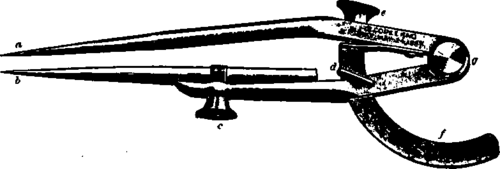
Fig. 18. Copeland dividers with one movable point, a, fixed point; 6, movable point; c, d, e, set screws; f, are; g, joint.
18. Calipers
Calipers are instruments having curved legs which are used in measuring the caliber, or diameter, of round bodies. Outside calipers are used for outside measuring, while inside calipers are used for inside measuring. They are indispensable in wood turning, but have little use in bench work. The legs are made of steel and are usually polished. The measuring points should come together evenly for accurate work.
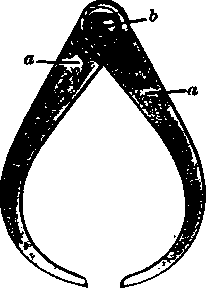
Fig. 19. Outside calipers. a, legs; b, joint.
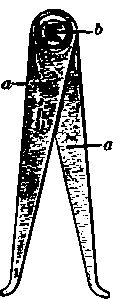
Fig. 20. Inside calipers, a, legs; b, joint.
19. Wire Gauge
The wire gauge is used in measuring wire, nails, etc. There is a lack of uniformity in wire gauges in the United States. The following different standards are in use. American or Brown and Sharp, Birmingham or Stubs' Wire, Washburn and Moen Manufacturing Company, Imperial Wire Gauge, and United States Standard. For tables of sizes and standards see Appendix B.
Continue to:


My Books

