


How To Find The Length Of A Rafter
Description
This section is from the "Educational Woodworking For Home And School" book, by Joseph C.Park . Also see Amazon: Educational Woodworking For Home And School.
How To Find The Length Of A Rafter
For a roof with 1/6 pitch (or the "rise" 1/6 the width of the building) and having a "run" of 12 feet: follow in the rafter table the upper or 1/6 pitch ruling, find, under the graduation figure 12, the rafter length required, which is 12 7 10, or 12 feet 7 10/12 inches.
If the "run" is 11 feet, and the "pitch" 1/2 (o; the "rise" 1/2 the width of the building), then the rafter length will be 15 6 8, or 15 feet 6 8/12 inches. If the "run" is 25 feet, add the rafter length for "run" of 23 feet to the rafter length for "run" of 2 feet.
When the "run" is in inches, then in the rafter table read inches and twelfths instead of feet and inches. For instance: if with 1/2 pitch the "run" is 12 feet 4 inches, add the rafter length of 4 inches to that of 12 feet, as follows: -
For "run" of 12 feet the rafter length is ... . | 16 ft. 11 8/12 in. |
For "run" of 4 inches the rafter length is ... . | 5 8/12 in. |
Total...... | 17 ft. 54/12 in. |
The "run" of 4 inches is found under the graduation "4" and is 5 7 11, which may be read 5 8/12 inches. If it were feet, it would read 5 feet, 7 11/12 inches.
9. Brace Measure
This is along the center of the back of the "tongue," and gives the length of the common braces.
36 36 50 91 - in the scale means, that if the run is 36 inches on the post, and the same on the beam, then the brace will be 50 91/100 inches, or the hypotenuse of a right angle triangle.
If the run is 51 inches on both beam and post, then the brace will be 72 12/100 inches, and so on.
10. Octagon "Eight-Square" Scale
This scale is along the middle of the face of the tongue, and is used for laying off lines to cut an "eight-square" or octagon stick of timber from a square one.
Suppose the figure ABCD, page 31, is the butt of a square stick of timber 6 x 6 inches. Through the center draw the lines AB and CD, parallel with the sides and at right angles to each other.
With the dividers take as many spaces (6) from the scale as there are inches in the width of the stick, and lay off this space on either side of the point A, as Aa and Ah; lay off in the same way the same space from the point B, as Bd, Be; also Cf, Cg and Db, Dc.
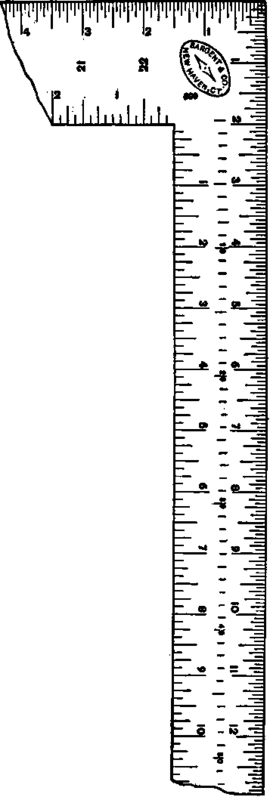
Fig. 9. Octagon "eigbt-square" scale.
Then draw the lines ab, cd, ef, and gk.
Cut off the solid angle E, also F, G, and H; this will leave an octagon or"eightsquare" stick. This is nearly exact.
11. Essex Board Measure
The figure 12 in the graduation marks on the outer edge represents a one-inch board 12 inches wide and is the starting point for all calculations; the smaller figures under the 12 represent the length.
A board 12 inches wide and 8 feet long measures 8 square feet, and so on down the table. Therefore, to get the square feet of a board 8 feet long and 6 inches wide, find the figure 8 in the scale under the 12-inch graduation mark and pass the pencil along to the left on the same line to a point, below the graduation mark 6 (representing the width of the board), and you stop on the scale at 4, which is 4 feet, the board measure required. If the board is the same length and 10 inches wide, look under the graduation mark 10 on a line with the figure 8 before mentioned, and you find 6 8/12 feet board measure. If 18 inches wide, then to the right under the graduation mark 18, and 12 feet is found to be the board measure. If 13 feet long and 7 inches wide, find 13 in the scale under the 12-inch graduation, and on the same line under the 7-inch graduation will be found 7 7/12 feet board measure. If the board is half this length, take half of this result; if double this length, then double the result. For stuff 2 inches thick double the figures.
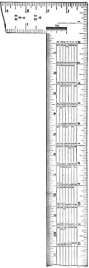
Fig. 10. Essex.
In this way the scale covers all lengths of boards, the most common, from 8 feet to 15 feet, being given.
12. History Of The Framing Square
The square was used by the ancient Greeks and Romans. Pliny said that the square and level were invented by Theodo-rus, a Greek of Samos; but this cannot be true, for the ancient Egyptians must have had and used these tools in the building of the Pyramids. Theodorus may have made improvements in the square and level, and probably discovered new problems in which they could be used. Prehistoric nations must have used them or similar tools also, for evidences of their use are found in the ruins of prehistoric races. A story of the history of tools is a story of the history and development of the race.

Fig. 11. Plumb and level.
Continue to:


My Books

