


Preface
Description
This section is from the book "Handcraft In Wood And Metal", by John Hooper, Alfred J. Shirley. Also available from Amazon: Handcraft In Wood And Metal.
Preface
In preparing this work the authors have endeavoured to show the possibilities of craftwork as an educational subject, and to briefly indicate its cultural aspects.
One of the prejudices against handcraft or so-called "manual work" has been that it had more value from a physical than an educational or cultural standpoint, with the result that "handcraft" in schools has too frequently been classed as "carpentry".
The authors think that lessons based upon the historical phases of craftwork, particularly in the development of types of construction in furniture and metalwork, and the growth of tools from prehistoric times, together with the study of simple applied art as displayed in historic work, will do much to increase the value of handcraft in schools.
Whilst the work has been prepared primarily for the teacher, the aim has been to render treatment of the subject such as to make the work of value and interest to the craftsman, and a useful guide for the pupil or student. As an aid to class teachers in helping on a technical side in central schools, they hope it will find a place among the books pertaining to craft and general education.
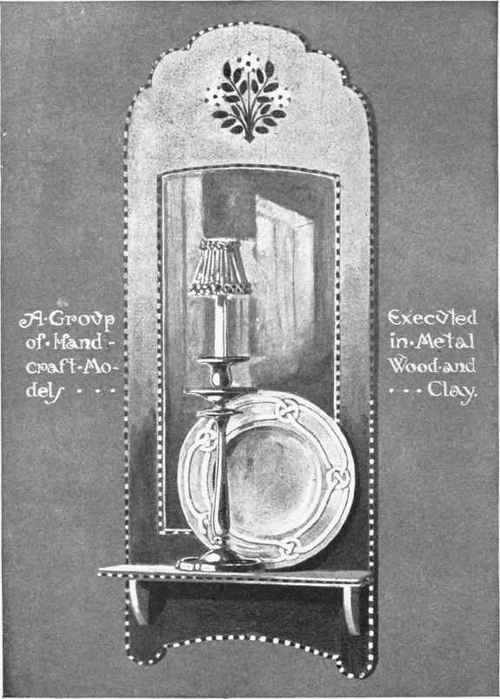
It is hoped further that the work will be regarded as a collection of suggestions and data, rather than an attempt to produce a series of models. The authors believe that at least one aspect of handcraft has been almost entirely neglected in the past, i.e. the artistic side ; and, whilst not claiming any special merit for the design of the models dealt with, they have endeavoured to embody some artistic merit in the designs, and have tabooed the meaningless joints and collection of joints which have only a limited mechanical value.
In the early stages, accuracy-whilst being encouraged-should not be too strictly insisted upon. It is a phase which should progress proportionately to the skill of the pupil.
The general impression in the past has been that any attempt at "freehand " curves or decoration in models necessarily means neglect of the mechanical side, but this does not follow according to the authors experience, and they would deplore the acceptance of this idea.
The main feature of handcraft work after the early stages is individual effort on the part of the pupil, which adds to the interest and value of the subject as a whole.
Much has been said upon "correlation" in handcraft. In well-directed handcraft "correlation" is inevitable. Thinking and doing must perforce be linked together, and when this is done in the class or craft-room it must work toward a better general education.
In elementary handcraft the tendency has always been to depart from traditional methods of construction and processes, but in the authors' opinion even the simplest models can be based upon traditional lines, and whether the object of the teacher be vocation or education, due regard to tradition and right methods is essential.
John Hooper A. J. Shirley London, June, 1913.
Note
Many of the models and lessons treated in the following pages have been designed and prepared in connection with the authors' duties at the L.C.C. Shoreditch Technical Institute: and they desire to express their thanks to the Principal, Mr. S. Hicks, for permission to reproduce these examples. To Mr. P. A. Wells they wish to extend their gratitude for much kindly help and criticism, also to Mr. A. Rowan of the Handcraft Teachers' Department for assistance in the preparation and revision of Mss. and proofs for the press. Messrs. Nurse & Co. kindly lent the illustration of a grindstone on page 201. Mr. Balfour of the Oxford University Museum has most courteously given permission to illustrate some of the prehistoric tools. Many of the examples of decorative craftwork reproduced in the book are due to the excellent facilities afforded by the authorities of the Victoria and Albert Museum, South Kensington, the source of these examples being noted in the text. In conclusion, the authors desire to place on record their appreciation of their publisher's ungrudging help and consideration during the progress of the work, which materially smoothed its path to the press.
Continue to:


My Books

