


Frame Fastening
Description
This section is from the "The Elements Of Wood Ship Construction" book, by W. H. Curtis. Also see Amazon: The Elements Of Wood Ship Construction.
Frame Fastening
Immediately after a square-frame has been up-ended in its proper location on the keel a small drift-bolt is driven through the center of one of the floors into the keel to hold the frame in place. These frames receive their principal fastening when the keelson bolts are driven, as all of these, and there are at least four to the frame, pass through the floors and keel and are clinched on both ends.
On the other hand, half frames and cants must be fastened thoroughly when they are set up. Generally, all of the bolts fastening the heels of cants, or half frames, pass through the deadwood and opposite cant or half frame and are clinched on both ends. They may be arranged in location and number, as shown in Fig. 57, and it should be noted that the clinch rings, or heads, are counterbored well inside the face of the frame. This is done to get them well clear of the dubbing, which is very often quite heavy in this vicinity.
It is not always possible to drive through and clinch all of the heel fastening for cants, particularly stern cants, as will be seen by referring to the radial stern cants shown in Fig. 65. The heels of these cants have plain fits, as shown in Fig. 56, part of them being fitted against the last half frame and the balance of them against what are called in this type of stern, whisker timbers. In this case, to secure as much through clinched fastening as possible, the erection would begin at each end of the series of cants, and the last cant placed in position would be the one landing in the crotch between the last half frame and the whisker timber. Lack of room would probably prevent through fastening the last three cants erected, but this would be compensated for later by placing a thwartship timber, called a transom, in way of these cants and on top of the ceiling, which would be clinch bolted through the cants before the planking is on. There are an indefinite number of arrangements of stern cants and half frames used, and it would be impossible even briefly to describe all of them within the scope of these chapters, but there are three principles which should apply to all of them, which may be stated as follows: First, the heels of all cants and half frames should be dapped at their landings wherever possible; second, the heels should be through clinch bolted wherever possible; third, where it is impossible to through clinch bolt the heels of such cants or half frames, compensation therefor should be provided either by the fitting of transoms or other approved means.
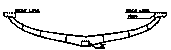
Figure 59. Transom Frames.

Figure 60. Arrangement Of Frame Fastenings.

Figure 61.

Figure 62. Limbers.
Frame Timber Fastening
Frame fastening is clustered about the butt, as shown in Fig. 60. The figure shows six fastenings to the butt, but this number may be more or less, according to the size of the frame and the location of the butt in the frame. In large frames six or more may be driven at the floor butts, six in butts at the bilge, and four to the butt above the bilge. It is necessary, of course, to drive enough fastening in the frame to hold it in shape while it is being erected. Four styles of fastening are used, namely; hardwood treenails, fir or pine treenails, iron drift bolts; and screw bolts. The screw bolts are generally machine bolts with square heads and nuts, with washers on each end. The screw-bolt fastening is the best for holding the frame in shape, while fir and pine treenails are the poorest for this purpose. Very often a combination of hardwood and softwood treenails are used, the hardwood treenails being used where the strains are the greatest.
Limbers
Limbers, unless of special type, must be cut in the floors of all square-frames. If they are of the style shown in Fig. 61, they should be cut as soon as the floors have been sawn, and before the frames are assembled. If they are to be as shown in Fig. 62, they should be bored as soon as the frame is assembled on the framing stage. Either style of limbers is generally arranged in a straight line along the middle of the first garboard, as in this position the limbers will clear the garboard fastening.
Limbers are usually fitted with ⅜" diameter close link galvanized chain, one length on each side of the keel, with the ends of the chains carried up through the ceiling and fastened. Some slack is left so that the chain may be pulled back and forth to clear the limbers should they become clogged. The chains should be lashed in place before the planking and ceiling are put on. Then as soon as the garboard is in place the lashings are removed.
Continue to:


My Books

