


Exercises In The Corresponding Style
Description
This section is from the book "The Manual of Phonography", by Benn Pitman And Jerome B. Howard. Also available from Amazon: The Manual of Phonography.
Exercises In The Corresponding Style
Benevolence.
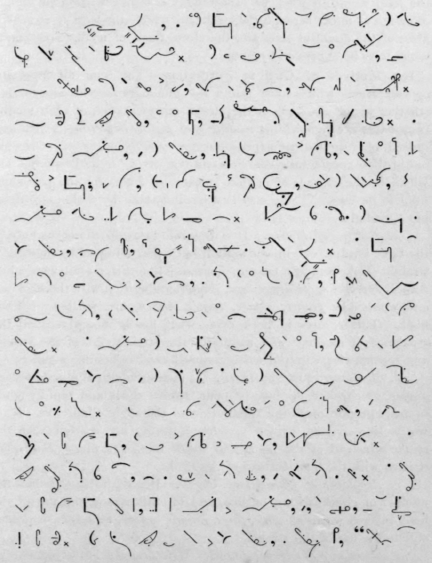
modified strokes or to write them out "in full" with the alphabetic strokes. In the case of medial s and z no difficulty is felt, for the circle is almost invariably the available and desirable form. See paragraph 81 h. The medial use of the loop to represent st is quite restricted (see paragraph 91 c) owing to the fact that in most cases the loop would, if used, be followed by a stroke written in such a direction as to cut through the stroke to which the loop is attached. Most of the doubtful cases are, therefore, those of medial consonants which may be expressed by hooks.
194. Motives Of Outline Formation
The two all-important considerations which must guide the phonographer in determining whether to use the hook or the stroke representation of such medial consonants are certainty in reading and facility in writing, which are, indeed, only equivalent expressions for legibility and speed. Growing out of these considerations are certain "motives" of outline formation which in the absence of definite rules, must determine the particular form to be used. These may best be illustrated by outlines containing a medial n. They are: a. Balance of Motion. It is desirable to avoid the occurrence of the same kind of curvilinear motion both preceding and following a straight stroke and at a tangent thereto. For this reason words like branch, apprentice, springe, cringe, grange, are written with the stroke-n, and words like plunge, sponge, blanch, blench, are written with the hook. This secures in both cases what has been aptly called the "balance of motion" and maintains the straightness of the stroke, which otherwise, in rapid writing, would tend to become a curve.
b. Avoidance of Obtuse Angles. It is desirable to eliminate obtuse angles, as checked joinings (see par. 24) are easily and rapidly made in exact proportion to the diminution of the angle. For this reason words like serenity, "warranty, wrench, range, are written with the stroke-;/ instead of the hook, and words like tinge, dingy, Dante, are written with the hook instead of the stroke.
c. Avoidance of Unnecessary Checks. It is desirable to reduce the number of checks in any outline, and for this reason the use of the hook in such words as clinic, tinge, jaunty, canopy, chinchilla, is preferable to the use of the stroke.
d. Avoidance of Abrupt Checks. It is desirable to avoid abrupt
Bridging East River.

or "jerky" checks and to substitute for them, whenever possible, such as produce smooth, flowing outlines. Thus, the stroke is to be preferred to the hook in such words as month, Monday, eminence, prominence, manage, impinge, etc.
e. Avoidance of Imperfect Hooks. It is desirable to avoid imperfect hooks, especially such as are highly imperfect, and for this reason the use of the stroke in words like tonic, carbonic, panic, is prefeiable to the use of the hook. In like manner, in words like assignor, dinner, joiner, the nr-hook is preferable to the n-hook followed by a downward r.
f. Derivation. It is desirable to write derivative words in accordance with the outlines used for the primitive words from which they are immediately taken. For this reason it is better to use the hook in such words as finer, finest, finely, fineness, finery, thus building the outlines for these words upon the form of the primitive fine.
195. Conflicting Motives
It will be seen that in deciding the outline for a given word we may have to consider two or even more conflicting motives, each of which, if considered by itself, would lead to an outline different from that indicated by the others. In such cases the balance of advantage must be kept in view; and here it is that outline-building affords some play for individual judgment and taste. Happily, the opinions of the best reporters do not vary widely in such matters; but there will probably never be absolute uniformity of practise among them, as some will always attach greater value to certain motives than do others. Whatever variation may exist, however, among well-trained phonographers will not in the slightest degree affect their power to read each other's notes, so long as the latter are written with reasonable care as to penmanship.
196. Use of the "Phonographic Dictionary." - Whenever in copying printed matter into phonography the learner meets with a word the correct outline for which does not unhesitatingly come into his mind, he should carefully weigh the principles and motives of outline formation which should lead him to a decision, and he should then write the word in accordance with his own judgment. On reading his notes - for all notes should be carefully read and criticised by the learner - each doubtful word should be marked and the student's outline compared with that given for the word in the Phonographic Die-
tionary. Should any discrepancy exist between the two, he should then endeavor to discover the reason therefor, and by repeatedly copying the Dictionary form make it thoroughly his own. In writing from dictation, the young phonographer must not pause to split hairs in deciding upon a dubious outline, but should promptly and boldly write an outline for the word, which, if not the best possible, shall, at least, express all its consonants in their proper order and in such form as to be vocalizable. On reading the notes so taken, the outline should be marked and compared with the Dictionary form. The Dictionary should never be used to save the learner the trouble of thinking how an outline should be written. Successful phonographers are not made by any process of mere memorizing of outlines. If, however, the Dictionary is consulted after the student has done his best in any case, it will prove a helpful friend and an invaluable timesaver, especially to the self-instructed student.
197. The Study Of Printed Phonography
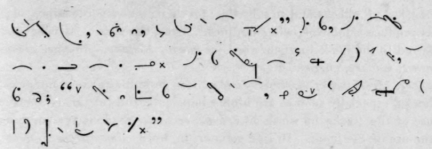
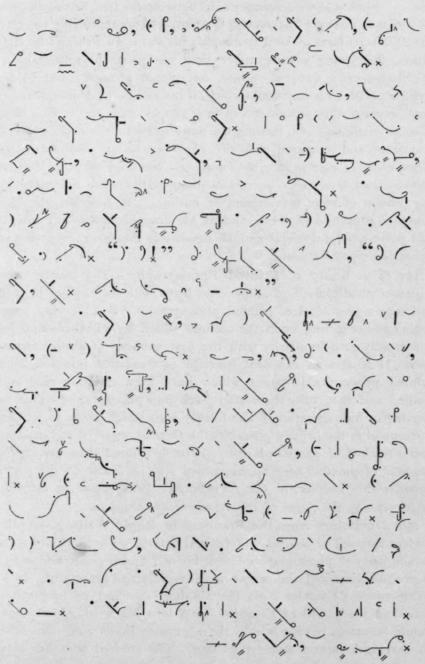
The learner who wishes to avail himself of all possible helps will not neglect to read and copy a great deal of printed phonography. By observing, comparing and reflecting upon the outlines which he will there find, he will rapidly gain familiarity with the best methods of outline formation. It is also an excellent exercise to transcribe into longhand printed phonographic pages which have been carefully read and studied and then turn the matter back into phonography either by copying or from dictation. The fidelity with which notes so written correspond to the printed notes should then be observed and discrepancies marked for special practise. Suitable printed phonography for the kind of practise here recommended will be found on the pages opposite this chapter, in the Phonographic Readers, and in monthly instalments in the pages of the Phonographic Magazine.
198. Deviations From The Standard In Rapid Writing
As the student through prolonged and faithful practise gains more and more familiarity with phonographic forms, he will find it easier and easier to execute them with the pen or pencil rapidly and gracefully. In so doing minor deviations from the absolute standard of proportion, slant and shade will of necessity creep into his writing, but these should be carefully kept within the narrowest limits consistent with an easy and natural style of writing. The student who has most
Franklin as a Printer.

conscientiously adhered to the exact standard of proportion in the earlier stages of his practise will be the one who can, with greatest safety and in the shortest time, adopt a dashing, cursive mode of writing without diminishing the legibility of his notes. No fixed standard of size can be prescribed which will be equally suitable to all writers, but the size adopted in these pages is that best adapted to the average phonographer, who should avoid, on the one hand, a large and clumsy style of writing, and, on the other, one too much cramped and condensed. The matter of chief importance, however, whatever standard of size may be adopted, is to retain the proper proportion between the full-length, half-length and double-length strokes. This caution is especially necessary in the case of strokes which stand alone - not joined to other strokes. Many learners show a tendency to efface the distinction between the three sizes of strokes by making the half-lengths a little too long and the double-lengths a little too short. This should be carefully guarded against and if any deviation from the true standard be allowed it should be in precisely the opposite direction - that of making the half-lengths a trifle shorter and the double-lengths a trifle longer than their true proportions. No detriment to legibility can result from this course, and, unless it be pushed to an unreasonable extent, it will impose no restriction upon the writer's speed.
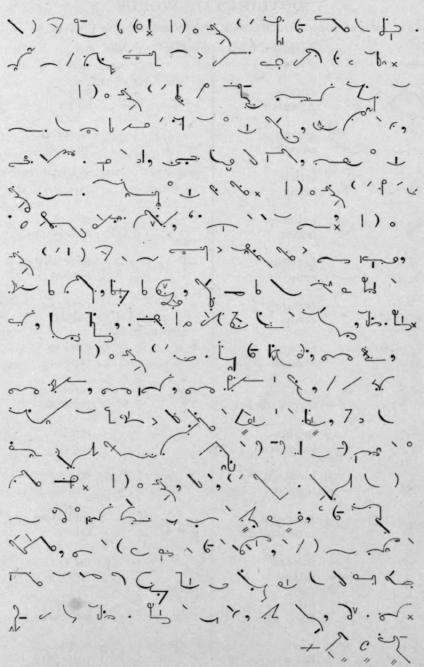
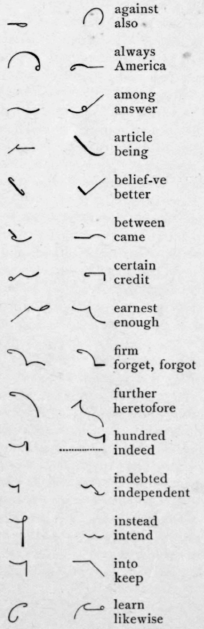
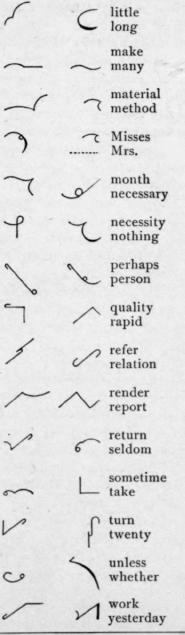
199. The "Corresponding Style." - The student whose object in learning phonography is simply to find in it a convenient and time-saving substitute for longhand in letter-writing, diarizing, personal memoranda, and the like, need give his further attention only to the faithful practise of vocalized phonography as explained in the foregoing paragraphs. He will, however, find it convenient to omit the vowels from the frequently-recurring words given on page 102. The form of writing thus produced has been called, for the sake of distinction, the "corresponding style" of phonography. No doubt, however, most learners of the art desire to acquire at least that degree of skill in phonographic writing which will enable them to take dictations with considerable speed, and such are advised to proceed at once to the study of the "easy reporting style" on page 172.
Outlines Of Words Of Frequent Occurence, Unnecessary To Vocalize
Continue to:


My Books

