


Prefixes And Affixes
Description
This section is from the book "Phonetic Shorthand", by William W. Osgoodby. Also available from Amazon: Phonetic Shorthand.
Prefixes And Affixes
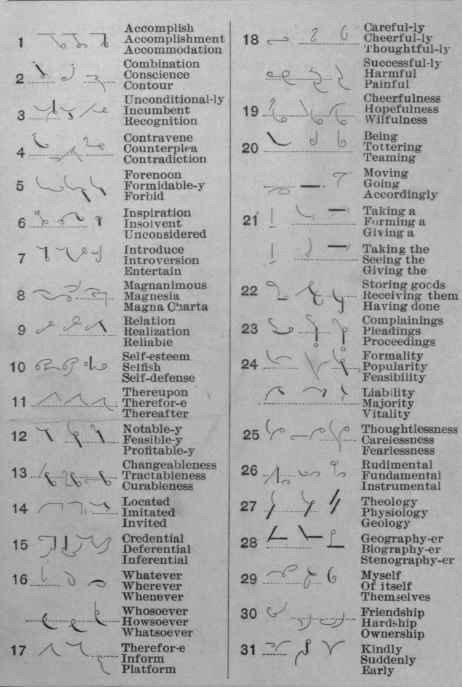
Sec. 26. One of the most important methods of abbreviation in Phonetic Shorthand, is that of using certain signs for frequently occurring prefixes and affixes, rules for which are given in this section. Illustrations of the use of these rules will be found on page 43.
Prefixes. - 1. The prefix Accom is indicated by the stem K, joined to the remainder of the word. (Line 1.)
- 2. Com, Con, or Cog, is generally indicated by a dot at the beginning of the first stem of an outline. In some words, however, it is better to use K with the N-hook for Con. (Line 2.)
3. In the middle of a word, Com, Con, or Cog, is indicated by disconnecting the outline at the point where the syllable occurs. (Line 3.)
4. Contra, Counter, by an inclined tick written in place of the Con-dot; by a half-length K with the N-hook, followed by Ar or Ray as is most convenient; or, in a few instances, by T with the R-hook, preceded by the Con-dot. (Line 4.)
5. For, Fore, by F, joined to the remainder of the word. (Line 5.)
6. In, Un, by the N-stem; or, when followed by Iss, by an initial back-hock, if the N-stem will not readily join. (Line 6.)
7. Inter, Intro, Enter, by a half-length N, either joined or disjoined. If disjoined, it should be written to the succeeding stem in the position of the first vowel of the prefix. (Line 7.)
8. Magna, Magni, by a disjoined M, written over or near the remainder of the word. Magnify, and its derivatives are written Mg. (Line 8.)
9. Bel, by the stem Ray with the L-hook. {Line 9.)
10. Self, by the syllable written in full, where convenient. In other cases, by the Iss-circle, as shown in line 10.
11. There should always be written with the stem Ray, but in such words as thereupon, therefore, thereafter, the inclination of the Ray should be so changed as to bring the remainder of the word in its proper position. (Line 11.)
Affixes. - 12. Ble, Bly, are indicated by B and the L-hook: or where the hook cannot be used conveniently, by B alone. (Line 12.)
13. Bleness, by B with the L-hook and final Iss, disjoined and written through the line. (Line 13.)
14. Ed, by halving the last stem of an outline; by a half-length T or D, joined or disjoined, after a full-length stem: or by an inclined tick after a loop or a half-length stem, as provided in section 25, a. (Line 14.)
15. Ential, Entially. by Sh following the N-hook. Essential and essentially are written Sn. (Line 15.)
16. Ever, by the F-hook; Soever, by the circle and V-stem. (Line 16.)
17. For, Fore, Form, by F joined to the preceding portion of the word. (Line 17.)
18. Ful, Fully, by the F-hook, except when the affix follows a circle or hook, in which case it is indicated by the stem F. (Line 18.)
19. Fullness, by F followed by Iss, written through the line near the preceding portion of the word. (Line 19.)
20. Ing is better indicated by the Ing-stem, in many cases. After the Tr- or M-hook, or after the F-hook on a curved stem, it is indicated by a small hook within the larger one. In other cases, it is indicated by a dot at the end of the last stem of an outline. In such words as exceedingly, the Ing-dot is placed at the end of the last stem preceding- L. See, also, section 10, b, and section 25, I. [Line 20.)
21. A perpendicular or horizontal tick, in place of the Ing-dot, indicates the syllable Ing followed by a, an or and. An inclined tick, in the same position, indicates ing followed by the. (Line 21.)
22. When a word ends with ing, it is often convenient to indicate the affix by beginning the next word near the Ing-dot place, or by striking the first stem of the succeeding word through the last stem of the word to which the affix belongs. (Line 22.)
23. Ings may be written with Ing and the small circle, or by making a circle in place of the Ing-dot. (Line 23.)
24. L-ty or R-ty, in such words as formality, popularity, may be expressed by detaching the preceding stem. In some cases, these terminations may be indicated by halving Lay or Ray, or by halving a stem bearing the L- or R-hook. Biliiy, as well as Ble and Bly, is expressed after a circle by the stem B. (Line 24.)
25. Lessness, by Lay and the Iss-circle, disjoined. (Line 25.)
26. Mental, Mentality, by a half-length M with the N-hook. (Line 26.)
27. Ology, Ological, by J, either joined or disjoined. (Line 27.)
28. Ography, Ographer, by G. with or without the R-hook. (Line 28.)
29. Self, Selves, by the syllable written out, except in a few cases where it is more convenient to indicate the affix by a small circle. (Line 29.)
30. Ship, by Sh, either joined or disjoined. (Line 30.)
31. Ly, by El, or by Lay joined or disjoined. (Line 31 )
Write Exercise XXVI. of the Speed-book.
Note. - When an outline is disconnected, the different parts must be written very near each other.
Continue to:


My Books

