


Advaita According To The Saiva Siddhanta. Part 3
Description
This section is from the book "Studies In Saiva-Siddhanta", by J. M. Nallasvami Pillai. Also available from Amazon: Studies In Saiva-Siddhanta.
Advaita According To The Saiva Siddhanta. Part 3
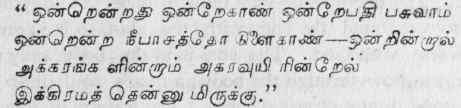
"In the Vedic text, 'Ekam' means that there is only one and that one is the Pati (Lord). You who say 'There is one ' is the Pasu, bound up in Pasa. The word 'Advaita' means that beside God nothing else will exist, as when we say that there will be no other letters (consonants) when the vowel 'A' is not." And the meaning will be clear when the illustration is fully understood. The illustration is that of vowel and consonants i.e., and
and or
or meaning soul and body.

"The vowel becoming one with the consonants is natural union," is the Nannul sutra.
And the illustration of body and mind or soul was what was stated in the first stanza.* So that we have two
*We are glad to extract the following from Mr. Armstrong's book, 'God and the Soul' wherein he brings out the same analogy.
"But I would much rather put it in this way: the relation of the physical universe to God is, within certain limits, analogous to the relation of my body to myself. The movement of my tongue as I speak, of my eyes as I glance at my friend, of my hand as I write these words, proceeds from that stream of conscious energy which you may call my mind, my soul, my spirit, my will, or myself- Instantaneously the command of my unseen self flows through my seen self and modifies its attitudes, its gestures, its several and separable parts. But the intimate connexion between myself and my body does not imply that I am my body or that my body is myself, the 'Ego.' If they are in absolute alliance they are also in absolute antithesis. Nor, even if you went on to imagine my body the absolute product of my own will, and its automatic and reflex action, the breath, the circulation of the blood, the beating of the heart, the growth of the hair and the nails to be the effect of my will, and my consciousness to be perpetually engaged in conducting these processes, would you be one step nearer identifying me, the' Ego,' the self, with this body, but it would be other than the body, above and beyond it, transcending it, of a nature belonging to a superior order to it, in another and a higher plane than it.
Press the analogy home, and you have a safeguard against Pantheism. The universe may be thought of as the body of God but as it is gross to confound the body with the man, so it is gross to confound the universe with God. The soul is in the body only in the sense that its energies flow through the body; a man's soul (that is the man) is not in the body in any physical sense. The body is its organ and its instrument.
But why do we shrink from Pantheism? Not from dread of losing the physical universe in God, but from dread of losing our own souls in God. Pantheism only becomes deadly to vigorous religion and morality when it makes the man's soul, the man's self, a portion of God. Theism claims that the human soul is a free cause, a separate island of individual will in the midst of the great ocean of the Divine Will. Leave us man confronting God, not absorbed in Him, and the conditions are preserved for the ethical life of the individual, and also for the communion of the, soul with God, as another than itself, the very possibility of which is destroyed if a separate personality is wiped out. On this matter of the otherness of man from God, I hope to say more in a later chapter." illustrations to describe the relation of God to the world, and these two illustrations going by the same name show that the relation between mind and body is what obtains between vowels and consonants.
Visishtadvaita writers have no doubt used the illustration of mind and body but nowhere do they discuss the nature of this relation; much less do they seem to have apprehended the analogy of vowels and consonants. Doctor Bain discusses this question in his book on "Mind and Body," and we wrote on the subject in the Siddhanta Dipika, Vol. II, page 13, and this is reproduced in pp. 52-63 of this book.
So that whatever word we may use, the nature of this relationship is clear. If the Vedic texts postulate oneness, it is in a higher sense than what is understood in the current philosophies. In this position is reached a higher and truer Monism. We have shown how true it is that St. Meykandan stated that there is no other letter but 'A.' So it is, we can state 'There is nothing else but God,' 'Only one, without a second.' This comes as the result of the Highest experience or Jnana or Sva-nubhava or Sivanubbava. And this is stated in the central stanza of Tiruvacagam, its Hridaya sloka:

"This day in Thy mercy unto me Thou didst drive away the darknes and stand in my heart as the Rising Sun.
Of this Thy way of rising - there being naught else but Thou - I thought without thought.
I drew nearer and nearer to Thee, wearing away atom by atom, till
I was One with Thee, Oh Siva, Dweller in the great Holy Shrine.
Thou art not aught in the universe, naught is there save Thou. Who can know Thee?
- (from P. A's Translation).
As man nears God, he wears away atom by atom, so that at the moment of union, nothing of him is left and what is left is the Presence of the Supreme One only and the feeling of His Presence; and no feeling or consciousness of feeling of himself or others. This feeling of the Presence and Bliss of God, is One and Advaita, and there is no consciousness of such oneness or Bliss, and duality will certainly arise the moment man regains consciousness. So what he is said to lose in fact atom by atom is his various conscious selves.
Continue to:


My Books

