


How To Perceive Truth?
Description
This section is from the book "Studies In Saiva-Siddhanta", by J. M. Nallasvami Pillai. Also available from Amazon: Studies In Saiva-Siddhanta.
How To Perceive Truth?
That is, we know the truth when we know the nature of Birth and Freedom (Moksha) and the causes thereof, free from error and doubt. This the Sanskritists call Tatvajnana. As this knowledge arises after desiring the desire of Him who has
* Pagdit Savariroyan derives 'Sivam ' from  and our Saint uses
 very frequently.
no desire, this chapter is placed in consequence after the chapter on ' Sanyasa.'

The delusion whereby men deem that the truth which is not, That is the cause of hapless birth.
Parimelalagar's Commentary.
This delusion consists in believing such books and doctrines which hold that there is no rebirth, no fruits of both kinds of Karma, and that there is no God and such like, to be the true books and doctrines. This delusive belief is same as when one mistakes One thing for another, a block for a man, shell for silver.  delusion,
 error,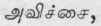
Avidya or ignorance are all synonymous words. As it is only sorrow that is reaped in all the four kinds of birth as Devas, men, animal and astrals, this couplet explains that birth is sorrowful and Avidya or error is its cause.
Note
By altering only a single letter in the first line an  ' a ' into
 'e,'
'e,'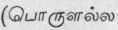 into
into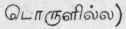 the meaning of the whole passage will be altered, and we will have a new system of philosophy directly opposed to our author's. Instead of it being then the truth, it will become the opposite of it. This is the same question which has arisen in interpreting the negative prefix in the word 'Advaita.' This 'a' or 'na' is interpreted in two ways either as meaning
 'not' or '
'no,' though the distinction in the English equivalents will not be very apparent. This is its  or
or
Siddhantins, of course, accept the former interpretation, and most followers of Sankara prefer the latter one. This latter view involves the negation of one of the two or may be both of the postulates in 'Advaita' Over this question, a huge war has raged and volumes have been written by the late Sri-la-Sri Somasundara Nayagar and his followers on one side, and the late Ratna Chettiyar and of his ilk on the other side. Anyhow, Saint Tiruva]}uvar's meaning is clear. He does not mean to repudiate anything as unreal or non-existent. To him, delusion or error consists in mistaking one existent thing as the shell, for another existent thing as silver. To him, to know the truth, is to understand the true nature of each one thing. The question of reality or unreality does not come in. Only one must not mistake one thing for the other or doubt its nature. It will be sufficient requirement of the definition, if one under* stands the true nature of God and man and the world, and one need not beleive any of these to be unreal. One of such truths is that birth is sorrowful This can be proved to be true. But one's ignorance or delusion comes when one takes this actual sorrow as happiness. You think that with this body, there is an end altogether when in fact there are future births.
Believing that there is no future life and future birth, one does not believe that there can be a soul; and if there is one, one thinks the body itself is the soul and believing so, all one's energies in this world are directed solely towards what would procure the greatest pleasure and gratification of one's senses, and one does not care what means one adopts provided one's passions are gratified. As it is, the whole foundation of morality will be undermined and one need have neither fear of men nor of God. All this is the result of want of knowledge of the true nature of his body and himself, and this ignorance is the cause of his birth. This ignorance is a fact, and to believe that this ignorance is itself unreal will be error or false knowledge. It is only when a man knows that he is ignorant, that he will learn and try to remove his ignorance. But can this ignorance be removed? Yes. If so, how ? This question is answered in the next couplet.

Darkness departs and rapture springs to men who see
The mystic vision pure from all delusion free.
Parimelalagar's Commentary.
 darkness is hell. 'The mystic vision pure' is the supreme object of knowledge. By this couplet is explained that by freedom is meant Niratisayananda and the Nimitta Karana, for this, the Supreme Being.
Note
Darkness and ignorance, Light and knowledge have at all times and in all climes been used synonymously and no two things are so analogous in nature as these two pairs of words. When will darkness vanish? When the sun rises. When will the sun rise? After the night is past. When will ignorance cease? When the source of all lights arises in his heart? When will this be? When he has attained to a well balanced mind
Continue to:


My Books

