


Editing The Film. Continued
Description
This section is from the book "Time Out for Living", by Ernest DeAlton Partridge and Catherine Mooney. Also available from Amazon: Time Out for Living.
Editing The Film. Continued
Tricks With Movies
There are many interesting tricks that can be performed with movies. These tricks add to the interest and variety of the film. Some of them you have seen in Hollywood productions. For example, you have no doubt seen titles come together on the screen from a jumbled maze of letters. To do this stunt, purchase a set or two of anagram blocks (each having a letter on it) from the ten-cent store. Arrange the letters in the words you wish to have in the title, hold the camera upside down, and take a few seconds of the title. Then gently agitate the surface upon which the letters are placed so that they roll about. When the film is developed the title is cut and turned around, and spliced into the finished film. When shown on the screen, the title will appear as a jumbled mass of letters from which actual words form themselves.
Another interesting stunt is to arrange the anagram letters in the form of words, as before, and then with the hose of a vacuum cleaner (the kind without a fan before the dust bag, since the blocks will injure the fan) suck the blocks up. When reversed and shown on the screen, it will appear as though the letters scramble out of the mouth of the vacuum cleaner and jump into their places.
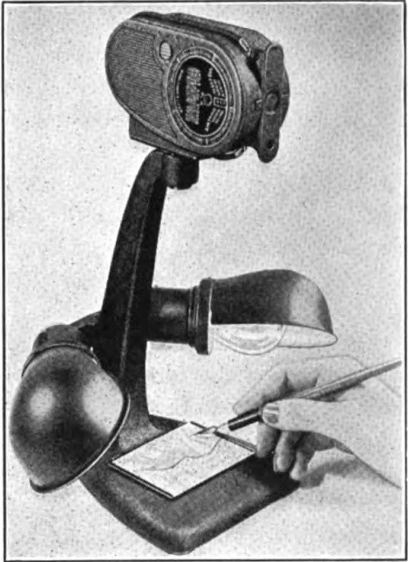
A Titling Machine
The camera is held steady. Titles arc set in the clip at the bottom.
Suppose you wish to show your pet dog backing out of the room, or backing around the corner of the house. You can do this stunt with the upside-down camera. Get a picture of him coming into the room or around the corner. Reverse the film when it is edited and you will have the desired effect. You can also make a movie that will show how your dog behaves when he is sleepy and lies down. Simply take an upside-down picture of him while he is sleeping. Then call him, so that he awakens and jumps up. When the film is reversed, he will seem to be lying down instead of getting up.
Some movie cameras have attachments that make it possible to take single pictures, one at a time. With these it is possible to make your own cartoons. Of course, yours will not be so good as Walt Disney's, but you will be delighted with the results. An easy way to do this is to have a toy with movable legs photographed in a series of movements, such as walking. To make the animated cartoon, move the legs and arms of the toy slowly in a series of movements, taking one snap for each small movement. When run on the screen, the toy will seem to be actually walking or running, according to the way you have arranged the movements.
These are only a few suggestions of what can be done in the way of taking trick shots with a movie camera. Anyone with a little imagination can work out many novel and original ideas to thrill those who see the finished productions.
In Conclusion
This hasty trip through home movie-land will give you some ideas about the fun of home movies. Why not talk with several different people who have this hobby and hear from them first-hand why they like it? If you would like to make your own movies and do not have enough money to go ahead, form a club and figure out ways of making money to buy some equipment. Second-hand cameras can sometimes be had and you can make much of your own equipment. After you have a camera, it might be possible to produce a movie and charge a small admittance fee to clear expenses.
You can do anything, if you really want to do it.
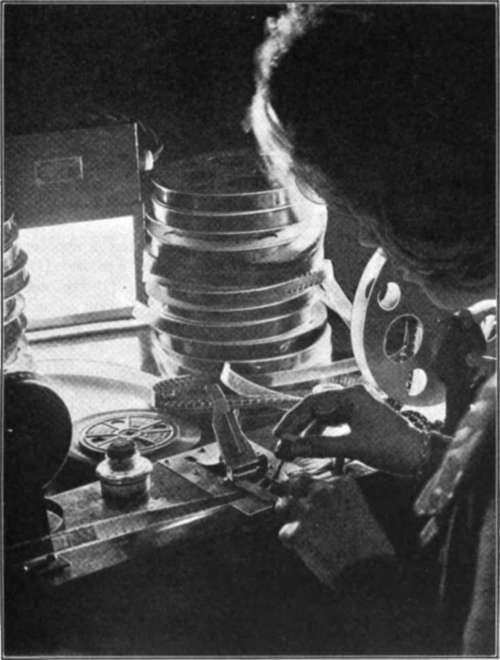
Home Movies not only are fun but also help develop a great degree of mechanical skill and ingenuity. The young woman shown here is splicing a 16 mm. film, an interesting operation in editing a movie.
Some Interesting Things To Do
1. Finish writing the scenario that is started on page 265.
2. For your own scenario prepare a plan of:
Scene Camera Position Description of Action
3. Plan an introduction for a class movie:
"Stars" _ in
Title __ with
Featured Players_
Bit Players _
Extras _(Group)_
4. Tryouts for movies are fun. Have a screen test of members of your class in a scenario. Here is a suggested scenario: (1) Boy wants to play. Father wants him to study. (2) Fire engines draw up before door. Sirens are heard. (3) (Fill in action.)
Have each member act out the scenario chosen. Let the class vote on the best.
5. Voice tests are entertaining, too. Put a screen across the front of the room (or use a closet with a cloth over the entrance). Number the volunteers secretly, so that the judges will not know who they are. Keep a check list of:
No. Tone of Voice Suggestions Pro and Con (pleasant, etc.)
6. Camera angles give different emotional effects. Lighting also has a strong effect. Invite some informed person to tell your class about each, or find the material in the library and report on it yourself. The Readers' Guide in your public library is very helpful if you are looking up magazine articles on the subject. Ask the librarian to help you.
7. List the phonograph records you know that give certain emotional effects which would be suitable for a movie you could make:
Name of Record Emotional Effect Suitable for Action
8. Good movie shots are the result of knowledge and practice. See page 268 for ideas. Take your still camera without any film in it and do some imaginary placing and experimenting. When you are quite sure of perfect shots, insert a film. The developed prints will tell you how expert you are.
9. Keep a record of each scene taken for the above project: Exposure Amount qf Light Kind of Film Results
10. Make an editing board, described on page 276, to lighten your work on the class movie.
11. Keep a record of Tricks I've Seen in Movies: For Titles For Effects.
12. Sketch some original designs of your own that could be used in an animated cartoon.
13. Television is coming! Start a file and collect notes and pictures about it. Date them. Write in your opinion of its value (how it could be of use to you at work or play). What would be the advantages and disadvantages of having television in your home? You'll enjoy this file many years from now.
14. Why not plan a movie of your class activities for the rest of the school year? You could have a lot of fun with it on class day. It would be especially entertaining at class reunions.
15. Make a brief outline of a movie to show the following: a. A Vacation.
b. The First Trip to a Farm.
c. A Trip to the City.
d. High-School Field Day.
16. Interview some person who has a hobby of movie-making. Find out why he likes it and report your findings to the class.
17. Find and show some home movies to your class.
18. Write a short article for your school paper on Movie-Making as a Hobby. Include such things as cost, how to finance the hobby, fun, and the like.
Helpful References
Dcschin, J., New Ways in Photography.
Floherty, J. J., Moviemakers.
Fraprie and O'Connor, Photographic
Amusements. Gale, A. L., How to Write a Movie. Gale, King, and Pessels, Make Your
Own Movies for Fun and Profit Gleason, M. N., Scenario Writing and
Producing for the Amateur. Henney, K., Color Photography for the Amateur.
Neblette, C. B., Photography Principles and Practices.
Neblette, and Others, Elementary Photography for Club and Home Use.
Sewell, G. H., Amateur Film-Making.
Shannon, W. J., Home Movie Gadgets Any Amateur Can Make.
Shannon, W. J., Money-Saving Tips for the Amateur Movie Maker.
Strasser, A., Amateur Movies and How to Make Them.
Magazines
Building America, Vol. 2, No. 8, Movies. Movie Makers, Amateur Cinema
Eastman Cine Kodak News, Eastman League, 420 Lexington Ave., New
Kodak Co., Rochester, N. Y. York City.
Filmo Topics, Bell & Howell Co., Popular Photography, 381 Fourth Ave.,
1801 Larchmont Ave., Chicago, 111. New York City.
Continue to:


My Books

