


Part 8. Presenting Mr. Puppet. Chapter Fifteen. Off On An Adventure
Description
This section is from the book "Time Out for Living", by Ernest DeAlton Partridge and Catherine Mooney. Also available from Amazon: Time Out for Living.
Part 8. Presenting Mr. Puppet. Chapter Fifteen. Off On An Adventure
Charles Adams Gibson is known as Chuck to his friends for no better reason than that it is much easier to say "Chuck" than "Charles." The most interesting thing about his name, however, is not the Charles part but rather the Adams, as we were to find out. Chuck came calling for me early one Saturday morning, and, as I put the finishing touches to a bowl of cereal and fruit, he asked me if I wanted to go with him to visit his Grandfather Adams. Well, the truth is, I never knew until that minute that he had a Grandfather Adams. It was also a surprise to me to know from where the Adams part of his name had come.
Because I had cut the lawn the night before, I had the day free; so, without really saying what I wanted to do, I found myself boarding a bus on Central Avenue for the other side of the city, where Chuck said his granddad lived. On the way we picked up Tom Billings, one of those talkative fellows who has to know the last detail about everything. Chuck and I never really talk much to each other because we each understand what the other is thinking. But Tom is different! Before the bus had gone a block, he was trying to pry out of Chuck why we were going to his granddad's place, how long we were going to stay, what we would see, and a thousand other things. I listened because it was good to have Tom along to ask the questions and save me the trouble.
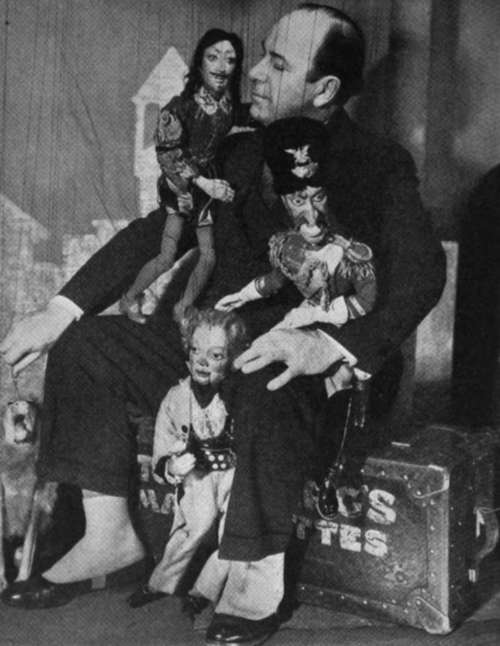
A Master Puppeteer with Some of His Folks.
I gathered from the conversation that Granddad Adams was a "puppeteer." This was Greek to me. Chuck even went so far as to say that he was an expert puppeteer, a fact which did not clear up my ideas at all about what he was. So right there the trip began to take on the earmarks of an adventure, and before the day was over it was an adventure, as you will see.
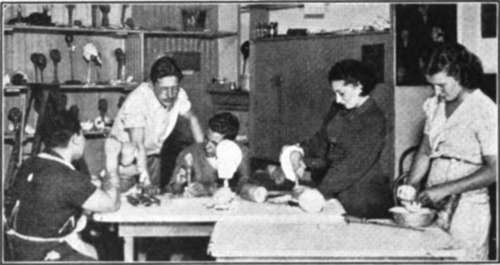
In a Puppet Workshop.
After changing buses twice, getting on the wrong one once, and accidentally knocking a bag of oranges out of a woman's hand while getting off - the bus was held up for at least three minutes while we picked them up - we finally arrived at the old section of the city on the other side of the river.
Grandpa Adams met us at the door of his shop, for this is what his house turned out to be. He was not an old man, surprisingly young for a grandpa, I decided. We were ushered into the workshop and told to make ourselves at home while he finished some business in the other room. When my eyes became accustomed to the dim light in the shop, I am sure they began to blink in wonder. Glancing at Tom, I could see that his eyes were bulging out too. Chuck was quite at home and immediately went over to the workbench and began to monkey around.
At first I thought we were in a morgue. All around the room were small faces, arms, legs, and loose-jointed wooden frames that looked like little skeletons as they hung on the wall suspended by strings. The place smelled of glue, paint, and freshly cut wood, and in the spaces on the wall that were not covered with dangling figures there were pictures of old costumes.
After standing with our mouths open for a while, Tom and I joined Chuck at the bench, where he was playing with one of these things. He was putting it on his hand and wiggling it so that it nodded and scratched its head. Chuck had played with it before, he said. For once I was as quick on the trigger as Tom.
"What arc they?" we both asked as if we had practiced together for weeks.
"Puppets," said Chuck knowingly.
"Whitchets?" asked Tom, beating me to the draw that time.
" Puppets," repeated Chuck. "Granddad makes all of these. They are used in putting on shows all over the country."
As Chuck was talking, Granddad Adams reappeared in the room. He was carrying some kind of puppet in his hand and he laid it down on the bench. Then, sitting on the edge of the bench, he said, "Well, Charles, what can I do for you and your friends today?"
"Tell them about the different kinds of puppets and something about their history," Chuck spoke up promptly.
Evidently the puppeteer liked to talk about his little people because he nodded and reached for some of the puppets.
"Many people," he began, "do not know that there arc different kinds of puppets. Really, any kind of doll or figure made so that you can cause it to move and act like a human being is a puppet. You will see that I have several different kinds of puppets here on the bench now."
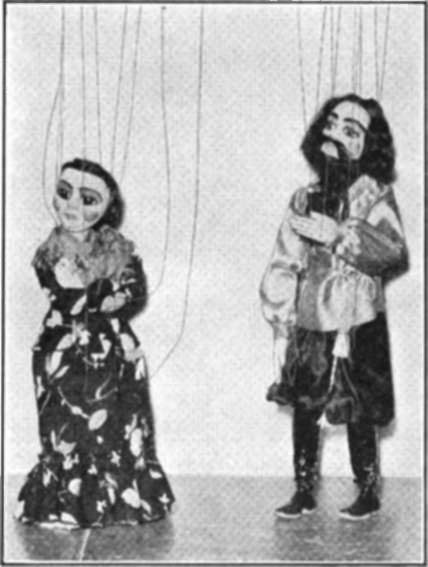
Two Well-Constructed Marionettes.
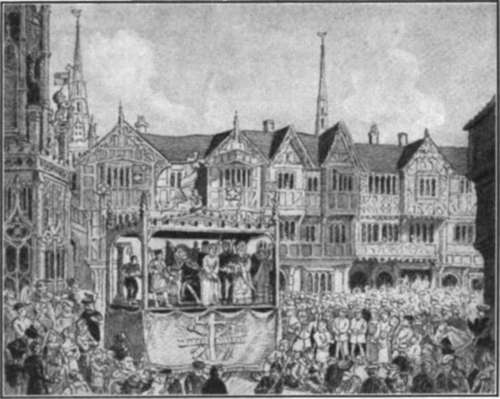
During the Middle Ages traveling theatrical companies presented plays in town and village squares. Sometimes puppets were used to portray the characters in place of the actors shown in this picture.
As he talked, he showed how the various puppets worked. There were some that fitted over his hand like a glove. He used his thumb and first two fingers to make them move. These were hand puppets. As he moved them, they did look human, nodding their heads and waving their arms. There were some puppets controlled by rods from below and others that moved by strings handled from above. Marionettes, we were told, are any kind of puppets worked by strings, rods, or wires from above.
Continue to:


My Books

