


Off On An Adventure. Continued
Description
This section is from the book "Time Out for Living", by Ernest DeAlton Partridge and Catherine Mooney. Also available from Amazon: Time Out for Living.
Off On An Adventure. Continued
Some Puppet History
Then Mr. Adams told us about the history of puppets. I never knew history could be so interesting. Maybe it was the small size of the workshop; maybe it was the way he illustrated his stories with his puppets and with pictures from the files; whatever it was, we sat and listened for a long time while he unraveled the family history of these little people.
Many different countries claim to be the birthplace of the puppet. India, China, and Egypt all present evidence showing that the idea of having movable images of human beings is very old. The puppets we have here in America today have come to us from Egypt by way of Europe. Small puppet theaters and puppets have been found in Egyptian tombs. Many Egyptian idols were really puppets worked from the inside by priests. The peasants, or fellahs, of Egypt brought gifts for the idol and asked it questions. The idol answered by moving the head, eyes, or hand. The Greeks copied the idea of moving idols from the Egyptians, and then the Romans borrowed it from the Greeks.
During all this time moving figures were being used for entertainment, too. Very complicated machinery was devised to make the puppets walk and gesture. With the coming of Christianity, puppets were used to tell the story of the Bible because very few people could read at that time. Finally these shows became so popular that the demand for them became widespread, and they were given in the village square instead of in the church. There, they continued to entertain and teach.
These mystery and miracle plays, as they are called, became very elaborate affairs. Beautiful scenery was painted and unusual lighting effects were made to add to the beauty. These productions were expensive, and it was necessary for the puppet company to tour many towns in order to make a profit. Because it was troublesome to carry scenery and puppets from one city to another, the shows had to be made simple. These traveling shows spread over wider and wider areas until they were soon all over Europe. The first puppet shows were brought to
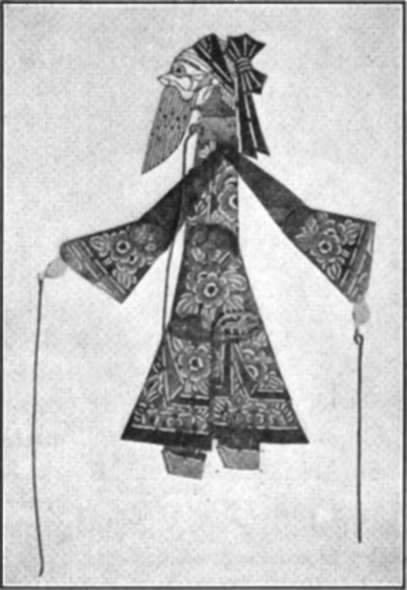
A Chinese Shadow Puppet, worked from below with rods.
America by European showmen, who, when they arrived, found that the Indians had been using puppets in religious ceremonies for many years.
While these things were going on in Europe, puppeteers in the Orient and the Near East were continuing their activities with little change in method or story. Shadow puppets were the most popular form there. Both colored and black-and-white puppets were used. Stories were taken from the old legends that passed from one generation to another by word of mouth. The characters were usually the same and easily recognizable as hero, villain, and father. The puppets were usually cut from the skin of some animal such as the water buffalo, donkey, or cow.
Oriental puppets were worked by sticks of horn or bamboo. They were held against a screen of silk or parchment, and a light behind them threw their shadows on the screen. The Chinese still have shadow puppets, and use them almost exclusively, while the Japanese have developed several other very interesting types. In Japan, large, painted dolls are sometimes carried around the stage by men dressed in black who move the puppets as they wish. There is also a type of puppet similar to the dummy used by ventriloquists in this country, except that instead of sitting on the knee of the operator it is held in front of him while he moves about the stage on a three-wheeled cart that looks like a kiddy car.
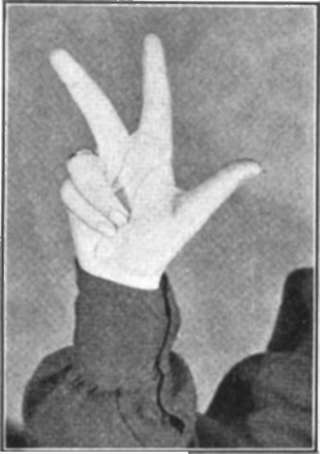
A hand puppet is manipulated with the thumb and first two fingers kept in the position shown above.
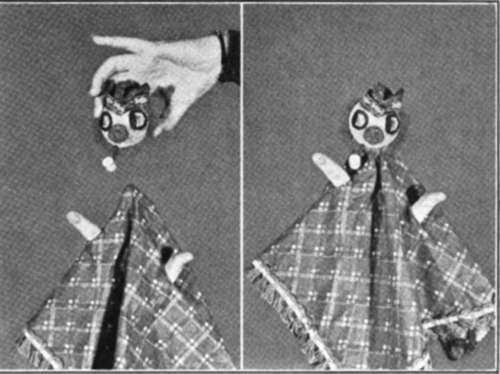
The body of the hand puppet is a piece of cloth with two holes for the thumb and second finger of the operator. The head fits over the index finger.
Most countries have their own puppet characters. England has Punch, and France has Polichinelle, while Germany has Kasper. Turkey has Karagheva, and Russia has Pctrouchka. As yet America has none of its own. What do you think it will be? Perhaps Mickey Mouse or Charlie McCarthy will make the grade.
No doubt you are beginning to feel as we did while Grandpa Adams was telling us about puppets. There is certainly more to puppets than we ever imagined, except perhaps Chuck, who had visited the shop before and knew a lot about it. One thing that interested us very much was the way in which the various craft guilds in the Middle Ages produced elaborate shows. They would work for many weeks on their productions and present them on festive occasions. In addition, there were traveling companies which produced shows.
We Get Excited
I believe it was Tom who first got the idea, although Chuck may have had it in mind when he invited us down to the shop. Anyway, we decided right then and there that it would be great fun to start a Puppet Guild and put on some shows. Well, then things began to happen. We were all for making some puppets right then and there, but the clock stopped all that by striking six. We should have been on our way nearly an hour before, but the time had passed so quickly that we had forgotten about getting home for supper. We did not leave before finding out when we could meet again. Grandpa Adams said he wanted to visit Chuck's family soon anyway, and might take a few things up to their house one night the following week and help us get started with the Guild. He suggested that we invite some girls to join, too, because they could help make costumes and take the female roles in the show.
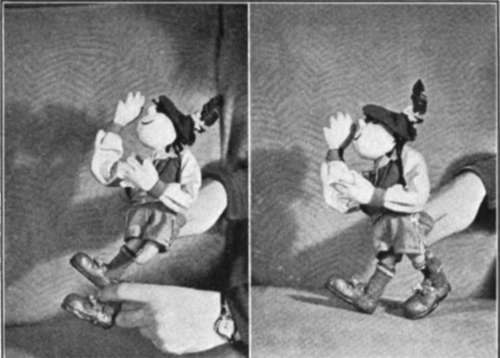
A Clever Finger Puppet
He can walk and dance. The operator's first two fingers arc the puppet's legs.
"It is best," Grandpa said, "to have the same person work the puppet and speak for it."
The next Wednesday night the first meeting of the Guild was held at Chuck's house. Grandpa Adams was there and so were about fifteen of our friends. There were so many of us that we decided to divide into two groups, one for hand puppets and the other for marionettes. After deciding on several rules for the club and selecting a chairman (as you can guess, it was Chuck), we settled down to discuss our first production. Those in the hand-puppet group listed the following three stories to work on: Robin Hood, Magic Tinderbox, and Story of Hiawatha. The master puppeteer (we decided to have someone who knew about puppets help us, and Grandpa agreed to serve in this capacity) suggested that the story of Hiawatha was not suitable for hand puppets because their peculiar proportions make them too comical. It is difficult to do serious plays with them. And since these puppets can pick up objects in a comical way, it is good to use a story that permits them to do it. Marionettes can be used for more serious subjects. The plays for both kinds of puppets must have plenty of action to make up for the lack of facial expression. It is best, he told us, not to try productions requiring complicated marionettes for the first show. For example, King Arthur might require a number of horses, which are quite difficult to make and to operate. Finally, after discussing the possibilities of Treasure Island, Ivanhoe (which we were studying in school), and other stories, we agreed to work on a production of Robin Hood for the hand puppets and Jack and the Beanstalk for the marionettes.
A Show The First Night
The master puppeteer suggested that it would be interesting and instructive if we could put on a show that very night without any practice. We liked the idea, but couldn't see how it would be possible without a stage and the necessary puppets. But he had come prepared. At his suggestion, we selected the Magic Tinderbox as a good story for the occasion.
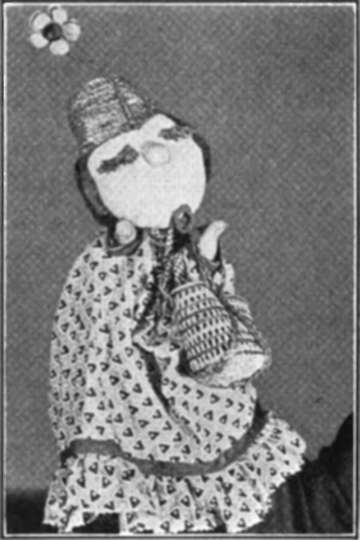
The head of this interesting character is made of sponge rubber.
Opening up his handbag, he spread out an assortment of materials that looked like anything but the makings of puppets. There were rubber balls, paste, scissors, paper, yarn, and some scraps of cloth. First a hole large enough to fit the index finger was cut in a sponge ball. Two upholstery tacks were pushed in near the top, and we could see that they were intended for the eyes. After nose and ears of paper had been pasted on the ball, it was easy to see that a dog was in the making. Finally, some brown yarn was made to look like straggly hair and pasted on the body. A piece of brown cloth with two holes for the fingers went over the head to form the body, and it did look like a dog. We all laughed to see how the master puppeteer could make it move about like a real dog. Some of us practiced barking for sound effects.
With such materials and a little imagination, we all went to work making witches, princesses, and other characters. The best puppets were chosen to play in our first production.
When it came time to make a stage, a sheet was stretched across a doorway just above our heads. We could then stand behind it, and by holding the puppets above our heads we made them appear over the top of the white sheet while we were hidden from view behind it. The audience could see the puppets but not the operators. After going over the story once or twice to see what the action was, we proceeded to put on the play. We tried it in different groups to see who could do it best. Each time new and comical action and speeches were added. It was great fun and we all voted that the first production had been a success.
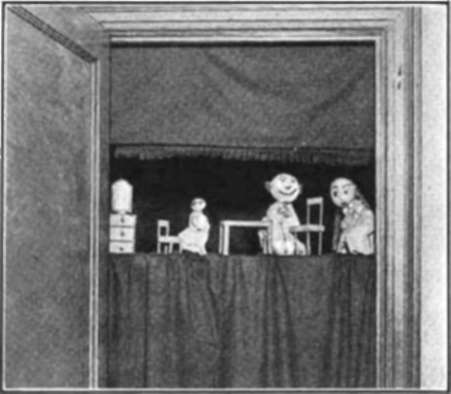
A hand-puppet stage can be constructed in an open doorway.
Some Interesting Things To Do
1. Form a Puppet Club and produce a show for your friends.
2. Set the class off on a "treasure hunt" for puppets and marionettes. Find out if friends and neighbors have any that can be borrowed for demonstration purposes.
3. Find out all you can about the puppet characters in each country, as listed on page 293. If possible, find pictures of these characters and sketch them.
4. Have a popularity contest of puppets, including those of all nations. Have each puppet tell his own reasons for his popularity. Let the class vote on the results.
5. List the stories you have enjoyed that would lend themselves to puppet plays.
6. How could you make an improvised hand puppet (1) on a hike, (2) in a kitchen, (3) in a classroom, (4) at a party?
7. List the funny things that have happened to you or your friends and could be dramatized by hand puppets. Try some of these in class.
8. Find as many pictures of different types of puppets as you can. You will find the encyclopaedias helpful in your search.
Large libraries may have picture collections. See also the books listed below.
Helpful References
Ackley, E. F., Marionettes. Hoben, A. M., The Beginner's Puppet Book.
Joseph, H., Book of Marionettes. Mclsaac, F. J., The Tony Sarg Marionette Book.
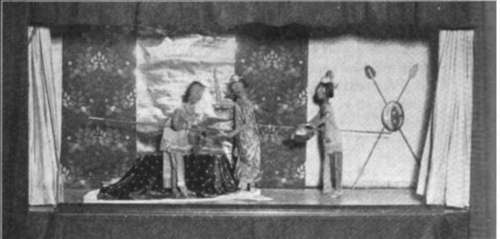
A Tense Moment.
Continue to:


My Books

