


Chapter Sixteen. Preparing A Show
Description
This section is from the book "Time Out for Living", by Ernest DeAlton Partridge and Catherine Mooney. Also available from Amazon: Time Out for Living.
Chapter Sixteen. Preparing A Show
Deciding On A Play
Of course, one of the first things to do when preparing for a puppet show, according to Mr. Adams, is to study the story you wish to produce and decide what characters are necessary. After discussing Jack and the Beanstalk, we found that there were three different places where action occurred: outside Jack's house, on the beanstalk, and in the giant's house. We decided to keep the scenes as few as possible because the changes would take time and the audience might lose interest. A committee was appointed to work out the problem of scenery in the best way possible for the particular show.
The various characters of the play were then discussed. As you remember, there were Jack, his mother, a fairy, the giant, and the giant's wife. As we talked about the play, it was decided that our parents would be coming to see the show and might like to see a modern version of the story rather than the real fairy tale. So it was agreed that there would be no cow to sell, but rather an old Model T Ford. The giant's wife would not be his wife, but a beautiful girl whom he holds captive and whom Jack saves.
It was now time to describe the characters in the story. Jack, it was felt, was a venturesome boy, not too bright and rather lazy. The mother was sad and helpless, while the fairy, of course, was good. In the story, the giant is wicked. So we decided to leave him that way and to add "ferocious" and "cruel" to his list of bad qualities. The girl was to be frightened, good, and beautiful. These different characters, we found, would need to be made clear to the audience through their speech, their actions, and their dress.
We then discussed the various ways in which the plot could be made more interesting to the audience. Suspense is good in adding interest, and so several things were decided upon to bring this element into the play. Jack was to hide behind a stove where the audience could see him but the giant could not. This situation would make the audience sit on the edge of their seats while the giant stormed around trying to find the hero. The fairy was also to warn Jack that the giant was a bad man and that he had better keep out of his way. Her warning would keep the audience wondering what would happen when Jack met the giant. Each scene was to end with some kind of interesting action, so that the audience would be impatient for the next scene.
By the time the plans were finally laid out for the production, there were the following crews or committees: property, construction, costume, and scenery. Each crew was to work out sketches for its part and to find as many interesting things by reading and talking with other people as would add to the interest of the final production. A full-sized working sheet of each one of the marionettes was to be made, before the actual production of the marionettes started.
And Then A Workshop
Well, by the time all of these jobs were assigned, it became quite apparent that some kind of workshop was necessary. The puppet shop of Grandfather Adams was too far away for those in the Guild, so it was suggested we find a shop much nearer. My family, upon hearing of the plans, agreed to let us turn the large room in our basement into a puppet workshop. The teachers at school were very much interested, and offered us a shop, too. In our place we had a heavy table and an old chest of drawers to use as workbenches; also cupboards, and a small table for sewing. This equipment was enough for us to start with. Later we found it necessary to add another table for general messy work, such as painting, pasting, and gluing. A few nails along the wall were sufficient to hang our unfinished marionettes upon during recess from work. After a few weeks, we took inventory of the tools and equipment that we had accumulated. Here is what we found: tools
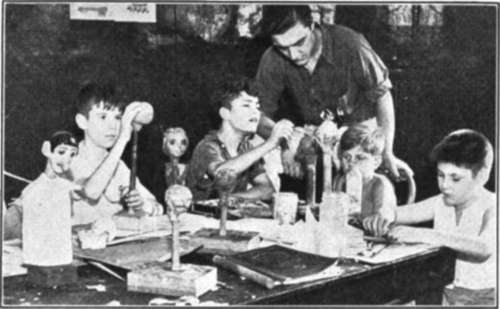
Constructing a puppet is as much fun as making it act.
2 vises
2 small hammers 2 jigsaw frames
6 jigsaw blades (coping saws are satisfactory) 2 wood files (coarse and medium) 2 old knives
1 hand drill (with bits Nos. 45 and 60) 1 pair pliers (with cutting edge) supplies
7 feet one-by-three-inch pine plank 5 one-yard sticks of one-inch dowel
4 feet one-by-eight-inch plank
15 feet one-half-by-one-inch pine lathing
1/4 pound tacks No. 4
12 screw-eyes No. 14
1 pound fine wire No. 12
1 small can Lepage's glue
1 spool heavy carpet thread
2 pounds wallpaper paste
5 yards unbleached muslin 2 rolls cotton batting Assorted small scraps of leather
Sewing supplies such as needles, thread, thimbles Colored scraps for costumes, yarn, fringe, fur paint and brushes
Paint:
1 pint flat white
1/2 pint flat yellow (If convenient, poster colors
1/2 pint flat vermilion may be used instead of oil
1/2 pint flat blue paints.)
1/2 pint flat black
Turpentine and Japan dryer if oil paints are used
2 line brushes
1 one-inch brush
1 card of 6 brushes (assorted sizes)
If you will glance over this list, you will see that many of these supplies can be found in the house. It was an easy matter to find what was needed by asking the members of the group to keep their eyes open.
With the help of the master puppeteer, we were soon ready to start on the puppets. He gave us the following instructions.
Continue to:


My Books

