


Plan For 10-Hour, 5-Meeting Course Of Two Hours Each. The First Meeting. Continued
Description
This section is from the book "Scouting For Rural Boys. A Manual For Leaders", by Boy scouts of America. See also: Outdoor Adventure Manual: Essential Scouting Skills for the Great Outdoors.
Plan For 10-Hour, 5-Meeting Course Of Two Hours Each. The First Meeting. Continued
Fourth Two-Hour Session
PRE-OPENING PERIOD-The exhibits may include the completed "Health Cabinets." Safety posters and exhibits would be valuable, also, as would nature collections, types of wood, and farm craft projects of various kinds.
OPENING (10 min.) by one of the Patrols. This might demonstrate a charter presentation ceremony to a sponsoring institution.
DISCUSSION PERIOD (30-40 min). "Question Hour on Rural Scouting" (see first part of this chapter). Mimeographed questions may be given out, covering the items listed earlier in this chapter as to how to make it easy for a boy to start in Scouting and hard for him to drop out, because leaders are trained, and the method of grouping meets the boy need in his own home neighborhood.
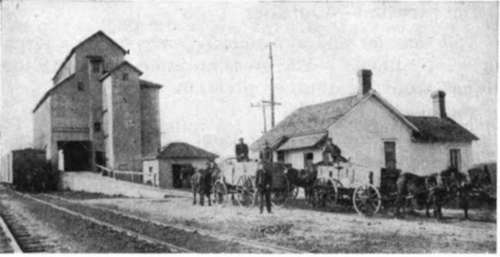
FARMERS' COOPERATIVE ELEVATOR-ILLINOIS.
PRACTICE PERIOD (60 min. or more). (By Patrols.) Handicraft practice in leather, wood, copper, tin, horn, wire, cement work, and other materials suggested in this manual on the many rural craft pages (Chapter XXXIV (Rural Crafts)).
DISCUSSION PERIOD (30-40 min.). "The outdoor Program of Scouting in Rural Areas"-Camping for Rural Scouts (see Chapter XXIV (Camping For Rural Boys)); educational hikes to farms and other hikes for rural boys; jamborees, field days, town street shows, fairs (see Chapter XXVII (Community Events In Rural Areas)); develop plan for rural hike (to farms or towns).
CLOSING PERIOD (10 min.). One or more Patrols may put on First Class Scout Investiture and/or other ceremony at closing.
Fifth Meeting-Outdoor Type
This may be held at a council campsite, on a farm, or some suitable picnic or camp ground. Among the things requiring advance provision are:
Transportation.
Food and equipment for camp cookery.
Some one who is expert, or trained, to instruct in camp cookery.
The program of action, guided by leader who knows what to do and how it's done.
The Program probably should center around the practice of rural Scout skills, such as, fire building and outdoor cooking (individual or by Patrols-doing their own).
Uses of rope, signaling, compass use, mapping the campsite area or part of it, judging, laying out of field, use of axe, nature lore, identification of farm products, work with breeds of animals, study of weeds, insects, pests, birds which are the farmer's friends-these may be made a part of a visit to some good farm.
Necessary food supplies must be brought individually, or by the management, as desired. This should be so planned as to have a wide variety of kinds of cooking going on at the same time. (See Chapter on Fires in "Adventuring for Senior Scouts.")
If someone is expert at barbecue, a suitable demonstration may be given.
If swimming is on the program, it affords a chance to practice the proper safety precautions for water sports in general. (See "Swimming, Water Sports and Safety"-B. S. A.)
If time permits, a camp fire program will prove both entertaining and instructive, giving program plenty of rural flavor.
The atmosphere of the occasion, of course, should be one of naturalness and enjoyment rather than dull, or "schooly," or academic.
Certificates
If possible, confer the certificates at the close of this session, otherwise they may be presented at a Council Court of Honor, or some special patriotic public occasion.
Literature
The Local Council, or the National Council can supply a catalog of Scouting and Cubbing, Explorer, Sea Scouting and Rovering literature, which is classified for quick reference into the various types of leadership needs-and interests. Every rural leader should have this Scout Literature Catalog alongside his U. S. Department of Agriculture list of bulletins and circulars.
Training For Isolated Rural Leaders
For the isolated leader, the Local Council and the District Training Committee may need to carry on training by letter. A Council Bulletin (often mimeographed) is used to carry small "helpings" of training and successful methods. There are many brief interpretations of Scouting aims and suggestions for program which can be mailed at regular intervals.
Continue to:


My Books

