


Stickleback
Description
This section is from "The American Cyclopaedia", by George Ripley And Charles A. Dana. Also available from Amazon: The New American Cyclopædia. 16 volumes complete..
Stickleback
Stickleback, the popular name of the acan-thopterous fishes of the mailed-cheeked family or sderogenidec, and genus gasterosteus (Linn.). They are also called banstickles, and are the epinoches of the French. Most of the species are found in fresh water, and are from 2 to 3 in. long; the sides are more or less protected by bony plates, the other parts being without scales; very small and crowded teeth on the jaws, none on the palate; branchiostegal rays three; tail keeled on both sides; ventrals abdominal, reduced to a strong spine, used as a weapon, and one or two soft rays; free spines, from 3 to 15 in front of the dorsal, which is supported by soft rays; bones of the pelvis large, forming an abdominal sternum. They feed on aquatic insects and worms, and the fry of fish; their pugnacity exceeds that of any other fish, and their voracity and fearlessness make it easy to capture them by the simplest means; they are very active, and sometimes spring entirely out of water. They breed in summer, in nests built by the males, which at this season have the throat carmine red and the eyes brilliant bluish green, the other parts above being ashy green and the abdomen silvery and translucent.
The nest is made of delicate vegetable fibres, matted into an irregular circular mass cemented by mucus from the body, an inch or more in diameter, attached to water plants, with one or two openings near the centre; when the nest is prepared the female is enticed or driven in, and there deposits her eggs, which are fecundated by the male; the latter remains constantly on guard, swimming in the neighborhood, driving away intruders with great ferocity, frequently putting in his head to see if all is right, and fanning the water with the pectorals and caudal to secure free circulation and ventilation for the eggs; he is frequently seen shaking up the eggs, and carrying away impurities in the mouth. The young are hatched in two or three weeks, and grow very slowly; any of the small fry getting outside of the nest are instantly seized in the mouth of the parent and put back. There are about 40 young to a nest. - The common European species (G. aculeatus, Linn.; since separated into three by Cuvier) has three spines in front of the dorsal, and is found in almost every pool and rivulet in Great Britain. The G. spinachia (Linn.) has 14 or 15 free spinous rays on the back, and has an elongated head and body; it is a marine species, found in the northern seas of Europe. The best known of the many species in the United States are the two-spined stickleback (G. biaculeatus, Mitch.), which is found from Labrador to New York, 2 in. long, olive-green above, yellowish green on sides, with two distant spines on the back and a third near the dorsal; and the four-spined stickleback (G. quadracus, Mitch.), of the Massachusetts and New York coasts.
Other species have eight to ten spines, and the males in all assume the red tint in the breeding season, both in salt and fresh water.
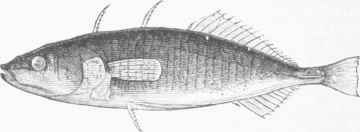
Two-spincd Stickleback (Gasterosteus biaculeatus).
Continue to:


My Books

