


Fontainebleau
Description
This section is from "The American Cyclopaedia", by George Ripley And Charles A. Dana. Also available from Amazon: The New American Cyclopædia. 16 volumes complete..
Fontainebleau
Fontainebleau, a town of France, in the department of Seine-et-Marne, 35 m. S. S. E. of Paris, on the Southeastern railway, in the midst of the forest to which it gives its name; pop. in 1866, 10,787. It has a college, a public library, three handsome barracks for cavalry and infantry, a hospital founded by Anne of Austria, an asylum for girls established by Mme. de Montespan, an obelisk erected on the marriage of Louis XVI. with Marie Antoinette, and the old residence of Gabrielle d'Estrees. Its manufactures of porcelain and earthenware have some reputation; and the delicious grapes gathered in the vicinity, especially at Thomery, and celebrated under the name of chassclas de Fontainebleau, are the object of a brisk and profitable trade. But the town owes its celebrity to its royal chateau, a magnificent pile of various kinds of architecture, which has been the residence of several monarchs. This chateau, originally founded by Robert the Pious toward the end of the 10th century, was rebuilt by Louis VII. in the 12th, and embellished by Philip Augustus, Louis IX., and others.
Francis I. had it entirely renovated and enlarged by artists brought from Italy. Rosso, Primaticcio, Nicolo dell' Abbate, Leonardo da Vinci, Andrea del Sarto, and Benvenuto Cellini ornamented it with their works, important remains of which may still be seen. It was improved by Henry IV. and all his successors. Napoleon I. spent here 6,000,000 francs between 1804 and 1813. Louis Philippe completely restored it and put it in splendid order from 1837 to 1840, and Napoleon III. did not neglect it. It is in fact a collection of palaces of different epochs and styles, and its ornaments, pictures, and statuary are of the highest excellence. Its library is invaluable. This chateau has been the scene of many historical events. Philip IV., Henry III., and Louis X111, were born in it. Christina of Sweden inhabited it during her sojourn in France; and it was here that in 1057 her favorite Monaldeschi was put to death by Santinelli. Here an alliance with Sweden was signed in 1661, and here in 1685 Louis XIV. signed the revocation of the edict of Nantes. Pope Pius VII. was confined within its walls for 19 months (1812-'14); and Napoleon, who had signed here his abdication, April 11, 1814, bade farewell on the 20th to his old guard at the principal entrance of the palace, known as la cour du cheval blanc.
He signed his second and final abdication here, June 22, 1815.-The forest of Fontaine-bleau (area, 41,000 acres), which was originally called the forest of Biere or Bievre (Sylra Bieria), is as fine as any in France, and abounds in game. It is adorned with statues, temples, lakes, waterfalls, and fountains. Its varied and picturesque scenery is highly appreciated by travellers and landscape painters, while its quarries supply the capital with most of its paving stones. An His-toire de la foret de Fon-tainebleau was published by Paul Donner in 1873.
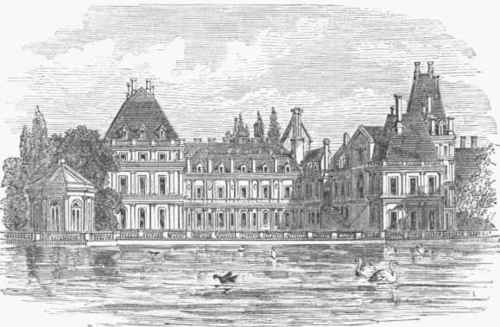
Chateau of Fontainebleau.
Continue to:


My Books

