


Chapter VI. Putting
Description
This section is from the book "Hints To Golfers", by O. K. Niblick. Also available from Amazon: Hints To Golfers.
Chapter VI. Putting
Although approaching shots are perhaps the most difficult ones to make, yet in nine out of ten games putting is what wins or loses the hole. For this reason, Tom Sayers, a celebrated professional, used to say, "rThe man who can putt can play anybody."
As putting requires a delicate touch, the shaft of the putter should be stiff and without spring, the essential thing being perfect balance. The shaft should also be short so that one can stand well over the ball in order to get easily the line of the hole. The head should be light, so that the club can be swung well back, to make sure that it is swinging along the line of flight, the besetting sin being too heavy a head.
In putting, one must not forget that there is a sharp distinction between approach putting and holing out, and that they mean different kinds of work. In approach putting the essential thing is the amount of impetus necessary to send the ball close to the hole, but in hole putting one must consider not only the proper amount of impetus, but the line between the ball and the hole and the lay of the ground. In both approach putting and holing out, although the ball has to travel much further in one case than in the other, the length of swing is practically the same in both cases. In both cases, therefore, the momentum put into the ball is determined by the amount of strength used and one has to gauge his muscles accordingly. The stroke, then, is wnolly dependent on mental calculations without being regulated in any way by mechanical rules. Putting, therefore, differs from all other strokes of golf and good putting means not only that correct instructions be given by the eve to the mind so that the mechanical movements of the muscles will be correct, but that the right amount of force is used without any deviation of the club head from the line of putt. The corollary, then, is that if one is off in his putting it is because the mind has not given the right instructions to the muscles, or, in other words, after one has learned to putt, all faults are mental if the eye is true.
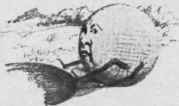
Not if I can help it!
(109)
As more elasticity goes into the ball from a wooden putter than an iron one, the wooden putter is the one to use for long putts ; and, because it does not run the ball so close to the ground, it is also the one to use for short putts when the green is rough or sandy. The iron putter, on the other hand, because it keeps the ball close to the ground, is the one to use when the green is smooth and also when the ball is near the hole as the ball is less apt to jump the hole if too much force is used. One peculiarity of putting is that nearly every golfer has his own fixed idea of the right way to do it and in no other part of the game is there such a bewildering variety of stance, grip and swing as in this apparently simple operation of sending the ball into the hole; some standing with the weight of the body on the right leg and the ball opposite that foot; some with the weight of the body equally on both legs and the ball opposite the centre of the body; and some with the weight of the body on the left leg and the ball opposite that foot; some putting with the wrist alone or arms alone, or by a subtle combination of the two; some holding the hands close together, some with them far apart; some holding the shaft at the top of the leather and some at the bottom; each one putting more successfully in his own way than in any other and in many cases admitted to be an expert. But whichever way one putts there are certain rules which should be followed.
(1) In getting the line, either glance from the hole to the ball and then along the same straight line back of the ball so as to get the line over which the club head is to swing, keeping the eye on that line during the swing or else while standing behind the ball picking out a blade of grass between the ball and the hole, and, dismissing from the mind the hole as an object of direction, address the ball with the thought only of sending it over the blade of grass with impetus enough to send it into the hole, keeping the eye on the blade of grass for direction while making the swing.
(2) In addressing the ball, first see that the sole of the putter rests squarely on the ground with the centre of the face opposite the ball. Then carry the club head along the ground the distance you intend to swing it, in order to satisfy yourself that with the putt it will go along the line to the hole, resting it just before making the putt so close behind the ball that it almost touches it, to see that the face is still at a right angle to the line of travel.
(3) When making the putt, swing the club head an eighth of an inch from the ground so that the centre of the face will come in contact with the centre of the ball.
(4) Let the hands feel all that the club is doing, as one fault in putting is forgetting the grip while the mind is concentrated on the direction and holding the club too slack during the swing. Do not, however, allow either hand to dominate the other or hold the club as if in a vise or so tight that it stops the circulation and stiffens the muscles. The best rule to follow is to relax the grip while the club head rests behind the ball and then to tighten up with the swing.
Suggestions
A good rule is to putt with the right thumb down the shaft, as it better keeps the face of the club at a right angle with the line of the hole. If, because of the slope of the putting green, it is desirable to putt to the right of the hole, hold the thumb more to the right on the shaft and if to the left of the hole more to the left on the shaft.
Continue to:


My Books

