


Bohemia. Part 10
Description
This section is from the book "Bohemia - John L. Stoddard's Lectures", by John L. Stoddard. Also available from Amazon: John L. Stoddard's Lectures 13 Volume Set.
Bohemia. Part 10
Ground ruthlessly between the upper and the lower millstones, there were always Israelites. Their quarter was the Ghetto, and their garb the gabardine. Restricted to a labyrinth of narrow streets, swarming with squalid lives, and reeking with the odors of compressed humanity, Prague's Hebrew precinct seemed, on my first visit to the place, in 1873, a pool of pestilence. Yet, as a matter of fact, the Ghetto always suffered less from epidemics than the European sections of the town, and its inhabitants as a rule lived longer lives. At present this old part of Prague has largely disappeared. New streets and squares and handsome modern structures have arisen from its ruins. But two extremely interesting relics of its past remain, and will, it is believed, be permanently spared. These are the ancient synagogue and its adjacent cemetery. The former has been standing here for seven hundred years, and is the oldest synagogue in Europe. Its pavement is below the level of the neighboring street, as if it were already partially entombed, and its two narrow windows can dispel so little of its twilight gloom that it suggests a prison. Such it virtually was. To-day the Jews of Prague have several handsome, modern synagogues, and civic and religious liberty is assured them. But during the long centuries, when only this dark, shabby hall, and that of its humbler predecessor heard the Hebrew's prayer, their plight was pitiable. No darker stain defiles the history of western civilization than its treatment of the Jew; and Prague, it must be said, contributed her share to the inhuman treatment meted out to them.
When, in the exigencies of the town or State, large sums of money were desired, the Jews were often accused of having offered insults to the Sacred Host, and fined extortionately. Excessive taxes, too, were laid upon them. From the belief that they did not deserve to live, it was an easy step to tax them heavily for doing so. Yet what a life was theirs! Confined to fetid, over-populated districts, and clad in a distinctive dress, they were excluded, usually, by law from the professions, industries, and even agriculture, and were compelled thus to become small traders or else money-lenders, yet were cursed for being so. If this, however, had been all, their fate would seem comparatively kind; but when to all their social and financial persecutions are added the appalling tortures, burnings at the stake, and massacres, inflicted century after century practically everywhere in Europe from Portugal to Poland, one closes, sick at heart, the gory record of their miseries, in horror at the depths of man's depravity, and in unutterable gratitude that in all European countries, except Russia, such deeds are now no longer possible. Not until well within the nineteenth century, however, did man in shame tear down the Ghetto walls; and it is certainly remarkable that the closing of Prague's Jewish cemetery in 1785 should have been practically contemporaneous with the first great effort of a European nation to put an end to Hebrew persecutions. For it was France, in one of the inspired moments of her Revolution, that first proclaimed the Jew to be before the law as free and equal as the Christian. One thinks of all these things within this Jewish city of the dead. It is at least coeval with the synagogue, and probably is far more ancient. Hebrews maintain that it dates from the year 632 a.d. At all events, it is undoubtedly the oldest Is-raelitish graveyard in the Occident. No burials havebeen permitted here for more than a century. Its volume of the dead is closed. Once it possessed an area of three acres, but is now much smaller. The modern city has encroached upon it. The quick begrudge the dead their valuable site. Were it not archaeologically interesting, it would have long since disappeared. Twenty-eight thousand of its tombstones still remain, huddled together timidly like frightened sheep, or like the dwindling remnant of a company of prisoners condemned to die. Yet even this excessive c r o w d i n g gives no adequate picture of its insufficient space.

The Old Jewish Council Hall, Prague.
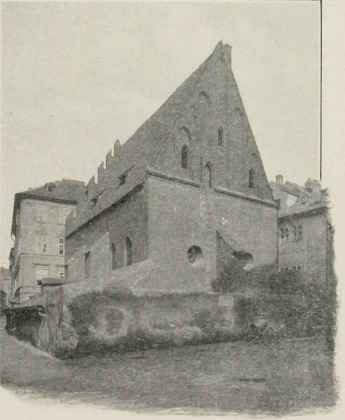
The Old Synagogue.

The Jewish Cemetery, Prague.
Continue to:


My Books

