


Bohemia. Part 11
Description
This section is from the book "Bohemia - John L. Stoddard's Lectures", by John L. Stoddard. Also available from Amazon: John L. Stoddard's Lectures 13 Volume Set.
Bohemia. Part 11

Memorials Of A Tragic Past.
Beneath each stone are many graves, placed one above another. After the Ghetto of the living, the Ghetto of the dead! The monuments are of different shapes and sizes, and more or less defaced by tempests and the tooth of time. But most of their inscriptions are astonishingly clear. Some are adorned with figures, emblematic of the tribes to which the dead belonged. A pitcher, for example, is symbolic of the Levites. Two hands denote the tribe of Aaron. A double triangle indicates the house of David. Occasionally, too, the name of the deceased is symbolized: Hirsch being represented by a sculptured stag, and Lowe by a lion. On many of them I noticed - what I had also seen on Jewish graves in Palestine - a multitude of pebbles, placed by relatives and friends, or possibly by pious strangers, moved to pity by their fate. What sort of people could these be, whose homes and sepulchres alike were so pathetically limited? One of the epitaphs may tell us. It reads as follows : "Here rests a lady eminent for the piety and purity of her life. She would have ornamented any society of happy, virtuous women. She devoted herself principally to beautifying places of religious worship. Never did she miss her morning and evening devotions. She gladly aided those engaged in study, and loved to entertain her guests. Her acts of charity were great and numerous. Every synagogue received from her a present.

The Ghetto Of The Dead.
She also educated orphans to lead upright lives. The community pays grateful tribute to her preeminent virtues.
May her soul gain a place of honor in the future world!"
Here also is the grave of a wealthy Israelite named Meissel, who from his private funds built here at Prague four synagogues and the Hebrew Council House. Six streets were also paved at his expense, and every week sixty poor mendicants were fed by him. What most impressed me, as I gazed on these memorials of a tragic past, was the mysterious possibility which lurked behind so many of these Hebrew hieroglyphs. For aught that we may know, within the veins of some forgotten Jew who slumbers at our feet, once flowed the blood of Hebrew patriarchs or princes; and some pathetic stone, distinguished by a double triangle, may mark the grave of one whose ancestors were kinsmen of the Son of David. How strange to think that in those same Semitic characters, which here record a few poor, individual annals of a hated race, was written every book of that Old Testament on which is based the Christian, no less than the Jewish, creed! It is amazing to reflect that all the dreadful wars which men waged here for centuries were largely caused by incompatible interpretations of a book, written by men whose lineal descendants they perhaps were burning! Unmindful of the facts that all the patriarchs and prophets of their Bible had been Jews, that all their sacred literature was the work of Israelites, and that the Sabbath they so strictly kept was instituted by the law of Sinai, they nevertheless compelled the progeny of the founders of their faith to huddle in a loathsome Ghetto, and treated them as slaves and pariahs. Astounding inconsistency! the sacramental elements, concerning which they fought like fiends, were those commemorative of the death of One they worshiped as the Prince of Peace, - yet One who, from a human point of view, had lived and died a member of that very race which they were treating with revolting cruelty.
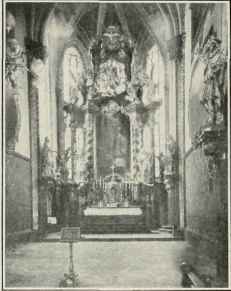
The High Altar At The Monastery Of Tepl.
Prague is a place of quick transitions and surprising contrasts. Creations of Charles IV., memorials of the Hussite wars, and modern structures, like the noble National Museum, are often simultaneously visible; while from the ancient cemetery of the Jews a few steps only bring one to the handsome Rudolfinum,-a splendid edifice, built in 1884, and named after the late Crown Prince of Austria. A part of this imposing building is devoted to Prague's world-renowned Conservatory of Music, the rest of the interior being occupied by Concert Halls and an Art Museum, among whose treasures are several paintings by the famous Bohemian artist, Gabriel Max. It is not strange that the Conservatory of Prague, which has now some twenty-eight professors and about four hundred pupils, is a great success, particularly as a school for violinists.
Continue to:


My Books

