


Bohemia. Part 18
Description
This section is from the book "Bohemia - John L. Stoddard's Lectures", by John L. Stoddard. Also available from Amazon: John L. Stoddard's Lectures 13 Volume Set.
Bohemia. Part 18

What Will The Future Bring?.
True, it does not especially exert itself to win them, and has the air of being a little too conscious of its power. Knowing that crowds must come to drink its waters for their livers' sake, it seems to say to them disdainfully : " Here is my sovereign cure. Take it, or leave it. Others will come, if you do not. Sprudel, or suffering!" Moreover, compared with other European health-resorts, Carlsbad is not remarkably attractive as a place of sojourn. True, it has many sumptuous hotels, good music, pretty environs, and streets of shops. But it is, nevertheless, a city; and, as such, is as fashionable, heartless, mondaine, and demi-mondaine as any of the "smart-set" sections of the Riviera. It must be said, too, of the Carlsbad buildings, that a large proportion of them look both dark and dingy, as if the millions of disordered livers that have there been cured had given the town a bad complexion. One might imagine that departing patients leave their sallowness behind, as serpents shed their skins. In this respect the difference between Carlsbad and Marienbad is the difference between shade and sun. Marienbad is a beautiful collection of bright, cream-white structures, radiant in a crystal air, two thousand feet above the sea. It is a cultivated island in a sea of pines -a miniature city compassed by the Bohmer Wald. Framed by a million fragrant conifers, it blooms for five months like a lovely flower; then, wrapped in snow and silence, slumbers till the following spring.
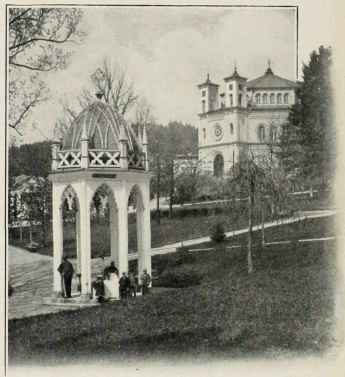
The Ambrosius Spring And Catholic Church, Mar1enbad.

The Sprudel.

Villas In Marienbad.
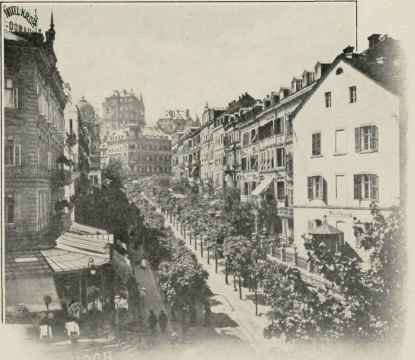
A Street In Carlsbad.
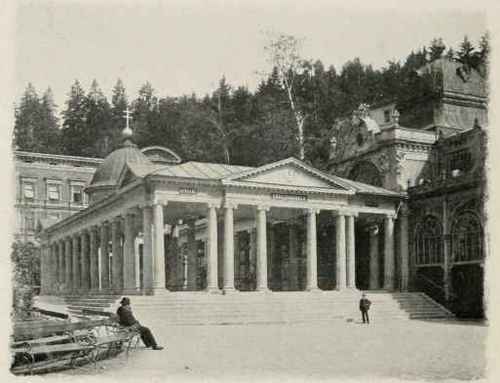
The Kreuzbrunnen Spring.
Within its bosom throb unceasingly the fountains that have given it life and made it world-renowned. How hard it is to realize, so inclined are we to think ourselves the only objects of the earth's munificence, that these great reservoirs of healing virtues lay unheeded and unknown for countless ages, ere a drop of their invigorating waters touched the lips of man! But little more than a hundred years ago this valley, now frequented annually by twenty-five thousand visitors, was a wilderness. No paved road led to it. No stage-coach made the place accessible. Only a mountain path, half overgrown with underbrush, wound thither over rocks and swamps, and through neglected forests. Nature apparently had wished to hide these treasures from the outer world. That mineral springs existed here, had, it is true, been vaguely known for years, and some attempts had been occasionally made to wring from them medicinal salts; but not until the opening of the nineteenth century did Marienbad's star attract the notice of mankind, at first obscure and tremulous, but destined speedily to become a luminary of the foremost magnitude. The entire region formed then, as it forms to-day, a portion of the vast estates belonging to the neighboring monastery of Tepl. In 1790, the medical attendant of this monastery was Dr. Joseph Nehr. Happily he was more than a physician. He was an enthusiast.
Monument Of Dr Joseph Nehr, The Founder Of Marienbad.
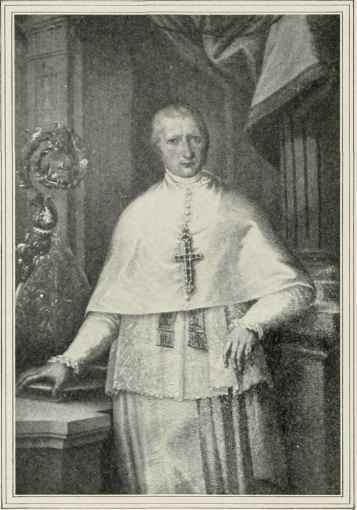
Father Reitenberger.
Convinced of the rare value of these springs, and eagerly predicting for them a great future, he labored indefati-gably to win men over to his views. Such were his faith and confidence, that he erected for himself within the limits of this solitude the first home ever built here, and called upon the world to follow him. Enthusiasm is contagious. Faith is inspiring when confirmed by deeds. The monks of Tepl, who at first had thought their doctor slightly mad, began themselves to dream strange dreams and see bright visions. The clouds that overhung this savage woodland gradually acquired a silver lining. It was, they thought, worth risking a few florins, to see if what the Doctor said was true. At first, however, they constructed cautiously only a little bathhouse with eight rooms, and nearly as many beds. Then, since monks rarely have believed that man can live on water only, they added thoughtfully a restaurant. More and more people came to it, and cures were made. Its reputation spread. More buildings were erected. Exactly one hundred years ago, in 1808, the brothers gave to the place the name of Marienbad, in honor of the Blessed Virgin. Since then its progress has been rapid and its fortune brilliant. As the world goes, it is remarkable that the pioneer and founder of the place is still remembered. So many benefactors are forgotten! A fine bronze bust of Dr. Nehr now stands beside Marienbad's principal spring, the Kreuzbrunnen; and his benignant face, not unlike that of William Lloyd Garrison, beams kindly on the passing crowd. There is, however, another statue here, commemorating one whose claim to gratitude is no less great than that of Dr. Nehr. This was the worthy prelate, Father Reiten-berger. For when elected abbot of the Tepl monastery in 1818, he used its funds with generosity and wisdom in furtherance of the Doctor's plans, and really put the health-resort upon the road to fortune. Moreover, his successors have carried on the work with energy and foresight, and the proprietors of the place are still the members of the Order, represented by Inspector Father Wurfl. To him belongs the management of the springs and baths, as well as the control of all the exportation of the mineral waters. Tastefully grouped upon the park-like area which surrounds Marienbad's springs are scores of handsome buildings. Although these are for the most part hotels, pensions, and villas, they are remarkably uniform in architectural excellence, stately in form, tasteful in decoration, and frequently imposing. They are distinguished also by that bright and cheerful look, which most Parisian structures wear during the first few months of their existence. Alas! in Paris these are soon begrimed with fog and smoke. Marienbad has, however, no fog, and practically no smoke, to dim their lustre. The health-resorts of central Europe represent in most respects the height of modern civilization, without frenzied luxury.
Continue to:


My Books

