


Bohemia. Part 17
Description
This section is from the book "Bohemia - John L. Stoddard's Lectures", by John L. Stoddard. Also available from Amazon: John L. Stoddard's Lectures 13 Volume Set.
Bohemia. Part 17
Some are already seldom-visited nonentities-their past forgotten, and their art ignored. At all events, Prague never will consent to be a German city until its palaces are laid in ashes, and its streets are heaped with dead. Long treated as despised inferiors, the Czechs will die en masse to prove the contrary. Nor can we shut our eyes to the fact that, in this strife of rival races, the Bohemians are steadily gaining ground. Many concessions have been made to them, whose justice is unquestionable. Less than a score of years ago, exclusively German schools were founded and maintained for the purpose of "denationalizing" as many as possible of the Czech children, while opposition Czech schools had to be maintained by private contributions to resist this tendency! Now Czech is taught in all the schools. Moreover, thanks to this great competition, and to so many places of instruction, there are in Bohemia practically no illiterates! Whether the change of status, sure to come upon the death of the present aged emperor, will bring these patriots nearer to the realization of their hopes, it is impossible to predict. Even as I write, the papers tell the story of new deeds of violence, of broken desks and well-nigh broken heads, and personal conflicts between Czech and German representatives. If we could judge the future by the standard of what ought to be, there would, I think, be only one opinion as to the future of Bohemia. But, looking down the blood-stained vistas of the past, we see that many a noble nationality has been destroyed, and that unlawful Might has often trampled under foot unquestioned Right beyond the

The Royal Mausoleum.
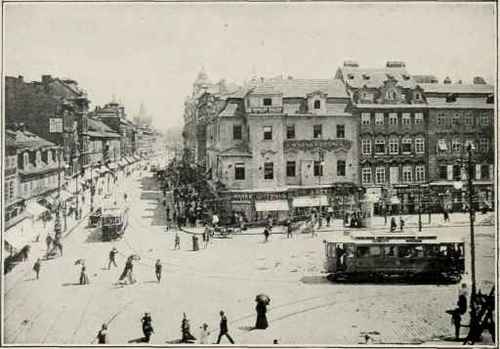
An Awakened City.

A Bohemian Wood-Gatherer.

Room Occupied By Mozart, Villa Bertranka, Near Prague.

The Emperor Francis Joseph.

The Czech National Theatre.

Czech Children Greeting The Bust Of The Emperor.

Poor, But A Patriot.

Approach To The National Museum Of Prague.

Railway And Hradschin, - The New And The Old.
possibility of resurrection. Yet something gives us hope that the sad fate of Poland will not be repeated here; that all these millions of brave Czechs, whom ages of repression have not crushed, will prove too strong and resolute to lose their birthright; and that the crown of Venceslas will once more glitter on the brow of a Bohemian king. Meanwhile, if I were asked to paint a characteristic picture of Bohemia, I would portray the genius of that nation either as a strong, intelligent maiden, standing erect upon her native mountain crest, and peering wonderingly, yet confidently, eastward toward the dawn; or else, and possibly with more exactness, as a Slavic sentinel in Austrian uniform, facing the German frontier with a watchful eye, and constantly expecting an attack.
In this brief verbal picture of Bohemia the author has selected two entirely different and yet thoroughly characteristic points, around which naturally group themselves the nation's chief historical associations and a portion of its social life. The first of these is Prague. The second is Marienbad. One is entirely national; the other international. The former is too much absorbed in her own evolution to pay much attention to the foreigner. The latter depends largely on that foreigner for success. In the northwestern corner of Bohemia are some of the most wonderful phenomena to be found upon our planet. Under the earth crust of that region lies apparently a lake of boiling water, charged with medicinal properties. Above this is a natural roof from three to twelve feet thick, formed by the incrustation of the mineral water as it leaps aloft, and falls again upon its shell. This hard deposit from the springs tends constantly to choke the channels through which all the liquid, steam, and gases, pent up in the subterranean caldron, make their exit. Hence, if these conduits were not cleared and widened four times every year, explosions of great violence would occur, as was occasionally the case before this fact was properly understood. One feels a kind of awe in looking at the principal spring at Carlsbad, - the renowned Sprudel. The mystery of what lies behind that indefatigable pulse is most impressive. It comes forth in a thick, strong jet, which yields two thousand seven hundred and nine quarts per minute, and has a temperature of about one hundred and sixty-three degrees Fahrenheit. Carlsbad, Mari-enbad, Franzensbad, and Teplitz are four different vents for this concealed vitality of our still vigorous globe. The first is doubtless the best known, as it is certainly the most remarkable. Carlsbad, however, is more cosmopolitan than Czech. Its guests are representative of every nation under heaven.
Continue to:


My Books

